

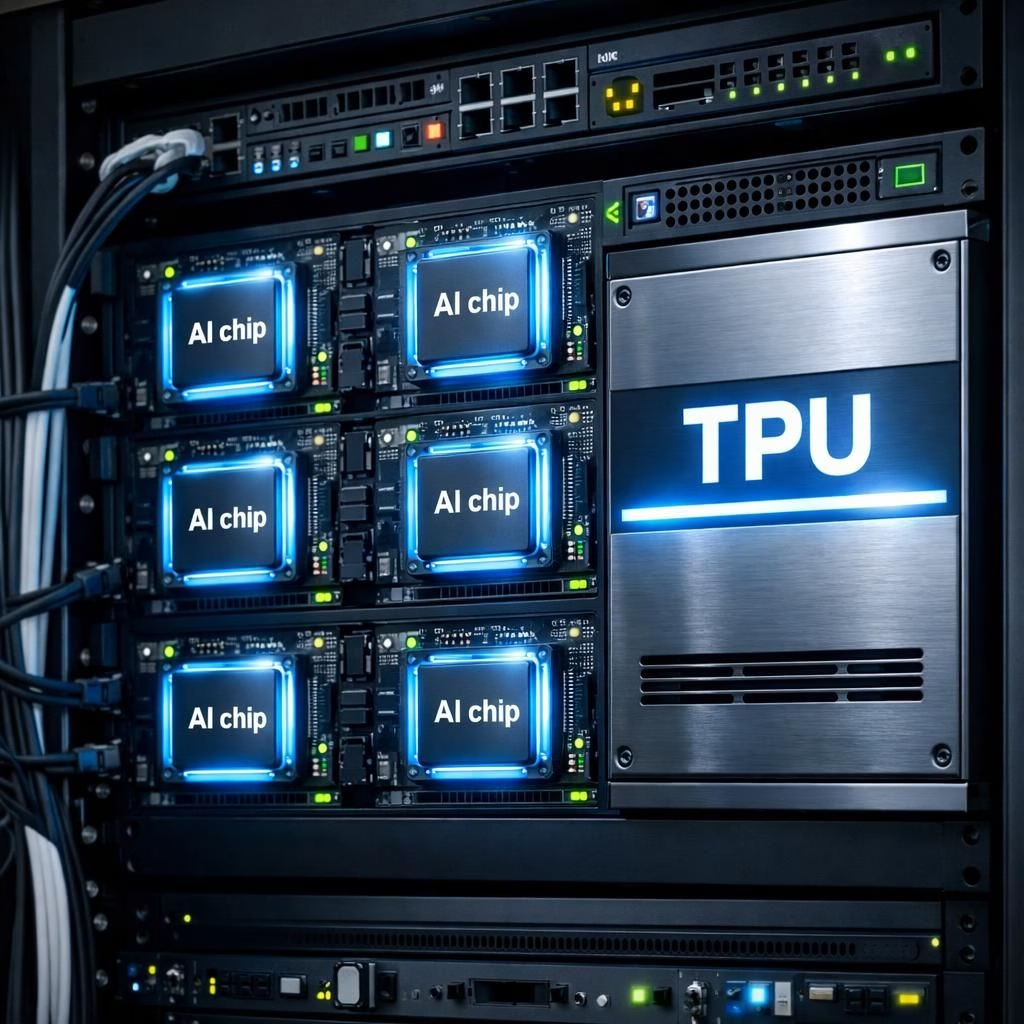
AI chips and TPUs power the 2026 AI hardware story with a practical mix of ambition and discipline. Broadcom confirmed it will manufacture future Google AI chips, anchoring the next wave of generative AI. This is more than a vendor update; it signals a shift in how AI compute is built and scaled. The arrangement cements Broadcom’s role at the core of the next wave of generative AI. Simultaneously, Broadcom announced an expanded partnership with Anthropic, which will gain access to roughly 3.5 gigawatts of computing capacity built on Google’s tensor processing units, or TPUs. In trading, Broadcom shares rose about 3% in the after-hours session, underscoring investor optimism. The broader story is not just about hardware; it’s about scale, speed, and a clearer path to production-ready AI.
AI chips powering the Google-Anthropic arc
Anthropic’s growth this year has been rapid and well documented, with annualized revenue now reported above $30 billion, up from $9 billion at the end of 2025. The customer base has jumped to more than 1,000 enterprise clients spending over $1 million annually — more than double the figure from just two months earlier. This is not magic; it’s steady scaling enabled by strategic partnerships and a roadmap that prioritizes reliability, security, and sustained innovation. Anthropic CFO Krishna Rao framed the expansion as deliberate infrastructure scaling designed to meet surging demand while keeping Claude at the frontier of AI progress. In practical terms, enterprises can expect more robust services and broader opportunities for cross-industry AI applications.
As AI chips expand their reach, the Google–Anthropic collaboration through TPUs becomes a practical backbone. The combined stack supports large-scale training and real-time inference, enabling faster value realization for customers who optimize logistics, customer experiences, and product development. Executives describe capacity as the currency and reliability as the price of entry. In this ecosystem, AI chips and TPUs are not competitors but complementary levers in a carefully choreographed path to more capable models and broader AI adoption.
AI chips in real-world deployments
Real-world deployments are the test bed for this alliance. The emphasis is on predictable delivery, scalable manufacturing, and transparent pricing that helps enterprises plan budgets and timelines. The Broadcom–Google–Anthropic collaboration aims to turn lab breakthroughs into steady, production-grade compute for diverse use cases—from logistics optimization to security-enhanced AI workflows.
TPUs fueling training and inference at scale
TPUs have long been the backbone of Google’s AI infrastructure. In 2026 they appear in new partnerships and expanded capacity, delivering the compute required for training larger models and real-time inference for billions of requests. Broadcom’s role as a silicon partner adds manufacturing discipline, predictable delivery, and economies of scale that matter when pushing trillions of operations per second. Analysts from firms like Mizuho have started modeling AI revenue trajectories, with projections suggesting meaningful upside in the near term and a roadmap toward multi-year growth. While numbers vary, the trend is consistent: more compute, greater efficiency, and broader deployment scenarios for AI chips and TPUs alike.
Industry observers remind us that the ecosystem remains broader than any single vendor or model. OpenAI and Anthropic still rely on a mix of Nvidia GPUs via cloud providers, with AMD GPUs likely to join the mix as capacity needs rise. The market is moving toward a hybrid compute paradigm where different chips share the stage, each bringing distinct strengths to training, inference workloads, and specialized AI tasks. The takeaway is hopeful: more compute paired with smarter software can shorten innovation cycles and deliver tangible value for enterprises seeking practical AI gains.
Looking ahead, Broadcom’s continued involvement with Google and Anthropic signals confidence in a robust, supply-chain-friendly AI hardware market. The 2026 plan emphasizes not just raw throughput but reliability, predictability, and security that enterprise clients demand. The overarching message is clear: the AI chips and TPUs alliance is about a scalable architecture that grows with customer needs while keeping costs in check. It’s a deliberate strategy to ensure that as AI models scale, the supporting hardware scales with them, minimizing bottlenecks and maximizing uptime.
Open questions remain about price, availability, and geopolitical considerations shaping procurement in the year ahead. Yet executives remain positive, grounded, and pragmatic about the future: more compute, more collaboration, and confidence that enterprise AI will continue to advance. The cross-pollination between chip makers, cloud providers, and AI developers is better viewed as a collaboration than a battle—an effort to move from proofs of concept to production-scale AI that delivers real value across markets. The takeaway is straightforward: hardware matters, but a clear human plan—coordination, transparency, and a strong view of how compute translates to business outcomes—is what keeps data centers running smoothly.
References and context come from multiple sources that shaped this analysis. For the original Reuters coverage, see: Reuters original article.
We invite readers to share their thoughts in the comments. Your feedback helps shape how AI chips, TPUs, and enterprise AI evolve in 2026.
Source attribution: Material drawn from the original Reuters coverage and related reporting. Link: Reuters original article.
External references
- Broadcom: AI chips manufacturing updates
- Anthropic: News and updates
- Google Cloud TPUs
- Reuters coverage
- Original source linkback: Times of India article on Broadcom’s AI-chips plans
Times of India – technology news