

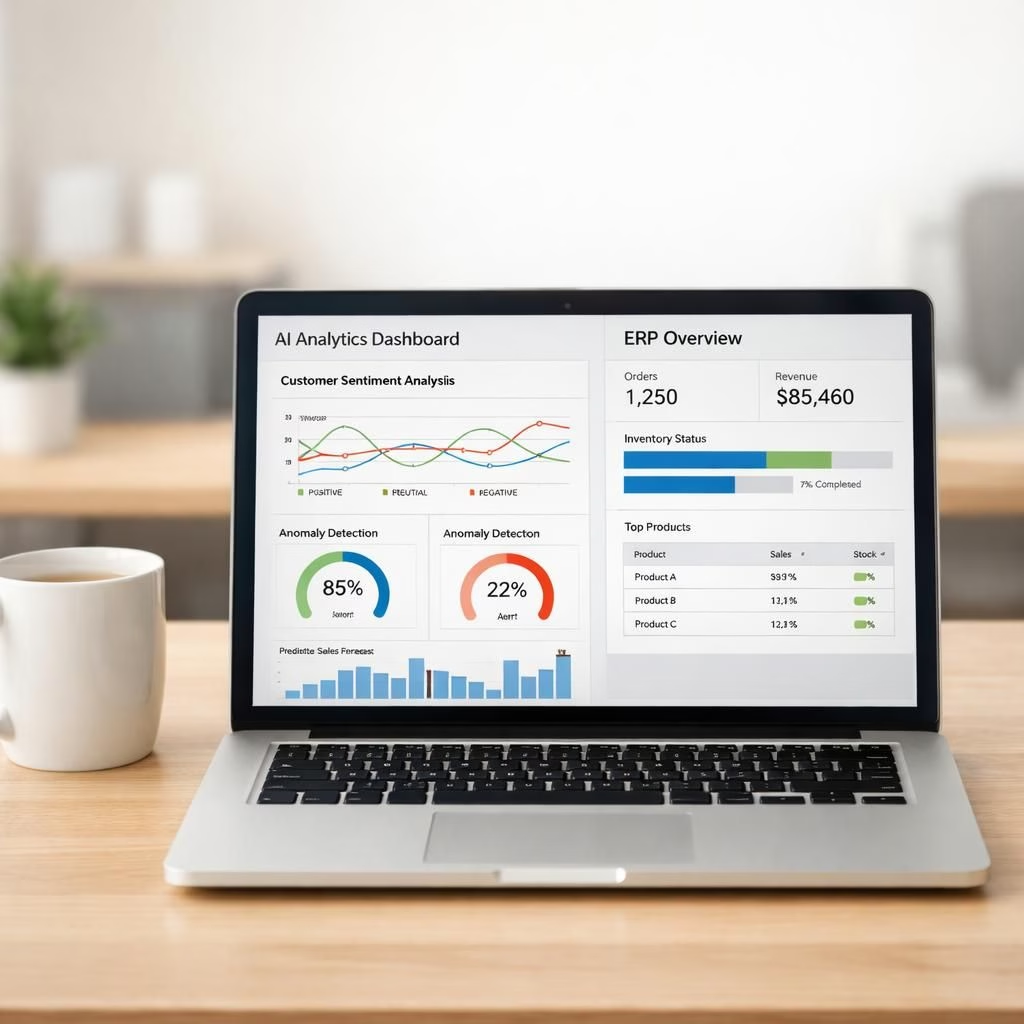
Welcome to ITDigest’s weekly roundup, where ERP and AI take center stage before people who actually run businesses. This edition surveys the bold moves shaping global technology markets, from automation to data transformation and smarter connectivity. As AI adoption accelerates across operations, finance, and infrastructure, the stories below blend practical insight with a dash of humor. ERP platforms are moving from back-office logistics to strategic copilots; AI is stepping in as a peer rather than a luxury. The result is a clearer map of what works, what still needs polish, and how leaders can steer complex systems without losing their sense of humor. Read on for a digest that treats enterprise tech like a living, slightly ironic toolkit for everyday impact.
AI and ERP: Twin Engines of Modern IT
Askey and Canoga Perkins have teamed up to accelerate deployment of 5G-enabled critical communications infrastructure. The partnership is about reliability, low latency, and the resilience modern teams demand when uptime equals mission success. In this world, ERP dashboards track asset health and service levels. AI analytics can help monitor networks and optimize performance, bringing a layer of proactive insight to operations.
Lattice’s move to acquire Mandala Technology signals a stronger emphasis on people analytics and “people AI.” The goal is to blend AI-driven insights with ERP-backed human capital processes, creating a smarter, more engaged workforce. Expect better talent development and more precise engagement analytics, with fewer spreadsheets screaming for attention.
AI and ERP in Practice: 2026 Trends
Kyndryl launches Agentic Service Management to accelerate IT operations with AI-driven automation. Autonomous agents handle routine tasks, freeing humans to solve the trickier problems. The ERP backbone remains essential as data flows between systems and AI orchestrates responses in real time.
SAP’s plan to acquire Reltio centers on building an AI-ready data foundation. Data quality, lineage, and unified governance matter more than ever, and ERP ecosystems thrive when the data feeding them is clean. The move underscores how data infrastructure is the backstage pass to scalable AI and efficient automation.
Google opens early access to Willow, its quantum processor, inviting researchers to test the far-out ideas that could someday reshape enterprise workloads. While today’s AI and ERP routines run on classical hardware, quantum exploration promises a future where optimization problems vanish faster than yesterday’s memes. Enterprises should watch this space but keep one foot in proven automation and ERP practices for now.
Ripple unveils a native digital-asset treasury management system, letting organizations manage liquidity and payments in environments with blockchain assets. AI-augmented analytics help decision-makers interpret flow while ERP-backed reporting stays airtight and auditable.
Provation debuts an AI-powered voice documentation tool for GI procedures. The human-in-the-loop remains essential, but ERP-backed records ensure compliance and retrieval later. Administrative burdens shrink, accuracy climbs, and clinicians gain time to focus on care.
Resecurity’s integration with Splunk expands threat intelligence and SOC visibility. Real-time analytics and AI-enhanced signals give security teams better context while ERP-backed incident tracking keeps responses documented and auditable. The security stack grows wiser and more collaborative, which is exactly what defenders want.
In 2026, enterprise systems evolve into intelligent platforms that weave AI, automation, and real-time analytics into the fabric of strategy. They’re no longer back-office only; they’re front-and-center in decision-making, with AI supporting planners and ERP delivering governance. The trend is clear: smarter data, faster action, calmer boards.
As always, this roundup blends a touch of humor with practical, grounded insight. AI and modern enterprise management are not hype; they are the operating system of today’s business, with dashboards that finally speak plainly and automations that actually respect human limits.
We invite you to share your thoughts in the comments and tell us which AI-focused approach you find most promising for your industry. And for those curious about the source material, big thanks to ITDigest for the original roundup that sparked this playful yet serious analysis. You can read the original article here: ITDigest original roundup.
Practical steps for AI and ERP adoption
- Map data flows and identify where AI can automate routine ERP-linked tasks without compromising governance.
- Prioritize a small, clearly defined use case to demonstrate impact quickly.
- Establish metrics for speed, accuracy, and user satisfaction before scaling.
- Build a change-management plan that includes training and stakeholder buy-in.
FAQ
- Q: How do AI and ERP complement each other?
- A: AI brings automation and insight to processes, while ERP provides governance and a single source of truth for data across departments.
- Q: Do I need to overhaul my ERP to start AI programs?
- A: Not necessarily. Start with data quality improvements and small, well-scoped pilots that integrate with existing ERP workflows.
- Q: What are common risks to watch for?
- A: Data quality, governance gaps, and change-management challenges are the top blockers to realizing measurable gains.
- Q: How can I measure ROI?
- A: Track cycle times, error rates, decision quality, and user adoption across a few high-impact processes.
Bottom line: a phased, data-driven approach to AI and ERP helps avoid hype and delivers real value. Start with a solid data foundation, implement governance, and pick a few high-impact pilots to test and learn from.
References
- Original source: ITDigest long-form roundup
- IEEE Spectrum on quantum computing: What is quantum computing?
- NIST: Quantum information science overview: Quantum information science
- IBM Think blog: AI for the enterprise: AI for the Enterprise