

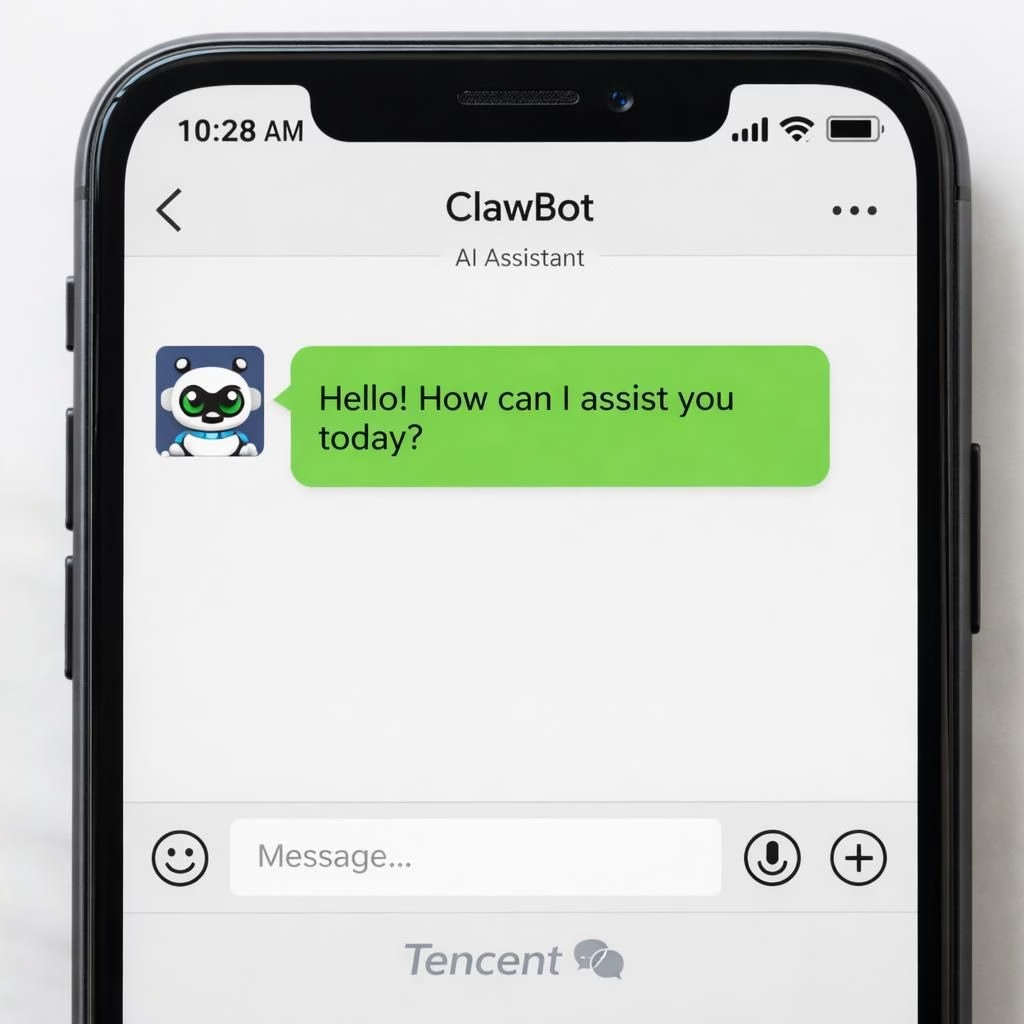
Welcome to a sunny tour through Tencent’s latest move: AI Agents are landing inside WeChat ClawBot, turning the world’s most popular chat app into a cooperative workspace. The promise? Fewer clicks, more thinking, and a dash of digital helper magic. OpenClaw — the open-source AI agent framework powering this integration — keeps the code accessible so developers don’t reinvent the wheel every time a task pops up. In practice, users will see WeChat ClawBot as a chat contact, ready to take commands, pursue goals, and actually follow through with multi-step tasks. This move marks a bold advance in the AI agent race that stays practical rather than theatrical.
AI Agents in the wild: WeChat ClawBot makes multi-task smart work
With WeChat ClawBot inside the chat, you can ask it to manage routine steps across apps, swap data between services, and monitor status changes in real time. The magic is not just the chat, but the execution: the agent can perform actions on behalf of the user, within the boundaries you set. The integration signals a shift from passive chatbots to proactive assistants. It is the kind of feature that scales business tasks while preserving a human in the loop when needed. The first wave of users is testing QClaw for personal tasks, Lighthouse for developers, and WorkBuddy for enterprises; the WeChat ClawBot integration pushes a single, familiar interface into the mix.
WeChat ClawBot and AI Agents: a quick landscape
The city of China’s tech giants is buzzing. WeChat ClawBot users are expanding, Alibaba has Wukong for enterprises, orchestrating multiple AI agents in one dashboard. Baidu has followed with a suite of OpenClaw-based agents across desktop software, cloud, mobile, and smart devices. The headline is simple: AI Agents are no longer a novelty product. They’re a platform shift, a way to choreograph tasks across systems rather than just respond to questions. The WeChat ClawBot approach shows how a super app can host autonomous agents without turning the chat into a command center or a maze. The emphasis remains on control, privacy, and security; the best implementations let you set goals, constraints, and escalation rules.
Security questions linger as agencies and users weigh convenience against risk. Chinese regulators have flagged AI agent security concerns, and the industry responds with careful design and robust guardrails. The balance will matter as more services plug into OpenClaw or similar frameworks. The fact that it is open source also invites community testing, audits, and rapid improvements. The result could be more transparent AI operations that still respect user boundaries.
For developers, the shift is exciting: new APIs, standardized tasks, and a playground where one AI Agent can coordinate with others in a single interface. It is a first-order shift toward autonomous, goal-driven workflows, not merely a chatbot that can spit back a list of steps. The pace in 2026 shows no sign of slowing; the next updates could add more devices, more integrations, and more ways for users to customize behavior to fit their daily routines.
In short, AI Agents inside WeChat ClawBot encode a practical future. They promise to reduce manual work, increase reliability, and keep interactions human-friendly. As the field evolves, the community will monitor how these agents handle complex tasks, error recovery, and privacy protections. The story is less about a single product and more about how platforms like WeChat are becoming the operating environments for intelligent agents—smart, safe, and surprisingly chatty.
Thanks to Reuters for highlighting the broader momentum around OpenClaw integration and the AI agent surge in China. You can read the original reporting here: Reuters original report.
What this means in practice
- Cross-app task orchestration: robots that move data and steps across tools with clear constraints.
- Human-in-the-loop safeguards: escalation rules and easy overrides keep control in your hands.
- Open-source benefits: transparency, audits, and community-driven improvement.
FAQ
- What is ClawBot? A chat-based AI agent that can perform tasks on your behalf inside WeChat, coordinated by the OpenClaw framework.
- Is using WeChat ClawBot safe? The platform stresses guardrails and user-set boundaries. Security depends on how you configure goals, data access, and escalation rules.
- How does OpenClaw fit in? OpenClaw provides the open-source engine that coordinates multiple agents and tasks across connected services.
- What happens if something goes wrong? The system supports error handling and escalation paths, so a human can step in when needed.