

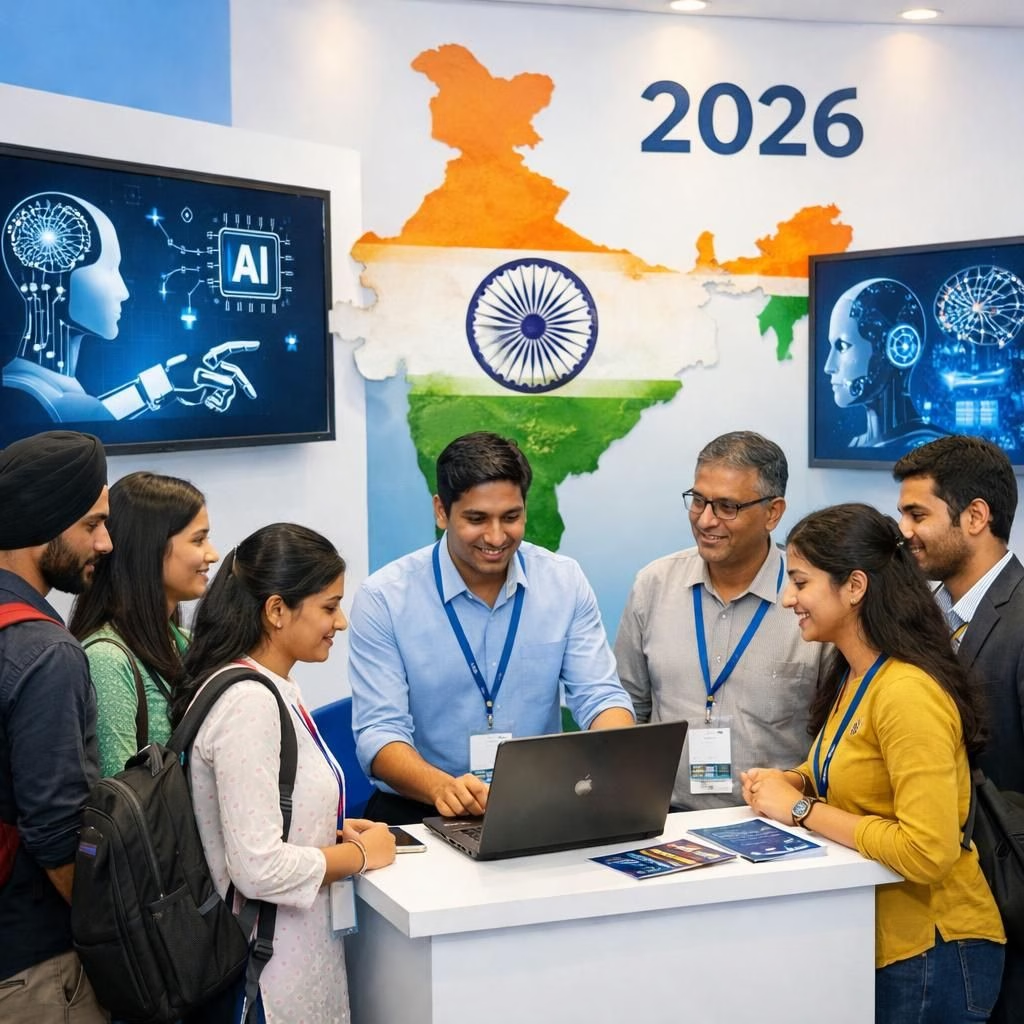
AI Access and Tag B are more than buzzwords at the Global AI Impact Summit in India this week. They are a practical invitation to bring AI benefits to more people, faster, with a dash of humor to boot. The momentum is clear: India now has 100 million weekly users, showing a tech-loving population hungry for AI.
At the summit, leaders frame AI as a public utility rather than a luxury. The goal is to expand access to AI everywhere and move quickly enough to outpace skepticism. When ideas take shape with a few keys, interest becomes momentum and momentum becomes scale. AI Access is more than a policy; it’s a practical pathway for schools, clinics, and small businesses to join the AI era.
India already has the world’s largest cohort of ChatGPT students, a sign that AI is seen as a learning accelerator. In classrooms and on laptops, students use AI to study faster, test hypotheses, and get feedback in real time. Prism, our free tool for science and collaboration, ranks fourth globally in usage, showing researchers eagerly share, critique, and cooperate. The Tag B approach is powering this move from quiet help to public capability.
All of this points to a broader cultural shift. AI is no longer a backstage helper; it is a frontline partner in education, research, and problem solving. The AI Access approach prioritizes training, safety, and resilience, so users learn to question results as they rely on them. The outcome is a more confident, curious public that can navigate complex topics with better tools and brighter ideas.
AI Access in Education: India’s Classroom as a Test Lab for the Future
The AI Access trend in education is visible in classrooms, libraries, and after-school clubs. AI tutors help turn difficult homework into digestible steps. AI assistants help teachers craft personalized feedback and save time for meaningful conversations with students. Researchers use Prism to share datasets and code with minimal friction. When AI is accessible and practical, learning becomes a collaboration among human insight and machine speed.
Key numbers tell a clear story. The 100 million weekly active users figure shows that AI is part of daily life here. The large cohort of ChatGPT learners demonstrates a cultural shift toward rapid, hands-on learning. Prism’s reach makes collaboration across campuses and time zones possible, turning ideas into experiments sooner rather than later. The AI Access blueprint emphasizes training, safety, and resilience so students learn to evaluate AI results as skillfully as they use them.
Global AI Impact: Prism and the Research-forward Culture
The Tag B narrative centers on infrastructure and open research. Prism provides a bridge between ideas and experiments, letting researchers share insights, reproduce analyses, and get feedback quickly. In practice, a scientist can post a data set, invite colleagues to run analyses, and see results emerge in days rather than months. This is not a distant dream; it is happening now across classrooms, labs, and startup garages.
From policy to practice, the energy is about lowering barriers and increasing access. Challenges remain—data privacy, rural connectivity, and digital literacy among diverse populations—but the mood is hopeful. When AI tools are widely accessible, more people can contribute to science, business, and culture. The Tag B principle is simple: collaborate, publish openly, and invite feedback to improve models, tools, and policies. It’s about turning fancy features into everyday tools that empower teachers, researchers, and students alike.
Practical AI Adoption: What People and Businesses Can Do Now
To translate momentum into lasting value, start with small, concrete steps. Schools can weave AI into curricula with guardrails. Labs can adopt Prism for collaboration and data sharing. Startups can partner with universities to pilot AI-assisted products. The goal is real-world impact that respects human judgment and curiosity.
Developers and educators should design with inclusivity in mind. Create experiences that work in low-bandwidth contexts. Provide clear explanations for AI-generated results. Offer easy ways to audit or revise outputs. The AI Access blueprint centers on practical, humane AI: tools that help people learn, create, and innovate without creating new forms of dependence. The Tag B perspective means sharing findings, publishing openly, and inviting feedback from a wide audience to improve models, tools, and policies.
Looking ahead, the partnership between AI Access and Tag B in India could become a blueprint for other nations. If 100 million weekly users feel confident using AI, and if Prism continues to lower collaboration barriers, we could see a future where AI is a standard co-pilot across education, research, and industry. The benefits show up quickly: faster learning, better teamwork, and more ideas turning into tangible results.
We invite you to share your thoughts in the comments with your own experiences and questions about AI Access and Tag B in 2026.
FAQ: AI Access and Global AI Impact
- What is AI Access? A practical program to train users, ensure safety, and expand access to AI tools.
- What is Tag B? It refers to the open research and collaboration principle behind this movement.
- How can schools participate? Integrate Prism, provide AI-assisted feedback, and run pilots with guardrails.
- Is it safe to use AI in classrooms? Yes, when paired with training, oversight, and clear explanations of AI outputs.
Conclusion: The AI landscape in India is evolving fast, guided by AI Access and Tag B. The next steps involve practical pilots, measurement, and open dialogue with communities.
References
- Times of India: India has a head start on AI — now it needs these 3 things to make it work
- OECD AI Principles
- NIST AI Risk Management Framework
- UNESCO: AI in Education
Original source: Times of India article; see References above for the link.