

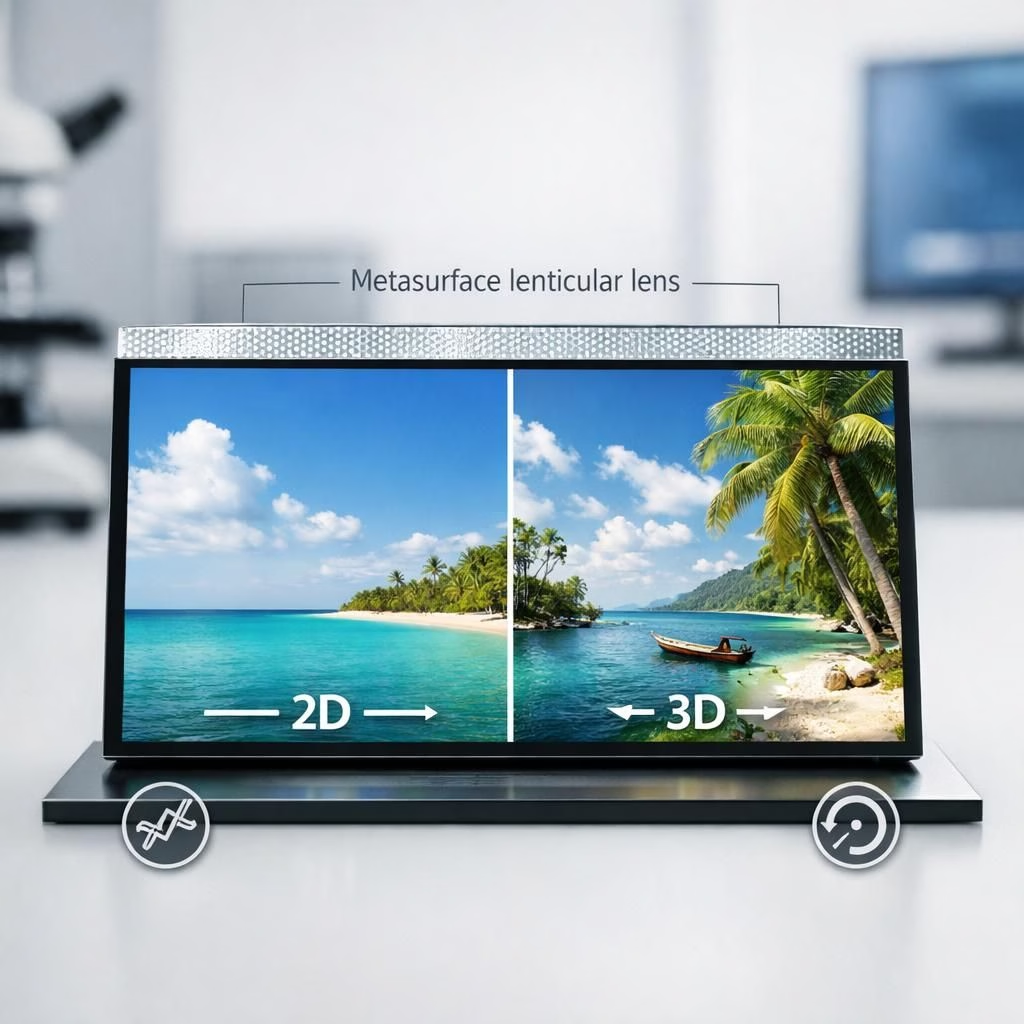
In 2026, Nature revealed a striking display—a full-color 2D–3D switchable light-field panel built around a metasurface lenticular lens (MLL). The device is slim, clocking in at a mere 1.2 mm, and it boasts a generous 25 cm² active area with a wide 100° field of view. The clever trick is polarization: the MLL shifts its focal behavior depending on the light’s polarization, so a single panel can switch between 2D clarity and immersive 3D depth. It can be mounted directly onto an OLED panel, and a voltage signal toggles modes. It sounds like gadgetry, but the science behind it is robust optics wrapped in an elegant, scalable packaging.
Metasurfaces replace bulky optics and moving parts with flat, patterned surfaces. The MLL encodes phase and polarization into nanoscale features, steering light paths on demand. In 2D mode, the device delivers crisp images with high numerical aperture, preserving color accuracy and contrast across the screen. In 3D mode, the same surface creates parallax cues that give depth without the need for glasses. The result is a scalable approach for wide-area displays that could fit into consumer devices and commercial screens alike, from phones to video walls.
Fabrication targets a large-area MLL integrated as a dual-dimension switchable optic. The ultrathin profile makes it feasible to keep the screen sleek, supporting modern devices that blend form with function. The active switching relies on voltage control rather than mechanical parts, simplifying integration with existing display electronics and firmware. The 100° viewing angle helps reduce the need for extra viewing adjustments, a practical boon for signage, retail displays, and public kiosks.
2D Clarity: design notes and polarization control
In 2D mode, the surface preserves high-resolution clarity. The optical design centers on a high numerical aperture to keep textures sharp, even at wide viewing angles. Colors stay faithful with minimal distortion, thanks to careful polarization management. The MLL’s polarization-dependent mechanism acts as the switch, reconfiguring the local optical path without any moving parts. This makes the approach both efficient and scalable for mass production, offering strong 2D fidelity across diverse content pipelines.
3D Depth: field of view and parallax advantages
In 3D mode, the same surface delivers depth cues through light-field delivery and parallax-enabled viewing. Polarization controls shift focal distances to support motion parallax, enhancing immersion while keeping the hardware compact. A 100° field of view helps users explore scenes with less head movement, a practical advantage for public displays and immersive kiosks. The glasses-free 3D experience emerges from the same finely tuned metasurface, avoiding bulky optical stacks and maintaining a slim device profile.
Practical implementation details highlight a path from lab to layout: voltage-controlled switching can be integrated with standard display electronics, so product teams can wire this into existing supply chains. The 3D option preserves familiar content workflows while the 3D mode opens new opportunities for interactive advertising, education, and entertainment. The metasurface lens system remains thin, robust, and compatible with current manufacturing techniques, which bodes well for large-area adoption. Researchers will likely push for higher efficiency, broader spectral support, and tighter polarization control to minimize viewing-angle variations across real-world lighting conditions.
As with many bold display concepts, the ultimate impact will depend on reliability, cost, and the content ecosystem that supports it. This 2D/3D switchable display demonstrates that metasurfaces can unify two distinct modes in a single, scalable device. The potential applications span consumer electronics, automotive dashboards, public information displays, and commercial signage—areas where the demand for high clarity in 3D and vivid depth in 2D coexist.
What are your thoughts on a single panel handling both 2D and 3D experiences? Could you see 2D content becoming the default while occasional 3D moments grab attention in retail or education? Share your ideas and experiences in the comments below, and tell us how you would use a 2D switchable display or a 3D-capable screen in daily life.
Original article: Switchable 2D–3D display through a metasurface lenticular lens. Nature (2026). https://doi.org/10.1038/s41586-026-10318-9. A big thank you to Nature for sharing this groundbreaking work and for providing the foundation that inspired this recap.
References and further reading: For readers seeking background on metasurface optics and 2D/3D switching, see Metalenses at visible wavelengths (Science, 2016). This context helps explain how flat optics can replace bulky lenses in modern displays.
FAQ
- How does polarization switch 2D and 3D modes? The metasurface lenticular lens (MLL) uses polarization-dependent phase shifts to steer light differently for 2D versus 3D content, enabling mode switching without moving parts.
- What viewing angle can users expect? The design targets about a 100° field of view, reducing the need for extra viewing adjustments in many settings.
- How hard is it to integrate into products? Voltage control replaces mechanical parts, making it compatible with standard display drivers and firmware. Content pipelines remain largely unchanged in 2D mode, while new 3D experiences become possible.
Practical steps for evaluation and adoption
- Assess compatibility with existing OLED or LCD panels, including driver voltages and polarization handling.
- Plan for polarization management and calibration to maintain color fidelity across lighting conditions.
- Consider spectral coverage to support full-color content without color artifacts.
- Map potential applications, from storefront signage to immersive education displays, to justify the added manufacturing steps.
Conclusion
Switchable 2D–3D displays built on metasurface technology offer a practical path to combine clarity with depth in a single, slim panel. If adopted widely, they could streamline product lines and open new content experiences without adding bulky optics.
References
Original Nature article: Switchable 2D–3D display through a metasurface lenticular lens. Nature (2026). https://doi.org/10.1038/s41586-026-10318-9