

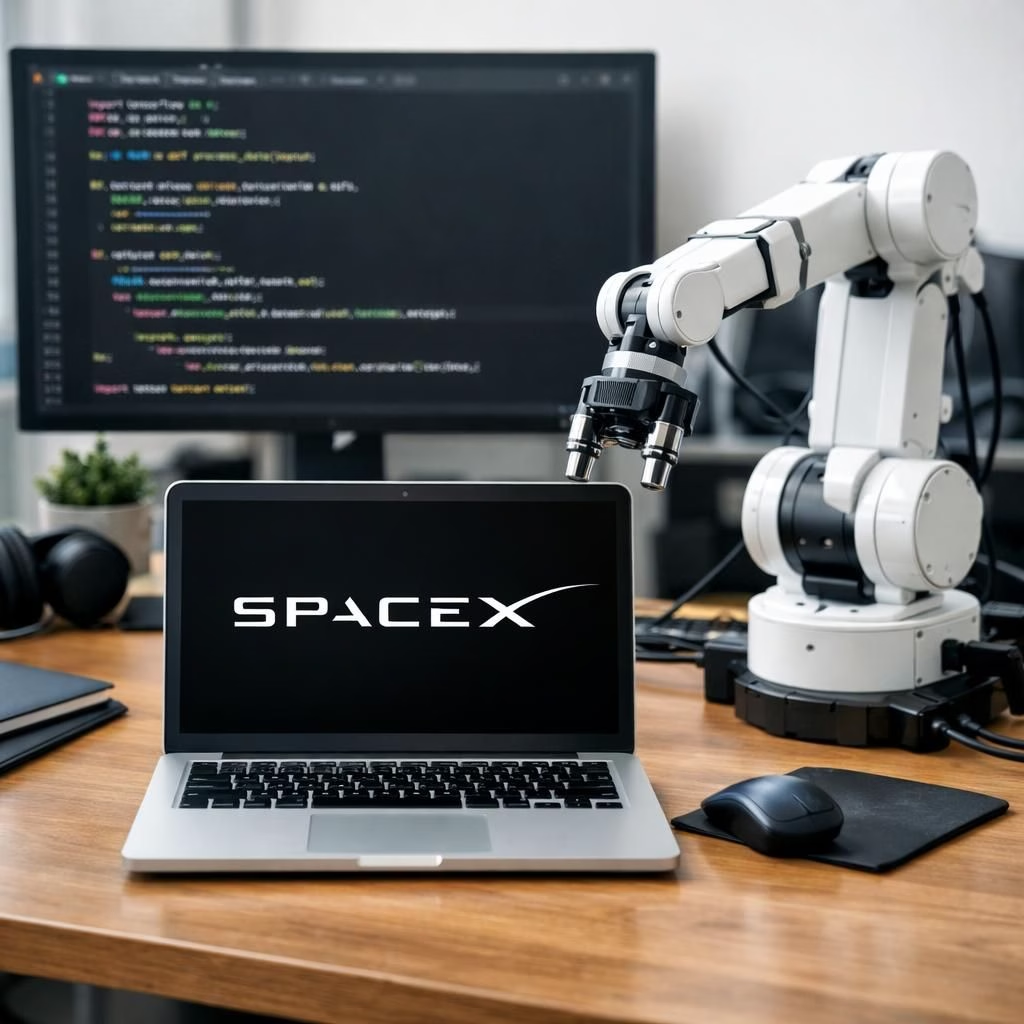
xAI is expanding in 2026 as Devendra Singh Chaplot joins SpaceX and the xAI team to push toward superintelligence. The move signals a bold bet on blending hardware intuition with scalable AI, hinting at a future where space-grade hardware meets cutting-edge models. Chaplot’s career spans IIT Bombay, CMU ML, Samsung, FAIR, Mistral AI and Thinking Machine Labs. Musk’s team frames the hire as part of a broader rebuild of xAI after a rough stretch and a public apology for missed talent opportunities.
xAI and superintelligence: the Chaplot hiring moment
Chaplot grew up in Mumbai and trained at IIT Bombay, earning a BTech in computer science and a minor in applied statistics. He pursued a PhD in machine learning at Carnegie Mellon University, where his work centered on autonomous navigation—intelligent agents that move through real environments. After CMU he spent time at Samsung Electronics in Seoul, combining robotics, perception, and hardware constraints. He then joined Facebook AI Research (FAIR) as a Research Scientist, where he spent more than five years building perception systems and autonomous decision-making prototypes. The shift to large language models came in 2023 with Mistral AI, where he contributed to Europe’s LLM push. By 2025 he joined Thinking Machine Labs, a hardware-minded startup that embraced hands-on experimentation, before joining Musk’s expanding empire.
His LinkedIn profile lists the role at xAI as a member of the technical staff, a label that masks the day-to-day effort required to drive a large project forward. Chaplot joined a team already known for bold ambitions and, at times, public missteps. His arrival follows Musk’s public apology for missed hiring opportunities, signaling a deliberate rebuild of xAI’s foundation and a more proactive approach to engaging promising candidates who were overlooked in earlier rounds.
Hardware meets AI: xAI’s path to superintelligence
The core idea behind the Chaplot hire is straightforward yet ambitious: SpaceX provides hardware muscle while xAI supplies software and models. Together they aim to fuse hardware and algorithms into a single, capable system. In practice, this means tighter collaboration between robotics teams and model developers, focusing on deploying AI that can operate in real environments, not just on servers. The emphasis on hardware reminds us that AI lives in physical devices—sensors, actuators, and robust computing stacks—where inference speed, reliability, and verifiability matter on factory floors and orbital platforms.
Chaplot’s track record—from autonomous navigation and computer vision to scaling LLMs—positions him as the kind of cross-domain talent xAI is signaling it wants. The broader trend is clear: the future will hinge on integrated teams that understand hardware and software as a single system, rather than siloed domains. This mindset could lift superintelligence to practical, real-world impact, not just theoretical promise.
Beyond Chaplot himself, the move signals SpaceX and xAI’s willingness to deploy frontier-scale resources and foster a high-agency culture. The teams are expected to move quickly, test relentlessly, and adapt on the fly. The public tone around the hire is pragmatic and optimistic—a refreshing shift after industry drama. If the plan succeeds, we will see smarter models paired with devices that use them in the real world, not just in controlled experiments. The collaboration treats hardware and software as two lanes on a single highway toward more capable systems.
As a closing note, the hire is framed as part of a rebuild and as a signal to talents watching from the sidelines. The team appears ready to reach back to promising candidates, potentially reshaping hiring in the space. For readers tracing the arc from IIT Bombay to CMU to Seoul to the Bay Area, Chaplot’s journey serves as a reminder that great ideas often require hardware labs, field tests, and patient iteration. The 2026 timeline adds urgency and relevance for those following this space closely.
Original article and background context: Times of India — Thank you for the original source material.
What this means for readers is that the intersection of hardware mastery and AI ambition remains alive. The next wave of AI systems may involve more hands-on control over devices and environments, moving beyond code-only development to dependable, real-world systems. If you enjoy thoughtful tech evolution with practical detail, share your thoughts in the comments.
Practical implications for teams
- Cross-domain teams bridging robotics and AI can accelerate deployment in real environments.
- Hardware-aware model deployment improves reliability and safety.
- Field-testing pipelines enable faster iteration and verifiable behavior.
FAQ
- Q: Who is Devendra Chaplot?
A: An Indian AI researcher and robotics expert with roles at IIT Bombay, CMU’s ML group, Samsung, FAIR, Mistral AI, and Thinking Machine Labs, now part of xAI’s technical staff. - Q: Why is this hire significant?
A: It signals a push to combine hardware expertise with AI software in pursuit of practical superintelligence and real-world impact. - Q: How does hardware influence AI development?
A: By coupling physical devices with models, teams can test, verify, and refine AI in authentic environments, not just simulations. - Q: Where did the story originate?
A: The Times of India article cited above provides the background; see the References section for the link.