

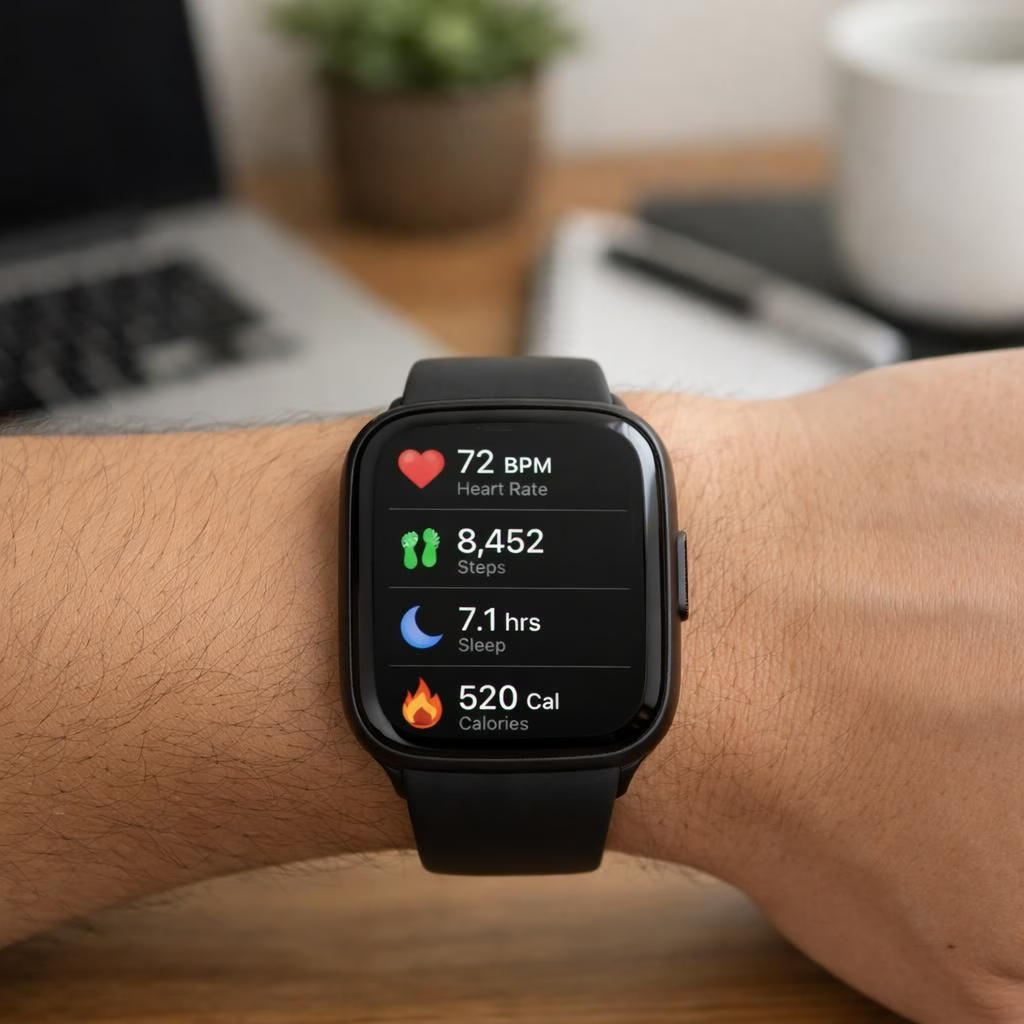
In a world driven by Wearables and Meta AI, Meta plans its first smartwatch this year. The project, internally codenamed Malibu 2, promises to blend health tracking with smart AI prompts.
Wearables and Meta AI: Malibu 2 momentum in 2026
The Information, which has followed Meta’s hardware experiments for years, notes that back in 2021 Meta explored an Android-based smartwatch with a detachable camera and up to three cameras. In 2022, Meta paused the project as Reality Labs cut budgets and laid off over 1,000 workers. The unit redirected its energy toward glasses and other Wearables, not the wrist companion.
Wearables and Meta AI in action: ambition meets restraint
Today, Meta’s Wearables roadmap centers on virtual reality headsets and smartglasses like Ray-Bans. Four AR/MR glasses sit in development, and Meta has pushed the next mixed-reality headset, code-named Phoenix, to early 2027. Malibu 2 would be the quiet return of a product line fans briefly cherished, then watched fade into the background.
Like any reboot, Malibu 2 faces a set of questions: battery life, app ecosystem, privacy, and the balance between data usefulness and user trust. Meta AI could offer health insights and contextual nudges that feel helpful rather than pushy. A clean, privacy-conscious design and a credible health narrative will be essential for success.
Historically, the smartwatch concept collided with competing priorities inside Reality Labs. The 2022 pivot signaled a shift toward wearables that pair well with eye- and head-mounted displays. If Malibu 2 appears in 2026, it won’t win everyone over immediately, but it could win a few skeptics with a straightforward feature set and a friendly AI assistant.
- Health tracking that complements daily routines (heart rate, sleep, stress metrics).
- Seamless integration with Meta AI for contextual recommendations and simple prompts on-device.
- Rumors of a detachable camera exist, but any implementation would need strict privacy safeguards.
- A design that harmonizes with Ray-Bans and other Wearables, creating a cohesive Meta ecosystem.
The broader Wearables market keeps mutating, and Meta’s approach blends hardware with software to keep users in the Meta orbit. Software polish, strong app support, and a user-friendly experience will determine whether Malibu 2 earns a loyal following.
Looking toward Phoenix, the early-2027 countdown hints at a broader plan to push immersive experiences. Malibu 2 could act as a bridge for users who want a health-focused smartwatch that chats with Meta AI rather than delivering a cold stream of notices.
Bottom line: 2026 could mark the moment Meta nudges its Wearables portfolio from rumor to real product. If Malibu 2 lands with credible health features, a privacy-forward stance, and solid software support, the company will have taken a meaningful step in the Wearables and Meta AI story.
What Wearables and Meta AI fans should watch in 2026
As the year unfolds, expect a careful balancing act between feature ambitions and the realities of hardware cycles. Meta will likely focus on a clean health-tracking core, Meta AI-assisted coaching, and a frictionless ecosystem that feels useful without feeling invasive. If the company ships Malibu 2 with an approachable price, dependable battery life, and robust privacy protections, it could win over casual users who want a simple, trustworthy companion rather than a data-mining machine.
Potential features to look for include: a straightforward health dashboard; adaptive Meta AI guidance that respects user privacy; an architecture that allows quick handoffs between smartwatch, Ray-Ban glasses, and the VR/AR stack; and a privacy-first camera approach that avoids creeping data collection. The design will matter as much as the technical specs, because elegance and ease of use matter more than raw horsepower in wearables.
Industry observers should also watch how Meta negotiates partnerships and developer ecosystems. A wearable succeeds not only on what ships at launch but on what app developers can build around it. Expect some initial friction cooling off as apps, wellness integrations, and cross-device features mature over time.
From a branding perspective, Malibu 2 signals Meta’s intent to reintroduce itself as a hardware-maker with a coherent software story, not merely an ads- or cloud-centric platform. If the device respects user autonomy and privacy while delivering real value, the public’s perception could shift toward curiosity and cautious optimism rather than skepticism.
On the horizon, Phoenix remains a beacon for 2027—a signal that Meta plans to expand its immersive experiences. Malibu 2 could serve as a friendly foothold into that broader world, offering a health-smartwatch entry point before users dive into more immersive waters.
In sum, 2026 may be the year when Meta tests its wrist-worn ambitions in the real world. A thoughtful Malibu 2 with solid health features, privacy safeguards, and a friendly AI assistant could turn wearables back into a welcome convenience rather than a headline risk. The next few quarters will show whether the company can translate ambition into everyday usefulness for a broad audience.
Attribution: Thanks to The Information for the original reporting and material that inspired this piece.
We invite readers to share their thoughts in the comments below.
Wearables and Meta AI FAQ
- When will Malibu 2 launch?
- Meta has signaled a 2026 timeframe, but timing depends on hardware cadence and software readiness.
- What makes Malibu 2 different from earlier wearables?
- Expect a health-focused core, tighter Meta AI integration, and privacy-forward design.
- How will privacy be protected with a potential camera?
- Any camera features would include strict opt-in controls, local processing, and robust data minimization.