

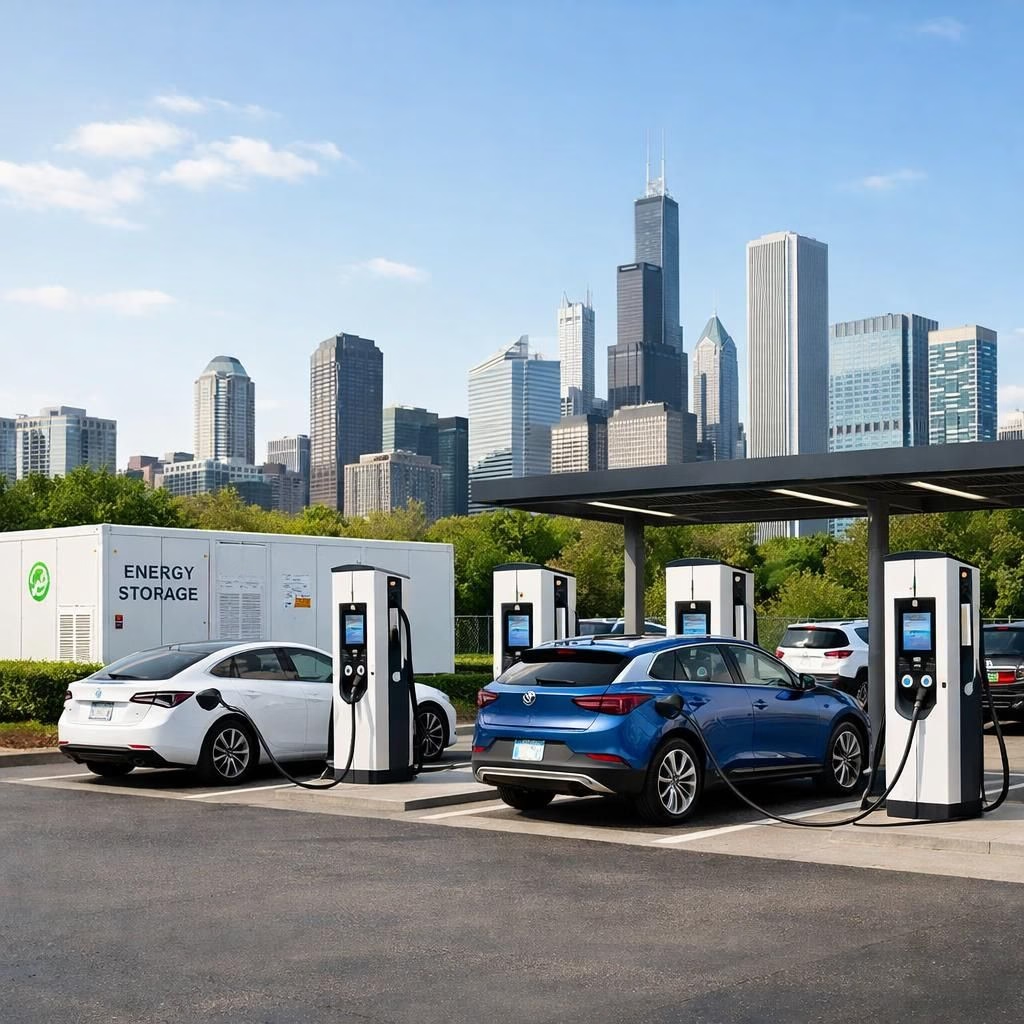
In 2026 the ultrafast charging revolution is racing ahead—and China EV tech players are leading the charge, no pun intended. Consumers balk at long waits to refill EVs, while engineers brag about five-minute miracles. The result: a decade of relentless R&D aimed at turning charging into a brief pit stop rather than a hardship.
Ultrafast charging milestones in 2026
XPeng’s S4 ultrafast charging system teased a five-minute claim that could push a typical daily range into the 210 km neighborhood. BYD followed with its Flash Chargers delivering around 1.5 MW, roughly four times the power of earlier hyper-fast systems unleashed in other markets. Lab tests showed BYD batteries moving from 10% to 70% in five minutes, and from 10% all the way to 97% in about nine minutes. If you could gain roughly 600 miles in not much longer than a gas fill, your commute would suddenly feel like a speedrun rather than a chore.
For broader context on ultrafast charging tech, see IEEE Spectrum: The race to ultrafast charging.
What makes BYD’s breakthrough notable is its end-to-end control: vehicles, battery cells, and charging hardware all in one ecosystem. The company shifted from lithium iron phosphate to lithium manganese iron phosphate, increasing energy density by roughly 5% while staying stable under heavy electrical loads. To handle the 1.5 MW surge, BYD redesigned electrodes, electrolytes, and separators so the pack can tolerate intense current without overheating or degradation. The goal isn’t merely speed; it’s reliability at scale—so drivers trust the new chargers on long road trips and daily errands alike. The Denza Z9GT is positioned for a Paris debut in April, potentially signaling a stylish, high-tech wave for future Europe-bound BYD products.
Industry coverage on the move toward high-power charging is also detailed by Reuters: Reuters: EV charging evolves rapidly.
China’s expansion plan aims to install over 16,000 new chargers across the country by year’s end, with roughly 2,000 units planned for Europe. Each station will be paired with stationary storage to buffer grid demand and offset spikes that could otherwise overwhelm infrastructure. The lab’s glow is impressive, but the real test will come from real-world use: how these machines hold up under cold starts, heat waves, and the constant churn of daily traffic. Expect ongoing iterations as field data rolls in and utilities adjust to the new load profiles.
China EV tech ambitions worldwide
Other Chinese automakers aren’t standing still. Zeekr has showcased a fully liquid-cooled ultrafast charger delivering up to 1.2 MW per charging gun, though questions remain about vehicle compatibility and firmware alignment. CATL has launched a succession of battery technologies, including the Shenxing platform, and delivered early sodium-ion solutions that promise cheaper materials and robust supply. The sodium-ion approach is intriguing: paired with high charging power like 1.3 MW, it could translate to about 2.5 km of range per second of charging in ideal conditions, a tempting combination for cost-sensitive fleets and early adopters alike.
Huawei added a 1.5 MW fast-charging system last spring, suggesting two charging guns could top up a 300 kWh pack in roughly 15 minutes. The company also signals that its heavy-duty electric trucks will be able to use these superfast technologies, broadening the fleet reach of ultrafast charging into commercial territories. In the United States, the race continues as automakers and suppliers push down battery costs while squeezing more range from existing chemistries. General Motors’ 2025 LMR (lithium manganese-rich) battery, developed with LG Energy Solutions, is slated for 2028 deployment and is designed to keep both cost and performance on a sustainable trajectory.
Beyond the plug, researchers and engineers are exploring wireless charging as a complementary route. The idea—charging a car when parked over a dedicated pad—appeals to consumers seeking frictionless refueling. Early studies show promise, but widespread adoption will hinge on regulatory clarity and consumer trust. When policymakers create friendly standards and grid-capacity is proven to handle the load, wireless charging could become a routine feature of urban life, especially in parking-rich environments like malls, airports, and office complexes.
As China EV tech races ahead in global EV manufacturing, a rising chorus of firms continues to push the boundaries of battery chemistry, power electronics, and charging control. By driving down costs and expanding access, BYD and its peers are shaping a future where EV ownership becomes more affordable, reliable, and delightfully convenient for everyday drivers. The emphasis remains on safe operation, system longevity, and a practical, consumer-friendly pace of adoption that avoids hype-bubble pitfalls. In other words, the dream of truly quick charges is inching closer to a real daily habit—not just a headline.
In short, the global and regional chessboards are transforming: ultrafast charging capabilities are not just about speed but about the resilience of energy networks, the economics of mass adoption, and the longevity of the vehicles themselves. The China EV tech ecosystem is leveraging its scale to prototype, test, and deploy solutions that may one day be standard practice in cities around the world. As the year 2026 unfolds, the market is watching closely to see which technologies survive real-world scrapes and which merely look good on a test bench.
Original article: Oilprice.com: China Pushes Electric Vehicles Toward the Five-Minute Charge Era — thank you for the original source material that inspired this remix.
If this piece sparks your curiosity or starts a thoughtful debate, share your thoughts in the comments. And as always, credit to the original author for the foundational material that helped seed this narrative.
Practical ultrafast charging steps for drivers
- Check your vehicle’s compatibility with high-power fast chargers and review the manual for max charging rate.
- Plan routes that include reliable ultrafast charging hubs equipped with grid buffering and energy storage.
- Precondition the battery on route to the charger to optimize temperature and charging efficiency.
- Keep a practical buffer (e.g., 10–20%) to minimize frequent high-rate sessions and protect battery health.
FAQ: ultrafast charging and China EV tech
-
What is ultrafast charging?
Ultrafast charging refers to very high-power charging that can significantly reduce stop times, potentially delivering hundreds of kilometers of range in minutes, depending on the vehicle and battery chemistry.
-
Is 1.5 MW charging safe for vehicles and grids?
Manufacturers design systems with thermal management and electrical protection; grid operators test buffering strategies to avoid spikes. Real-world performance depends on vehicle compatibility and local infrastructure.
-
When will five-minute charging become common?
Progress varies by region and model, but the industry is moving toward higher-power chargers and faster batteries. Wide adoption will take time and coordinated policy, standardization, and grid upgrades.
-
Will wireless charging catch up?
Wireless charging remains promising but is still in early wide-scale deployment. Regulatory clarity and consumer trust will determine its spread in cities and parking areas.
Conclusion: what this means for drivers
The move toward ultrafast charging aims to reduce friction and lower total cost of ownership by expanding usable range and ensuring reliability. For shoppers, expect more compatible charging networks and clearer guidance on when to charge to protect battery health. The journey from headline demos to daily habit is underway, with practical benefits for everyday driving.