

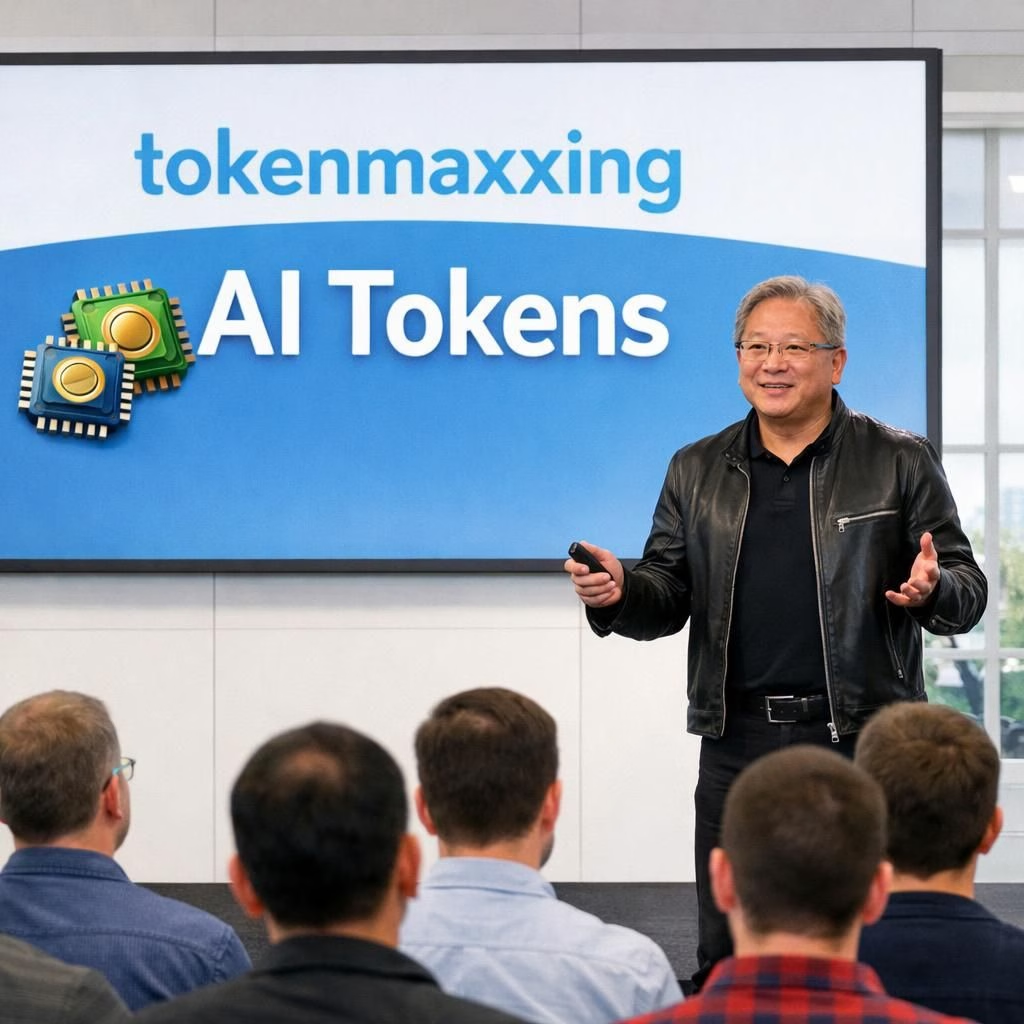
In 2026, tokenmaxxing and AI tokens are not footnotes; they are the currency of workplace productivity. Nvidia’s Jensen Huang has suggested token budgets deserve a formal line item in engineering compensation. He says he would be deeply alarmed if a highly-paid engineer spent too little on AI tokens. The idea is practical: more token usage means more AI agents and more outputs per engineer. The concept treats tokens as a budget item, not a one-off expense, and it invites disciplined governance rather than vanity spending.
tokenmaxxing in the wild: AI tokens as KPI
Token budgets are becoming a KPI. The premise goes beyond flashy tech; it aims at sustained investment in AI compute. Tokens are the unit AI systems use to process text, from small fragments to four-character chunks. Each prompt and each response consumes tokens on both ends. Running autonomous agents around the clock can push a single engineer toward hundreds of millions of tokens per week, and OpenAI’s pricing makes those numbers matter in real dollars. Nvidia signals that token budgets should be as visible as a salary and as measurable as a quarterly report.
The trend dubbed tokenmaxxing has drawn attention from Meta and OpenAI. A New York Times report notes that employees compete on internal boards tracking token consumption. Managers even factor AI usage into performance reviews. One OpenAI engineer reportedly processed 210 billion tokens in a single week, described as reading Wikipedia more than 33 times. Tokenmaxxing is not a joke; it signals ambition and careful resource allocation.
Hiring managers are listening. Thibault Sottiaux, who leads Codex at OpenAI, notes that candidates now ask about token access during interviews. They weigh token budgets alongside salary and equity. In 2026, token access becomes a differentiator as much as a resume bullet. The talent market is responding to tokenmaxxing by seeking larger budgets, better tooling, and clearer governance on when and how tokens can be used. The result is a job market that rewards those who plan to deploy AI tokens as a team sport, not a solo sprint.
Why Nvidia pushes token budgets so hard
Nvidia’s enthusiasm is not purely philosophical. Its GPUs generate the tokens that power AI workloads. That makes token consumption a proxy for GPU demand. Yet Huang’s argument is blunt: a senior engineer with a robust token budget and a fleet of AI agents is not a single person anymore; they are an engine of productivity. Companies that skim token budgets may appear to save a few dollars now, but they sacrifice time, speed, and market relevance later. Tokenmaxxing is a practical shift toward scalable software craftsmanship.
tokenmaxxing as a KPI in practice
In practice, token budgets act as a measurable lever for engineering teams. When governance is clear and budgets are transparent, teams can accelerate iteration without letting costs spiral. The idea is not to chase tokens for token’s sake but to align tooling, governance, and outcomes around AI-assisted execution.
AI tokens in modern workflows
Careful governance matters. Used well, AI tokens help teams scale collaboration, shorten cycle times, and automate repetitive tasks. The key is to couple budgets with governance, dashboards, and concrete performance metrics that show real value, not just activity. A disciplined framework ensures token investments translate into tangible results while keeping costs in check.
Critics worry about waste or ethical missteps. They caution against conflating token use with real value. Yet token budgets, properly governed, can align incentives with outcomes. When token usage is transparent and paired with measurable results, teams avoid the old trap of crediting effort without impact. In a world where AI agents operate in parallel, the cost of token mismanagement scales quickly. Tokenmaxxing becomes a call for intelligent governance, cost awareness, and balanced tradeoffs.
Tokenmaxxing and AI tokens in performance reviews are entering the corporate playbook. It is not a license to burn tokens for fun; it is a disciplined metric tied to AI-assisted execution. Engineers who steward their token budgets with care often show higher throughput, faster iteration cycles, and better software quality. The pairing of token budgets with intelligent agents can reduce manual toil and accelerate experimentation. In this sense, tokenmaxxing offers a practical way to amplify talent without leaning on vanity metrics, and it is a welcome twist in software culture.
The critique remains: we must avoid token inflation or token chicanery. Governance, auditing, and sensible policies are essential. Yet the core truth persists: token budgets enable teams to test, pivot, and scale faster. If properly managed, tokenmaxxing drives outcomes, not merely spend, and it redefines how we assess engineering leadership in 2026.
For the curious reader, token budgets are not merely about flashy demos. They reflect a broader shift in how companies view AI as a multiplier for human skill. Token usage translates to real-time problem solving: faster code generation, quicker bug fixes, more thorough code reviews, and the orchestration of agents that can read, interpret, and act. When a team designs a cooperative AI ecosystem, tokens become the fuel that powers this ecosystem. The result is not reckless spending but a deliberate investment in capability, with tokenmaxxing acting as a compass for direction and ambition.
As with any compelling trend, questions about fairness, governance, and sustainability will arise. The key is to pair token budgets with transparent outcomes, auditable budgets, and budgets aligned with a company’s product goals. In other words, tokenmaxxing should be a disciplined practice, not a reckless race. In 2026, that balance matters more than ever.
So, what does this mean for readers and teams outside the C-suite? It means you can be more productive with the right tooling, but you should also be mindful of resource use and governance. If you are a software engineer, consider how you structure token access, how you measure value, and how you communicate results. If you are a manager, ensure your token policies are fair, auditable, and strategically aligned with product milestones. If you are a critic, you can still applaud efficiency while asking for accountability. Tokenmaxxing, when done right, is a practical upgrade to modern software work.
Taken together, tokenmaxxing and AI tokens symbolize a broader trend: software teams that treat AI as a partner, not a luxury. Nvidia’s candid stance invites debate, but it also offers a pragmatic framework for scaling engineering effort in a world of expensive compute. The future of software may look different as tokens become a currency, but the goal remains the same: more value, faster, with less wasted time and more carefully chosen prompts.
Original article: Thank you to the original author for the material.
Want to share your thoughts? Please leave your comments below and join the discussion about tokenmaxxing and AI tokens.