

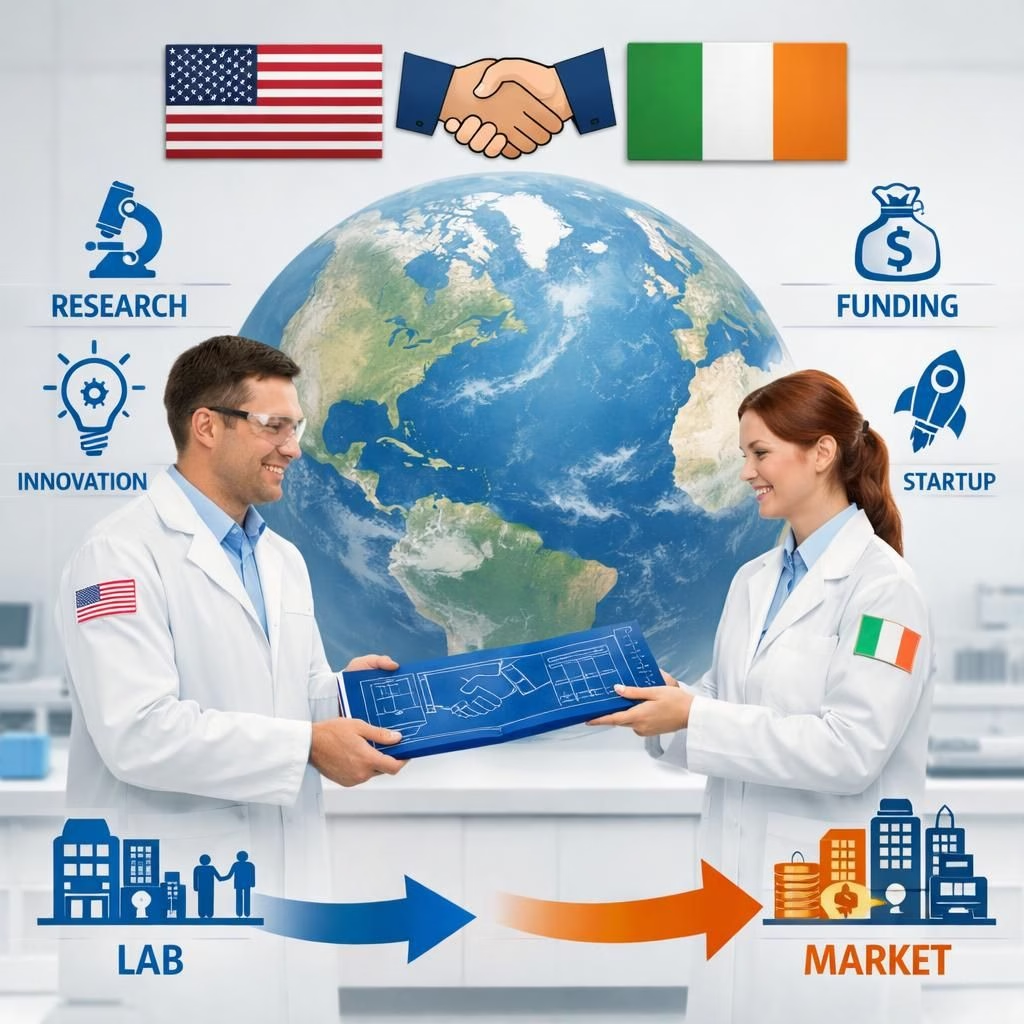
Welcome to a sunny, slightly cheeky tour of how technology and translational research are colliding to speed up big ideas. The National Science Foundation’s directorate for technology, innovation and partnerships has teamed up with Research Ireland and Northern Ireland’s Department for the Economy to accelerate the commercialization of emerging technology. On Friday, NSF launched the U.S.-Ireland Research Translation and Commercialization Initiative, a cross-border program designed to translate science and engineering research into market-ready technology and viable businesses. In other words, this initiative isn’t just about grant paperwork and fancy slides; it’s about turning clever findings into products people actually want to buy. The trilateral effort builds on the U.S.-Ireland Research and Development Partnership established back in 2006, which has supported collaborative research across nanoscale science, telecommunications, cybersecurity, and energy. Technology and translational research aren’t abstract ideas here; they’re marching orders for a transatlantic startup sprint.
Technology and Translational Research in Global Collaboration
The new program seeks to identify projects that already received some federal backing but show commercial promise, then provide teams with tailored help to speed the journey from lab bench to marketplace. It will emphasize how technology can reach customers faster by pairing researchers with industry mentors to translate potential into actionable roadmaps. Selected teams will receive mentorship from commercialization experts to develop translation roadmaps and may secure additional funding to launch startups. In practical terms, NSF aims to pair researchers with industry mentors who can translate technical potential into business plans, regulatory roadmaps, and customer discovery strategies. The goal is speed, scale, and a little less patience for “maybe next year.” The emphasis on translation signals a shift from abstract discovery toward practical impact, a move that makes both government and industry smile in a way that only a properly structured grant program can induce.
In support of this approach, the program will surface operational gaps and coordinate cross-border efforts. The emphasis on translational research will be paired with hands-on guidance, milestones, and community building to move ideas toward customer value.
Coordinating Across Borders: A Roadmap, Not a Roadblock for technology and translational research
According to NSF leadership, the initiative will also leverage a trilateral framework with technology and translational research at its core. The plan is to identify previously funded but under-exploited projects and then connect teams with mentorship, governance, and potential funding to accelerate market entry. The U.S. side brings federal support and a culture of rapid prototyping; Ireland and Northern Ireland bring regional ecosystems, private networks, and a shared appetite for building things that last. The collaboration is designed to be flexible—think of it as a co-development sandbox where researchers can test ideas with real-world feedback instead of waiting for the perfect grant cycle. Expect a blend of workshops, mentorship, and iterative milestones rather than a single, brittle milestone that nobody remembers a year later.
Practical Steps: From Lab to Market for technology and translational research
Part of the plan is to identify operational gaps that stall promising research. The program envisions a dedicated industry partner to help run the framework, identify high-potential research, and mentor participating teams through translational research planning, intellectual property considerations, and market analysis. This partner would also oversee funding oversight and coordinate with researchers, investors, and policymakers—an exercise in bureaucratic choreography that, when done well, feels almost magical. The approach echoes a simple truth: great science alone rarely becomes great products without a thoughtful translation process, regulatory awareness, and a dab of private-sector seasoning.
When the U.S. seeks a partner to handle the nuts and bolts, this is where operational excellence meets strategic risk-taking. The government has signaled openness to an other-transaction agreement with a four-year performance window for the program support services. In plain English: there’s room for experimentation, but with clear deadlines and accountability. The timing matters, too. The initiative’s requests for information (RFI) published in SAM.gov show a preference for coordinating workshops, linking researchers to industry and investor networks, and guiding teams through intellectual property and product development—key steps that often separate a cool idea from a successful business.
Other Interesting Threads in the 2026 Landscape
Beyond the U.S.–Ireland collaboration, the broader federal spectrum continues to pulse with notable developments. Utah State University’s Space Dynamics Laboratory recently secured a substantial contract modification with the Missile Defense Agency to sustain technical and analytical support for missile defense. The Department of War (now more commonly referred to as the Department of Defense) highlighted the role of University Affiliated Research Centers in delivering specialized expertise and proprietary data to tackle complex systems engineering challenges. While these programs serve different missions, they share a common thread: research institutions partnering with government programs to move sophisticated capabilities from concept to capability faster than pure curiosity would allow.
On the intellectual property front, the U.S. Patent and Trademark Office rolled out the Trademark Classification Agentic Codification Tool, or Class ACT, aims to automate early steps in trademark processing with AI assistance. That move illustrates how the government is embracing AI to streamline routine tasks, freeing humans to focus on higher-value decision-making. Experts will explore responsible AI adoption at upcoming Digital Transformation events, where policy, technology, and business strategy converge—an area where technology and translational research often learn to speak the same language, even if their accents differ.
Meanwhile, an advanced manufacturing facility in Cherokee, Alabama, marks a practical milestone: an offshore-to-core capability expansion for submarine components. Hadrian’s factory, the Factory 4 site, targets Virginia-class and Columbia-class submarines, with full-rate production anticipated within two years. This example shows how the U.S. is investing in domestic industrial capacity to support national-security objectives while nurturing private-sector manufacturing ecosystems. It’s a textbook case of technology-enabled manufacturing scaling, with a dash of strategic resilience thrown in for good measure.
All these threads—federal R&D support, cross-border collaboration, AI-enabled administrative tools, and advanced manufacturing—form a tapestry where innovation meets implementation. The U.S.–Ireland initiative sits at a crossroads: it’s about turning research into market-ready products, sure, but it’s also about strengthening jobs, regional ecosystems, and the broader scientific enterprise that feeds the innovation pipeline. In this sense, technology is the raw material, while translational research is the operating system that makes the machine run smoothly.
For researchers, students, and innovators, the message is clear: if you’ve got a discovery with market potential, this initiative wants to help you translate it into a real business outcome. Expect mentorship, structured roadmaps, and a network that spans two oceans and multiple policy regimes. That’s where translational research becomes practical, bridging lab and market.
Original article: NSF News Center — U.S.-Ireland Research Translation and Commercialization Initiative. Thank you to the original source material for laying out the ambitious framework and for inspiring this exploration of how technology and translational research can work together on the world stage.
If you enjoyed this overview and want to see more deep dives with a touch of optimism and humor, drop your thoughts and questions below. I’d love to hear how you see technology and translational research shaping our 2026 landscape, and what practical steps you’d add to help labs turn ideas into everyday solutions.
Frequently Asked Questions
- What is the goal of the U.S.-Ireland Research Translation and Commercialization Initiative? A cross-border program to translate research into market-ready technologies and viable businesses, with mentorship and potential funding for teams.
- Who can participate? Teams with prior federal backing that show commercial potential and a track record of collaboration across the involved regions.
- How does the program handle intellectual property? It includes IP considerations and structured commercialization planning guided by mentors and industry partners.
- Where can I find official notices or RFIs? Notices are published on SAM.gov and related agency portals; follow the NSF and partner agency updates.
Conclusion: Turning research into real-world impact
In short, this initiative blends government support with transatlantic collaboration to speed the journey from discovery to market. By pairing researchers with mentors, roadmaps, and a broad network, it aims to move lab breakthroughs into customer hands while strengthening regional innovation ecosystems.
References
- Original source: https://www.executivegov.com/articles/nsf-us-ireland-research-commercial-tech
- NSF News Center — U.S.-Ireland Research Translation and Commercialization Initiative: https://www.nsf.gov/news
- USPTO Class ACT: https://www.uspto.gov/about-us/news-events/class-act
- SAM.gov notices: https://sam.gov