

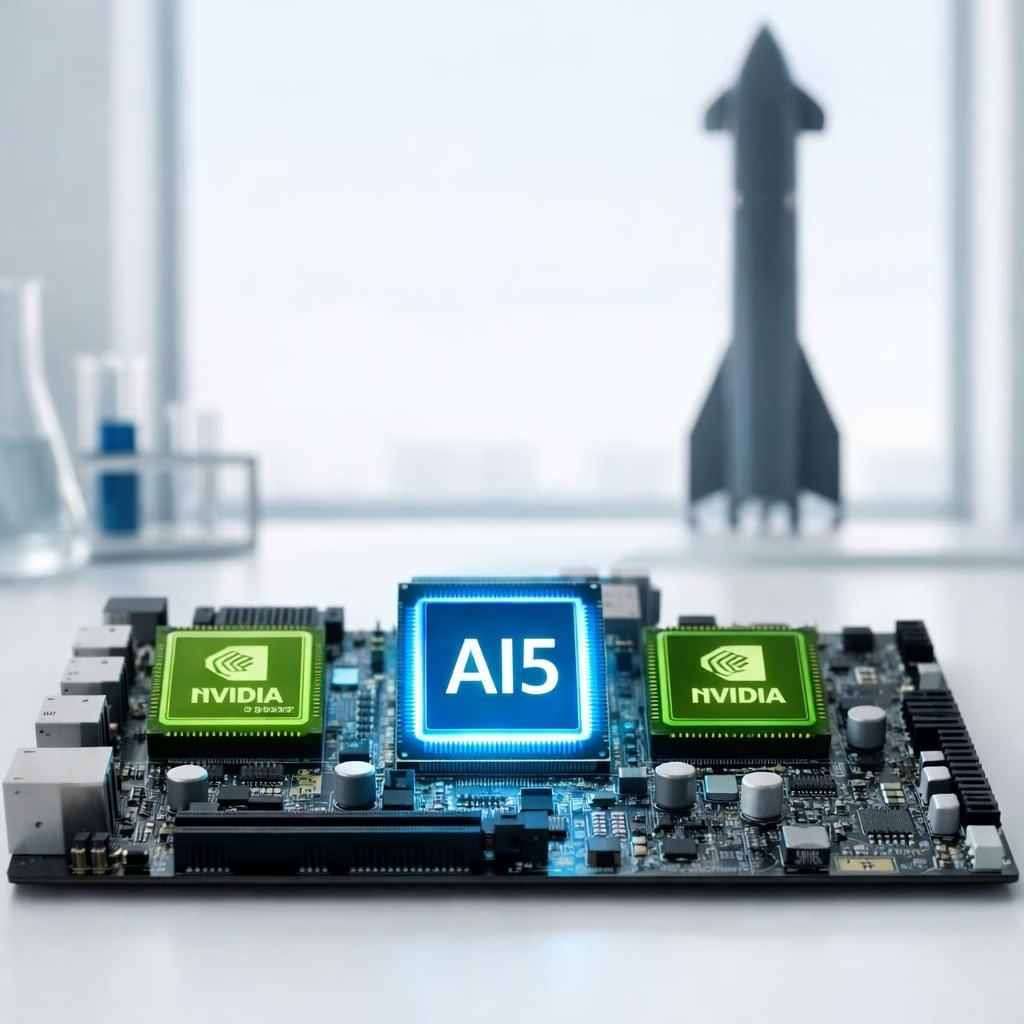
SpaceXAI is more than a branding exercise; it’s a signal that ambitious hardware goals ride on a silicon backbone. SpaceXAI and NvidiaChips are not rivals but teammates, trading bursts of compute for headlines and launches. Elon Musk has reiterated that both SpaceX AI and Tesla will continue buying NvidiaChips in large quantities even as the carmaker pushes ahead with in-house AI silicon. On X, Musk publicly named the merged SpaceX and xAI venture SpaceX AI, a nod to last month’s all-stock move that stitched together an AI startup with a rocket company. He reminded followers that NvidiaChips remain the backbone of these efforts, at least for now, because they reliably deliver the scale and diversity AI teams crave. The takeaway is straightforward: NvidiaChips are the workhorse today, and in-house silicon is the dream of tomorrow. Yet the branding charm of SpaceX AI is the sense that complex tech can feel approachable rather than a corporate mystery. The SpaceXAI strategy blends external compute with in-house silicon for a balanced roadmap.
SpaceXAI Strategy: The Dual-Engine Plan
From a product posture, the SpaceXAI strategy resembles a dual-engine plane: one engine runs on NvidiaChips to keep operations smooth while the other pursues its own silicon ambitions to protect margins. Musk has reassured investors and fans that Nvidia chips will stay on the roster at scale even as Tesla doubles down on AI5, the edge-optimized chip. AI5 is pitched as a workhorse for Optimus and Robotaxi, designed so Tesla’s software stack gets the most out of every circuit. Musk says it’s not just training in a data-center context; AI5 is optimized for edge compute—designed to live on a robot or a car and still act like a well-trained assistant. There is talk of AI6 possibly matching or surpassing AI5 on the same process, a claim that sounds technical but aims to reassure audiences that in-house silicon will keep chasing efficiency gains through clever design like half-reticle layouts. The SpaceXAI strategy thus maintains a practical balance between external scale and internal optimization.
Behold the half-reticle idea: a design Tesla champions to boost yield. The AI5 uses a half-reticle design, effectively doubling yield by fitting two chips per lithography shot. In contrast, Nvidia’s Blackwell fills nearly a full reticle, making it a single-reticle design. Musk has been clear that if Tesla hits compute and efficiency targets with the half-reticle format, fab requirements could shrink significantly, and the Terafab project will look less like a slide and more like a real factory plan. The debate isn’t just about chips; it’s about scaling a fleet that includes Optimus-on-board compute and a Robotaxi that needs reliable on-board inference. The vibe is hopeful, pragmatic, and a bit nerdy—perfect for a future where rocket science and silicon science share a single table.
In this story, NvidiaChips remain the anchor for today’s scale and reliability, while SpaceX AI’s branding makes the path to in-house silicon feel closer to reality. Musk’s admiration for Jensen Huang—“I am a huge admirer of Nvidia and Jensen btw. That market cap is well-deserved.”—reads like a mutual respect treaty between two fast-moving technologies. The public exchange underscores a simple truth: SpaceX AI and Tesla will continue to order NvidiaChips at scale because the present demand persists, even as the long-term plan seeks more manufacturing autonomy. The result is a hybrid strategy built on external supply strength plus internal engineering discipline, with branding flair to keep stakeholders engaged.
NvidiaChips and the AI5 Benchmark
NvidiaChips remains the center of industry conversations because it anchors today’s capabilities while inviting tomorrow’s optimization. Beisel’s explanation of chip design clarifies why Tesla’s approach isn’t a copy of Nvidia’s approach but a complementary philosophy. Tesla’s AI5 is edge-optimized, with the entire software stack crafted to extract maximum value from each circuit. The discussion of AI6—the idea of matching AI5 on the same process node—signals a plan to narrow the gap between edge and center while managing production risk. If AI5 delivers solid compute and efficiency on a half-reticle approach, Terafab becomes a tangible path forward. Musk teased a timeline of Terafab potentially starting within seven days, a bold bet investors and engineers seem ready to entertain. Terafab is not a magic wand; it’s a production mindset: disciplined process, yield management, and a steady hand on the fab, blended with a show-me attitude about edge and cloud performance. NVIDIA materials often reinforce that scale matters for both training and inference.
From the broader AI ecosystem view, NvidiaChips’ role as a dependable supplier remains essential, while Tesla’s AI5 and potential AI6 developments aim to reduce future dependence on external suppliers. The half-reticle approach for AI5—paired with a vision for AI7 and beyond—demonstrates a careful balance: push the envelope with in-house design while preserving supply chain flexibility via continued Nvidia orders. The humor here isn’t lost on insiders: two ambitious teams explore manufacturing, yield, and scalability with a blend of math rigor and brand-savvy optimism. The 2026 narrative now centers on SpaceX AI, Tesla AI5, and NvidiaChips co-creating a future that feels both bold and achievable.
As the year unfolds, the interplay between SpaceXAI, NvidiaChips, and AI5 continues to shape roadmaps, fab schedules, and investor sentiment. The optimism is contagious, but so is the discipline: this is not a simple race to ship the most chips; it is a long-term plan to balance external supply, internal fabrication, and edge performance in a way that preserves growth and margin. The broader takeaway is that the AI hardware landscape is settling into a hybrid rhythm: external chips for scale and training, in-house silicon for control, efficiency, and eventual cost reductions. The narrative remains practical, with Musk’s humor and a readiness to pivot as new data arrives. Please share your thoughts in the comments—and a nod to the original article at original article for the groundwork and inspiration.
Practical takeaways for readers
- Understand the dual-engine approach: external chips for scale, in-house silicon for efficiency.
- Watch the half-reticle strategy and its impact on fab timelines and costs.
- Note how branding and partnerships influence investor confidence and public perception.
FAQ
- What is SpaceXAI?
- SpaceXAI is a branding term for the combined SpaceX-Ai efforts; it signals a broader push into AI hardware, software, and edge computing.
- Why is NvidiaChips still important?
- They provide scale, reliability, and proven performance as Tesla and SpaceX continue developing in-house silicon.
- What is Terafab?
- A planned manufacturing facility to produce AI chips in-house, reducing dependency on external suppliers.
In short, Musk’s hybrid approach aims to balance speed and control: leverage NvidiaChips for scale today while advancing SpaceX AI and Tesla AI5 to improve edge compute and eventual cost structure. The plan remains pragmatic and ambitious, with branding that keeps enthusiasts engaged while maintaining a clear path to production.
References
- Times of India: Times of India