

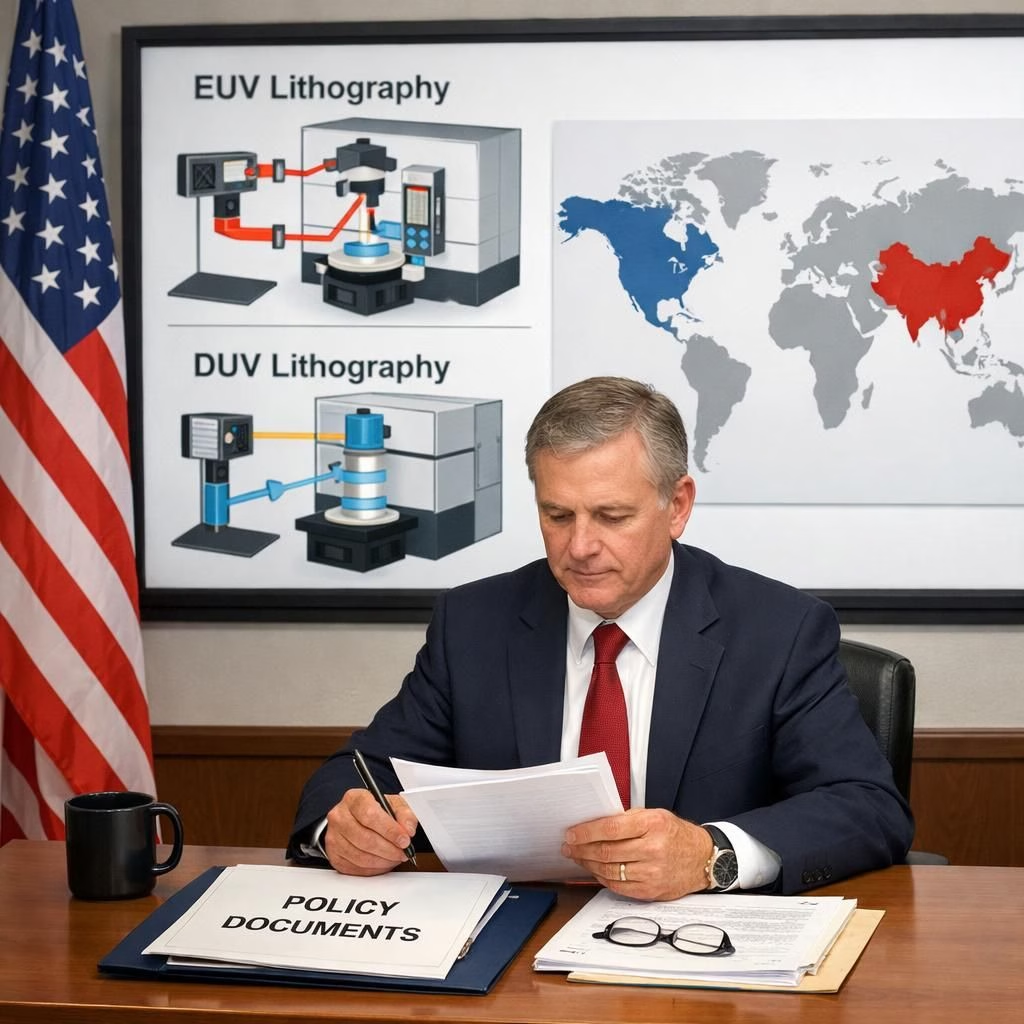
In this policy roundup for 2026, lawmakers fancy themselves as the guardians of the silicon realm, tightening the export leash on Beijing’s AI ambitions. The MATCH Act—Multilateral Alignment of Technology Controls on Hardware—aims to curb sales of the most advanced chipmaking gear to China, while leaving room for measured cooperation elsewhere. The idea is simple: limit access to machines that can produce cutting-edge semiconductor devices, and boost domestic resilience in both the economy and national defense. If this sounds like a high-stakes game of chess, that’s because it is — just with bigger boards and smaller wafers.
semiconductor policy snapshot: MATCH Act explained
The bill, introduced in the House in early April 2026, seeks to broaden the categories of chipmaking machines banned from sale to China and tighten restrictions on services and software tied to those machines. It is led by Representative Michael Baumgartner, with co-sponsorship from Representative John Moolenaar, who chairs the House Select Committee on China. The aim is to slow Beijing’s AI hardware ambitions a bit—think of it as adding a few more roadblocks in a high-speed lane. It isn’t about punishing China; it’s about buying time for U.S. and allied industries to strengthen their own footing.
Why this matters: NBC News reported that China’s imports of semiconductor manufacturing equipment jumped dramatically in recent years, climbing from around 10.7 billion in 2016 to roughly 51.1 billion last year. Silverado AI think tank researchers frame this surge as part of Beijing’s plan to domesticate its AI supply chain and lessen dependence on foreign chips. This reflects a broader policy shift in how technology is controlled. If China can assemble its own cutting-edge semiconductors, it could shift the tech balance and test U.S. diplomacy—while giving entertainment to analysts who love a good chart.
semiconductor policy implications and EUV vs DUV reality
Washington has already blocked the most advanced machines, those that perform extreme ultraviolet lithography, which are central to producing the leading AI chips. In 2026, a former White House AI adviser dubbed the export ban the single most important export control related to AI — an accolade that sounds dramatic but reflects real strategic risk. Yet there remains a gap in restrictions: older deep ultraviolet lithography (DUV) machines can still be used to produce very advanced chips. The policy debate is now about which devices to include and how to enforce strict controls without choking legitimate research and non-Chinese markets.
Why the policy keeps evolving: only a handful of firms manufacture today’s most advanced chipmaking machines, and most of them operate out of the United States, the Netherlands, and Japan. That triad gives Washington leverage and creates a practical chokepoint in the global supply chain. The MATCH Act would formalize and expand those chokepoints, closing loopholes that might let China obtain or repair critical production lines. It’s policy meets pragmatism in a high-stakes chess match.
In practice, this policy approach uses a mix of export controls, licensing, and restriction of software and services linked to the machines. The aim is to complicate China’s ability to scale up its own advanced chip manufacturing without unduly harming allied users or stoking escalation in the tech cold war. Supporters argue that strong controls help preserve U.S. tech leadership and deter competitors from advancing too quickly without checks. Critics warn of unintended consequences for global research collaborations and for regional chip supply resiliency in Asia and beyond. The conversation is nuanced, and the stakes are high.
The policy conversation is ongoing, with lawmakers weighing economic impact against strategic risk. The challenge is to maintain healthy momentum in AI and semiconductor development while avoiding a brittle, weaponized tech ecosystem. The MATCH Act is a test case for whether a modern, technologically dependent democracy can calibrate its export controls with precision and wit, keeping the doors open to beneficial research but keeping out the most dangerous shortcuts.
Finally, the conversation touches on who owns the future of manufacturing. A successful approach blends incentives for domestic production, open channels for essential software and services, and robust oversight to prevent diversion of sensitive tech. The goal is not to isolate, but to align interests: secure supply, fair competition, and steady progress in AI hardware—without turning the world into a rigid fortress.
We invite you to share your thoughts in the comments below.
Linkback attribution: Thanks to NBC News for the original reporting on the MATCH Act: NBC News. For analysis and context, courtesy of Silverado AI think tank: Silverado Policy Accelerator.
practical implications and what readers can watch for
As this policy landscape evolves, small and large players in the semiconductor ecosystem will monitor licensing decisions, supplier relationships, and the pace of allied collaboration. Here are practical signs to watch for:
- Licensing trends for equipment upgrades at non-Chinese facilities.
- Announcements from major chipmakers on supply-chain diversification with trusted partners.
- Public dialogue about research collaboration with non-Chinese labs and institutions.
What this means for the semiconductor ecosystem
In the near term, expect continued focus on chokepoints in the equipment pipeline and on safeguarding sensitive know-how. For researchers, funding bodies, and industry partners, the emphasis will be on responsible cooperation in non-sensitive areas while maintaining robust oversight to prevent leakage of critical capabilities.
frequently asked questions about the MATCH Act
Q: What is the MATCH Act?
A: It stands for the Multilateral Alignment of Technology Controls on Hardware. The goal is to tighten export controls on high-end chipmaking gear and related services to restrict access to China, buying time for the U.S. and its allies to strengthen domestic capabilities.
Q: How could this affect global supply chains?
A: By reinforcing chokepoints around the most advanced equipment, the Act could steer certain production and know‑how toward trusted partners while slowing the growth of domestic Chinese manufacturing in the short term.
Q: Will this hinder scientific research?
A: The aim is to preserve open, beneficial research while preventing sensitive technology from crossing borders in ways that could threaten national security. The bill includes narrow guardrails to protect legitimate collaboration in non-sensitive areas.
Q: When might the policy become law?
A: If approved by Congress and signed by the President, implementation would occur through licensing rules and compliance programs. Timelines depend on committee action, debates, and broader geopolitical considerations.
conclusion: balancing openness with protection
A measured, policy-driven approach to semiconductor leadership aims to secure critical supply chains without stifling innovation. The objective is to keep advanced AI hardware within a trusted circle, while preserving healthy collaboration in non-sensitive domains. The outcome will shape the global arc of AI capability for decades to come.
References
- NBC News coverage of the MATCH Act
- Silverado Policy Accelerator analysis
- Times of India — After AI chips, US lawmakers want to ban sale of key equipment to China
Original source linkback: Times of India