

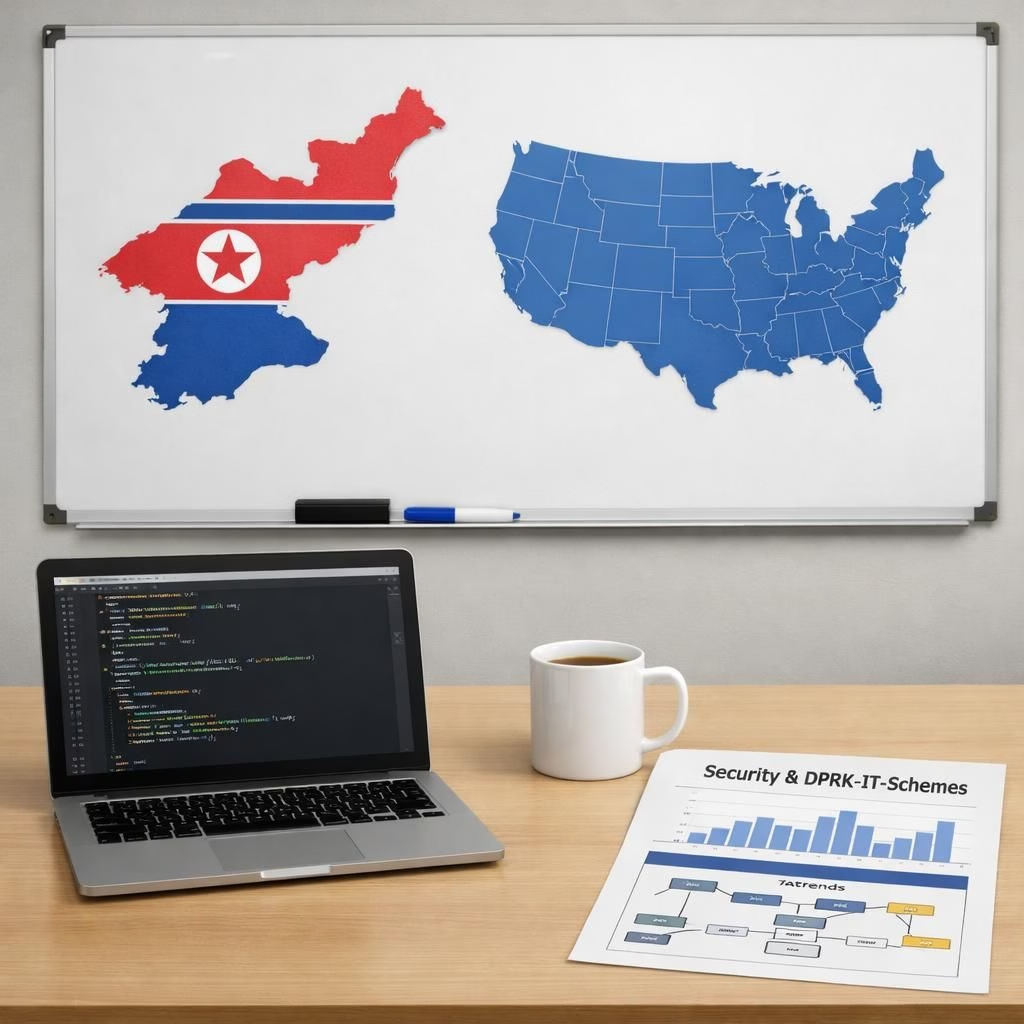
Today’s post spotlights a security case from the Justice Department that shows how Tag B can scale and threaten national security. Kejia Wang and Zhenxing Wang, two U.S. nationals, allegedly helped North Korean IT workers pose as ordinary U.S. residents to land remote gigs at more than 100 companies. The case highlights how a complex fraud can exploit trusted identities for illicit revenue that benefits the DPRK. The takeaway is clear: security, and the linked Tag B threat, is only as strong as your controls.
Security lessons from a DPRK IT-schemes case
The sentencing underscores the seriousness of these crimes for national security and corporate resilience. Kejia Wang was sentenced to 108 months in prison, while Zhenxing Wang received 92 months. In addition to imprisonment, the judge imposed three years of supervised release and substantial forfeitures and restitution. The penalties reflect a zero-tolerance posture toward crimes that fuel illicit state revenue and compromise U.S. networks.
The pattern relied on stolen identities from more than 80 U.S. persons to place workers at over 100 companies, often using shell entities tied to the operation. A Tag B approach enabled overseas actors to access laptops and move funds through controlled accounts.
Evidence shows Kejia Wang traveled to China in 2023 to meet overseas partners and supervise at least five U.S. facilitators who hosted hundreds of laptops in private homes. Zhenxing Wang was among those facilitators and helped route compromised devices to overseas colleagues. The laptops often held ITAR-controlled defense data, underscoring the risk to sensitive information.
Security experts describe this as a breach in slow motion. The operation married a legitimate payroll illusion with cross-border access to corporate networks, enabling revenue to flow back to the DPRK. Investigators seized domains and financial accounts used to launder proceeds and recovered a large fleet of laptops in 2024, illustrating the scale of the scheme.
Officials stressed that this is not only a matter of law enforcement. The Department of Justice framed the case as part of a broader effort to cut off illicit DPRK revenue. The FBI highlighted interagency cooperation to identify co-conspirators and prevent future flows of funds. DHS and HSI emphasized the role of financial infrastructure in national security and the need for ongoing vigilance. The overarching message: security requires partnership among government, business, and the cybersecurity community.
From a technical lens, the ITAR data loss underscores why data governance matters. Proper labeling, access controls, and monitoring of remote environments are essential. The underlying risk is not unique to North Korea; Tag B is a pattern that any actor could exploit to gain access to sensitive information.
To defend against future threats, security teams should adopt a multi-layer approach. Robust background checks for remote workers, strong identity verification, and continuous monitoring of endpoints reduce risk. A culture of fast reporting and remediation helps catch suspicious activity early. Automated risk flags can trigger credential and device audits when anomalies appear. This case also demonstrates how investigators trace activity across individuals, shell entities, and overseas co-conspirators.
Eight defendants remain at large as of today, with the Rewards for Justice program offering up to $5 million for information disrupting the DPRK’s illicit networks. The ongoing focus on this case underscores the need for vigilance in both the public and private sectors.
In sum, the case reveals an ecosystem that enables illicit IT work. Remote employment can become a national security risk if checks are lax. The 2026 landscape calls for stronger interagency cooperation, more rigorous hiring practices, and sustained attention to the security of supply chains linking remote workers with corporate networks.
Practical takeaways for leaders: implement continuous identity verification, strict device management, and clear processes to report suspicious activity. While no defense is perfect, layered security and rapid response raise the bar for would-be attackers. If you have experience with remote hiring risk, share your insights as we work to protect teams in 2026.
Original article reference and thanks: The details in this post draw on official DOJ materials. See the original article: https://www.justice.gov/opa/pr/two-us-nationals-sentenced-facilitating-fraudulent-remote-information-technology-worker
Understanding the dprk-it-schemes behind the operation
In brief, the operation combined identity theft, fake employment records, and remote access tools to reach hundreds of U.S. networks. The Tag B approach helped overseas actors gain payroll legitimacy without local staff.
Strengthening security: practical steps for teams
- Strengthen background checks for remote workers and verify IDs.
- Deploy robust device management and endpoint monitoring.
- Classify data and enforce tiered access, especially for ITAR-related information.
- Establish clear processes to report suspicious activity and trigger rapid responses.
- Regularly audit third-party and shell entities involved in remote work programs.
FAQ
- What prompted the investigation? A multi-agency effort revealed a scheme tying North Korean actors to U.S. companies through remote IT workers.
- What were the penalties? Kejia Wang was sentenced to 108 months; Zhenxing Wang to 92 months, plus supervised release and forfeitures.
- What can companies do now? Implement identity verification, monitor remote endpoints, and tighten access controls for sensitive data.
- Why is this a DPRK IT worker case? It centers on North Korean actors using stolen identities to defraud U.S. firms and earn illicit revenue.
Conclusion: taking action in 2026
The case reinforces that national security is a shared responsibility. By strengthening hiring, monitoring, and data governance, organizations can reduce risk and deter future misuse of remote IT work.
References
- DOJ press release on the sentencing
- Department of Justice – National Security Division
- FBI – Cyber Division
Original article: https://www.justice.gov/opa/pr/two-us-nationals-sentenced-facilitating-fraudulent-remote-information-technology-worker