

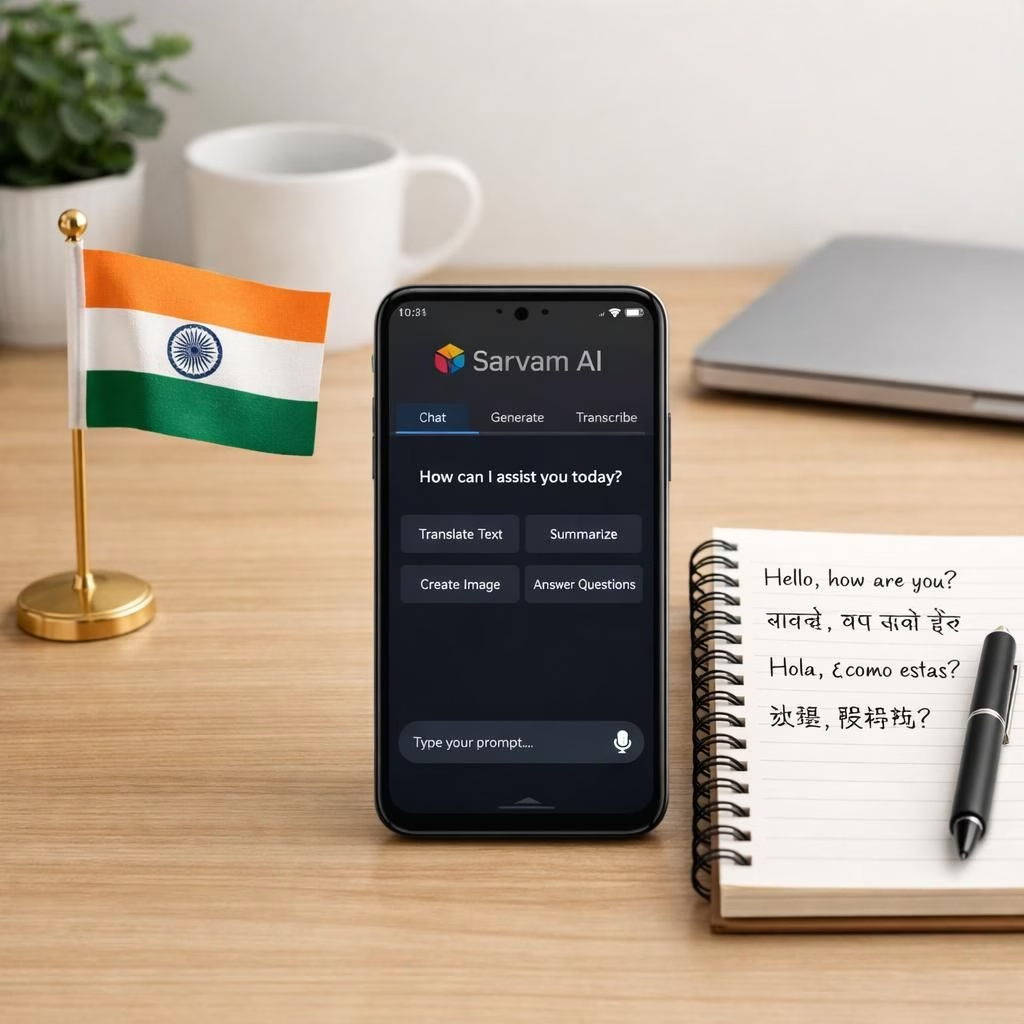
At the Tag B 2026, Sundar Pichai offered a rare compliment to Sarvam AI, praising its focus on Indian languages and local models. The developer energy in India, he observed, is bar none; the entrepreneurial ecosystem is thriving. With that vibe in the air, Sarvam AI emerges not as a flashy novelty but as a practical case study in how language and context drive scalable AI. The headline from the summit wasn’t just about splashy demos; it was about an ecosystem that sees language as a feature, not an afterthought, and about a startup that translates that belief into real-world capability. In this moment, Sarvam AI is positioned as a bridge between global ambitions and local needs, and the Tag B is its stage. Sarvam AI and the Tag B are not just buzzwords; they’re a signal that language-aware AI can thrive in India’s diverse digital landscape.
Sarvam AI: Language-first AI frontier
Sarvam AI’s architecture is purpose-built for a multilingual nation. The model is trained on 22 official Indian languages, spanning financial documents, literature, newspapers, and historic texts. The on-device footprint is crafted for practicality: a 74-million-parameter speech model fits into roughly 294 MB, and a 24-million-parameter speech synthesis model sits at about 60 MB. The system can automatically detect the language being spoken and run at about 8.5x real time, delivering a time-to-first-token under 300 milliseconds on a Snapdragon 8 Gen 3. Translation continues to scale with a 150-million-parameter on-device model occupying around 334 MB, enabling bidirectional translation across 110 language pairs, including 10 Indian languages and English. This isn’t just clever engineering; it’s a deliberate effort to keep AI usable where users live and work. You can learn about the Snapdragon 8 Gen 3 capabilities here, and see how large-language models like Gemini 3 Pro set benchmarks in broader AI tasks. The translation layer uses a 150M-parameter model with 334 MB on-device footprint to support 110 language pairs, including 10 Indian languages and English.
- Multimodal vision-language: integrated image understanding for captioning, chart interpretation, and table analysis.
- Document understanding focused on Indian languages: high-accuracy OCR and knowledge extraction across scripts.
- Charts and data interpretation: visual analysis that goes beyond plain text.
- Multilingual visual processing: handling visuals across multiple languages in the same document.
- Leading performance: benchmarks like the Sarvam Indic OCR Bench demonstrate strong results for Indian languages.
- Accessible API: production-ready document intelligence APIs available for exploration, including a February 2026 free tier for experimentation.
The effort isn’t just about talking points; it’s about a practical toolset that respects the state of Indian scripts and the realities of mobile devices. When you’re focused on 22 languages, you don’t get to pretend that one size fits all. Sarvam AI leans into complexity, then packages it into a form that developers and end-users can actually use. This is the kind of engineering that quietly shifts the baseline for what everyday AI can do in a multilingual country.
India AI Impact Summit-backed momentum
What sets Sarvam AI apart from models like Gemini or ChatGPT is not just the languages it prioritizes, but the way it handles inference at a lean scale. The team emphasizes English performance but keeps Indian languages as first-class citizens, achieving higher accuracy on regional scripts. In practice, this means a model trained in 22 Indian languages can extract more meaning from documents with scripts that folks in India actually encounter every day. The result is not a niche tool but a robust document-understanding system that aligns with India’s administrative, educational, and cultural contexts. It’s a reminder that the global AI conversation can benefit from local specialization without sacrificing interoperability.
Sarvam AI’s on-device inference approach makes it practical for user devices. The 74M-parameter speech model, coupled with the 60 MB 24M-parameter TTS module, means offline use isn’t a fantasy. The bidirectional translation across 110 language pairs and on-device footprint around 334 MB for the translation model keeps latency in check and privacy in focus. The result is an AI assistant that can understand, translate, summarize, and even narrate content in regional tongues, with a footprint that respects device constraints. For developers, the on-device promise translates into lower server costs and better offline resilience—something the Indian market has long desired. For users, it means meaningful, language-grounded AI features that feel native rather than borrowed from a global template.
Sarvam AI features in plain terms
Some quick highlights: a 3B-state-space model that remains inference-efficient, a document intelligence stack that favors Indian languages, and a benchmark suite that tests the model on realistic, language-rich tasks. The on-device translation enables working across languages without routing through an intermediate language, a small but meaningful design choice that reduces error propagation and simplifies workflows. Sarvam AI’s data pipeline includes high-quality datasets spanning official texts, historical archives, newspapers, and literature—precisely the sort of material needed to build reliable language understanding in context-rich scenarios.
India AI Impact Summit and the practical AI revolution
The February 2026 window promises a free Document Intelligence API, enabling practitioners to experiment at scale with Sarvam Vision. That kind of access matters because it lowers barriers to entry for startups, researchers, and public sector projects that want to test language-aware document understanding in real-world settings. In short, the combination of a strong regional focus with accessible tooling is the kind of practical innovation that accelerates adoption. It’s not merely about novelty; it’s about building a foundation that others can extend, in India and beyond.
What this means for developers, businesses, and the public
For developers, Sarvam AI offers a platform where 22 Indian languages are not an afterthought but a core capability. For businesses, the on-device footprint and multilingual capabilities translate into better user experiences, lower latency, and improved privacy. For the public, this means AI that can engage with texts, speech, and visuals in languages people actually use, not just the ones that look good on a whiteboard. The result is a more inclusive AI ecosystem that respects linguistic diversity as a strength, not a complication.
In sum, the Sarvam AI story is less about a single breakthrough and more about a deliberate, scalable approach to multilingual AI. The India AI Impact Summit has served as a validating stage, turning a regional capability into a case study with global resonance. If you want AI that understands India’s languages, scripts, and cultural contexts, Sarvam AI is a compelling example of what thoughtful localization and efficient design can achieve.
Source: Times of India — Original article on Sarvam AI and the India AI Impact Summit.
Have thoughts or questions about how language-aware AI can reshape India’s digital landscape? I’d love to hear your take in the comments below.
FAQ
-
What languages does Sarvam AI cover?
The model is trained on 22 official Indian languages plus English for translation tasks, enabling broad regional coverage across scripts such as Devanagari, Bengali, Tamil, and more. -
Is Sarvam AI on-device capable?
Yes. It runs a 74M-parameter speech model on-device (about 294 MB) and a 60 MB TTS module (24M parameters), supporting offline use with low latency. -
How does the OCR perform for Indian scripts?
Sarvam AI features high-accuracy OCR tailored to 22 Indian languages, along with robust knowledge extraction from scanned documents and historic archives. -
How can developers access the API?
The Document Intelligence API is free for February 2026 to encourage experimentation with Sarvam Vision; sign-up details are provided on the platform.
References
- Times of India article: https://timesofindia.indiatimes.com/technology/tech-news/explained-what-is-indias-sarvam-ai-model-that-google-ceo-sundar-pichai-is-quite-impressed-with/articleshow/128540072.cms