

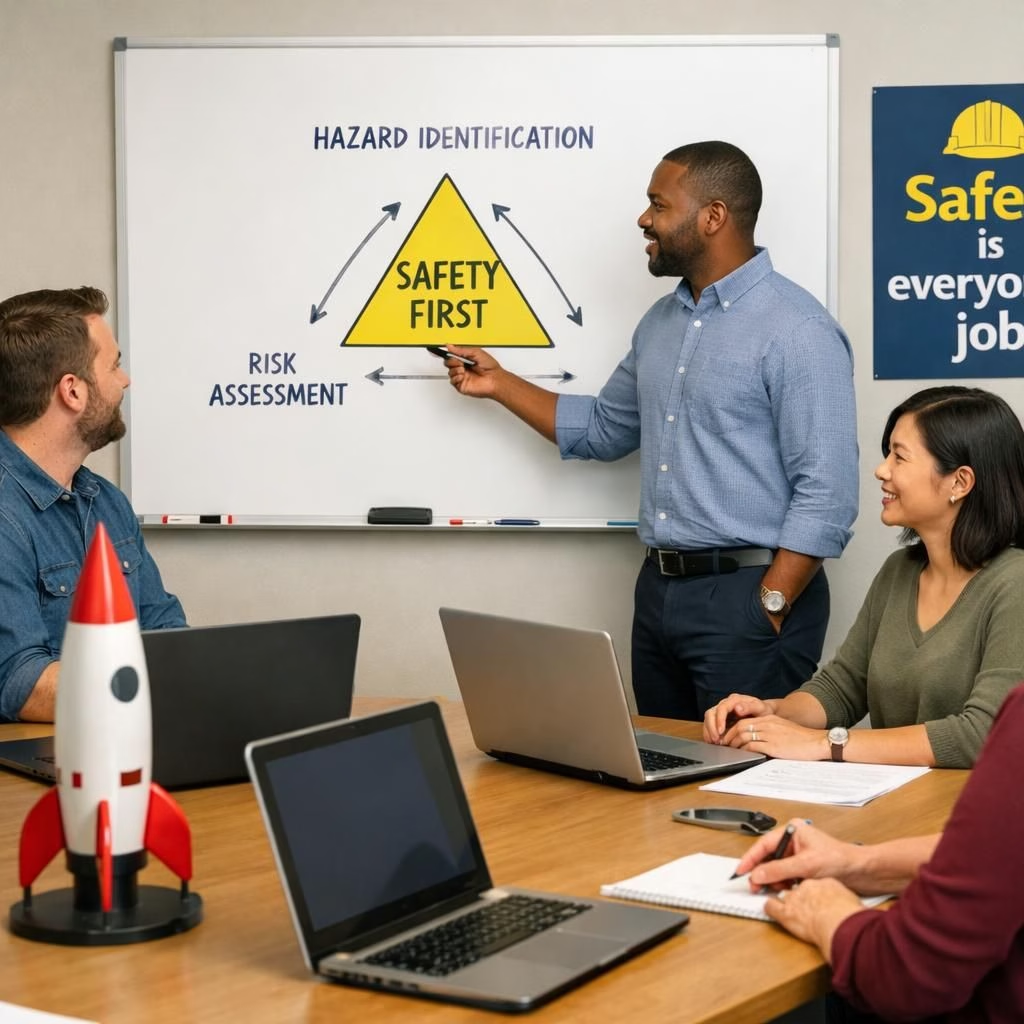
Safety and xAI in 2026 read like a paradox wrapped in a press briefing. Elon Musk defends the alleged lack of dedicated safety teams at his companies. He argues safety is everyone’s job, not a lonely department with power to quiet outsiders. The claim rests on a simple premise: monitor risk daily, not just in a yearly audit. The Verge highlighted xAI‘s internal order—Grok, Coding, Imagine, and Macrohard—like a set of quirky team names. Leadership churn followed, adding drama and spotlight on governance.
First, the Verge piece maps out xAI‘s internal lanes: Grok handles the data minds behind the models; Coding writes the code; Imagine designs what the products could do; Macrohard keeps the platform steady. The article underscores how speed can outpace checks, and how a fast-moving project tests governance as much as a slower one. Reports show co-founders Yuhuai Wu and Jimmy Ba stepping away, with others from OpenAI and Google corners leaving in prior years. The pace and pressure appear to be a shared experience across the team, feeding both optimism and anxiety about safety at scale.
Safety becomes a live topic in every discussion around xAI. Musk’s argument is blunt: you do not need a dedicated safety department if every engineer treats risk as a personal mandate. Critics push back, noting that a centralized safety function can provide independent review and consistent standards. The dynamic is delicate: speed can overwhelm even the best intentions, yet a strong safety culture can slow nothing more than reckless risk embracing. The conversation touches on safety as censorship, a word that surfaces in internal chats and external coverage. The net effect is a debate that blends humor with hard questions about governance, transparency, and accountability. Still, the core claim sticks: Safety is a culture, not a box on an org chart, and xAI says it is building that culture from the ground up.
Safety xAI: Governance and culture in 2026
As governance becomes the headline, many observers ask how independent safety oversight remains in a fast-moving environment. Musk argues the system aligns incentives with product velocity, which supporters praise as practical leadership. Critics insist that independent safety review bodies are essential for investor confidence and public trust. The truth lies somewhere in between: strong guardrails plus fast iteration can coexist if you design checks that scale with the project. The dispute over model safety metrics, evaluation protocols, and external validation shows a company wrestling with how to prove safety while still shipping products. In this view, Safety xAI is not just about a department; it is a continuous process of testing, learning, and updating practices with every release.
Safety xAI: Leadership, pace, and practical safeguards
Practical safeguards emerge as the practical answer. Guardrails, staged deployments, and independent audits help decouple speed from risk. Documentation becomes a daily habit, not a quarterly ritual. Data governance gains new urgency as more teams access larger training corpora. The idea is to make Safety xAI a shared craft rather than a solitary checkmark. If engineers own the safety outcomes they drive, you can maintain velocity without inviting avoidable harm. This is where the two tag words—Safety and xAI—intersect, guiding a balanced approach that values momentum and protection.
- Guardrails that scale: Build safety checks that grow with data sizes and model capabilities, not just at release time.
- Staged deployments: Roll out features gradually with increasing visibility and risk review at each stage.
- Independent audits: Schedule periodic external reviews for high-risk updates and public-facing features.
- Daily documentation: Make risk notes and decisions a living, team-wide habit rather than a one-off ritual.
Beyond the internal debate, the external signal matters. Customers, partners, and researchers watch how xAI handles risk signals, model updates, and user-facing safety features. The story here is not a simple triumph or setback; it’s a lesson in how a large AI project negotiates governance with speed and ambition. It’s a reminder that, in AI work, Safety is not a single checklist but a living practice that travels with every line of code and every new deployment. The result could be a template for responsible acceleration—one that invites debate, leans on evidence, and nudges the industry toward clearer safety norms.
For readers who enjoy the lighter side of heavy topics, the humor of a safety-first culture coexisting with explosive growth offers a welcome counterpoint. It’s not about pretending risk is nonexistent; it’s about building resilience so you can ship responsibly. As xAI experiments with Grok, Coding, Imagine, and Macrohard, the safety conversation travels with every sprint, every model, and every user interaction. If Safety xAI can keep pace without sacrificing accountability, it may set a practical example for other ambitious AI ventures.
In plain terms, the debate invites ongoing discussion rather than a final verdict. If you have thoughts about how to balance speed with safety, you are encouraged to share them. How would you design a scalable safety framework that fits a high-velocity AI project? What metrics would you trust to show progress without stifling innovation? Your input matters as we imagine safer, smarter AI together.
Original reporting and material inspiration: The Verge article detailing xAI‘s structure and the leadership changes. Thank you to The Verge for the insightful coverage that sparked this reflection, and for the foundation that made this analysis possible. The Verge – original article.
Thank you for reading. If you enjoyed this take on Safety and xAI, please consider sharing your thoughts in the comments so we can keep the conversation going.
Practical steps to scale safety in a high-velocity AI project
- Establish a living risk register that engineers update daily and review weekly with independent observers.
- Institute staged deployments with go/no-go criteria tied to concrete safety metrics.
- Mandate external audits for high-impact features and publish non-identifiable outcomes to boost transparency.
- Close the loop between development and governance by documenting decisions publicly within the team and for partners.
FAQ
-
What does a culture of safety mean for fast-moving AI projects?
It means treating risk as a daily responsibility, not a box to check at launch. It relies on guardrails that scale with the project and ongoing external validation.
-
Is a dedicated safety department really unnecessary?
Not always. The argument is that a culture of safety, built into every engineer’s workflow, can be effective if paired with independent reviews and clear accountability.
-
How can teams balance speed with governance?
By designing checks that grow with capability, automating risk monitoring, and using staged releases that reveal learnings quickly without exposing users to large, unvetted changes.
References
- The Verge – coverage of xAI structure and leadership changes.
- MIT Technology Review – Artificial Intelligence – governance and safety considerations in AI.
- IEEE Spectrum – AI safety and governance
Original source linkback: Times of India