

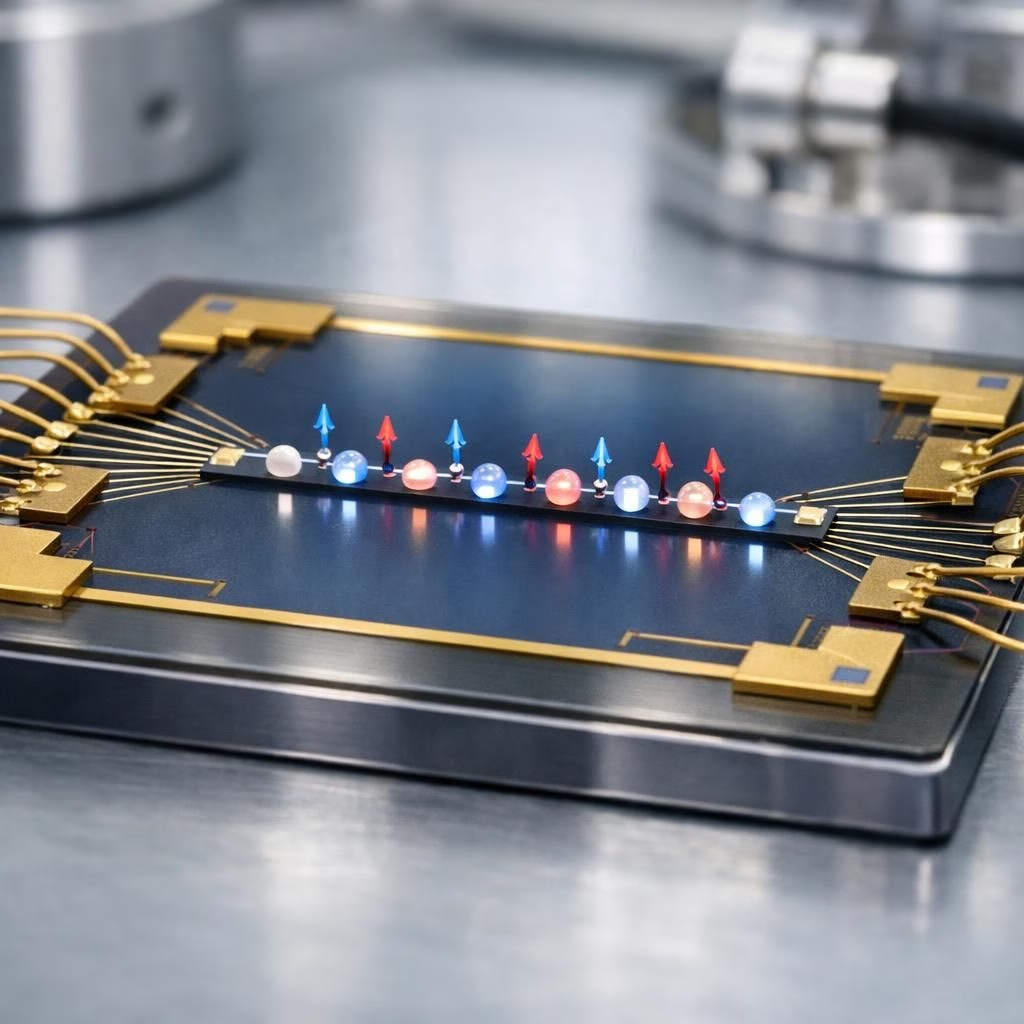
Welcome to a sunny look at quantum-dots and qubits, where the dream is to pair bulk manufacturing with flexible quantum error correction. The old divide in quantum computing often looks like a tug of war between mass-produced hardware and adaptable, room-for-change intuition. Some builders want to host quantum bits on chips we can churn out at scale; others prefer atoms or photons as the defining units for stability. The mid-2020s reveal a different beat: a pathway that could offer the best of both worlds.
quantum-dots in motion: moving spins and entangling qubits
A clever new paper by Delft University of Technology and QuTech shows quantum-dots can shuttle quantum information without a dramatic loss of coherence. A linear chip holds six quantum dots with single electron spins at the ends. By applying precise electrical signals, the spins slide along the dots, inching toward overlap. When the spins share space, two-qubit gates can entangle them, a cornerstone for building error-corrected logical quantum states. The result is a demonstration that you can physically move spins around in a scalable chip while preserving quantum information.
In the test device, two-qubit gates succeeded over 99 percent of attempts, and teleportation—moving a quantum state without moving the particle itself—worked about 87 percent of the time. Those fidelities aren’t the final home run, but they’re promising signs that the approach could evolve with further engineering, cooling, and smarter control. The team achieved this on a small device not optimized for performance, but the fidelity numbers already catch the eye of researchers and hardware makers alike.
Quantum-dots act like tiny electronic cages that hold an extra electron. The spin of that electron becomes the quantum bit when expressed as a usable state, controlled by gate voltages as if you were choreographing a crowd on a tiny stage. Compared to ion or neutral-atom quantum bits, quantum-dots fit neatly into chipmaking flows, but trade reliability for manufacturability and fixed connectivity. Still, the researchers argue that a single chip could carry dedicated storage zones and fast tracks for interaction zones, enabling entanglement and gates on demand. The result could be a scalable, compact path to larger quantum memories.
Like any other manufactured chip, the wiring that connects the quantum dots is locked into place during the chip’s manufacture. Since different error-correction schemes require different connections among the quantum states, this forces us to commit to specific error-correction schemes during manufacturing.
So, quantum dots appear to typify the trade-offs that we’re facing with quantum computing: it’s easier for us to make lots of quantum dots and all the hardware needed to manipulate them, but it’s seemingly not possible for them to benefit from the flexibility that other types of qubit realizations have.
The whole point of this new paper is to show that this isn’t necessarily true.
The new work was done in collaboration between researchers at Delft University of Technology and the startup QuTech. The team built a chip that had a linear array of quantum dots, and they started out with single electron spins at each end. Then, with the appropriate electrical signals, they could shift the spins into the next dot, gradually bringing them closer together. (And, by gradually, we mean a fraction of a second here, but relatively slowly compared to basic switching in electronics.)
Once the electrons were close enough, the spin wavefunctions overlapped, allowing the researchers to perform two-qubit gates on them. These manipulations can be used to entangle the two spins and are thus needed to build error-corrected logical quantum states; these gates are also needed for performing calculations.
The researchers then confirmed that they could move the electrons back to their starting positions, after which measurements confirmed that their spins were entangled. And since quantum teleportation also requires a two-qubit gate, they showed that the process could be used for teleportation. Teleportation can enhance the sort of mobility provided by moving the qubits around, since it can be used to move states around after the qubits have been widely separated.
(Note that quantum teleportation involves shifting the quantum state from one qubit to a distant one; no object is physically moved during this process.)
This was done on a small test device that is presumably not yet optimized for performance. But the operations were done with pretty reasonable fidelity. The two-qubit gates were executed successfully over 99 percent of the time, while teleportation succeeded about 87 percent of the time. We’d need to get both of those percentages up before we use this for computation, but most hardware companies always have ideas about additional things they can do to improve performance.
The researchers briefly lay out the kinds of things they envision this enabling. In this system, there are a bunch of dedicated storage zones where quantum states can live when they’re not being used for operations. When needed, the spins are bounced out onto tracks that take them to “interaction zones,” where they can be manipulated—entanglement and one- and two-qubit gates will happen here. And connectors will allow the quantum states to move onto different tracks to enable longer-distance interactions.
Practical implications for developers
- Design chips with separate storage zones and fast interaction tracks to enable on-demand entanglement.
- Plan connectors that allow re-routing to increase connectivity without major redesigns.
- Integrate bulk-manufacturable control electronics with the quanta path to keep the system compact.
- Prepare for swapping error-correction schemes as architectures evolve, without starting from scratch.
FAQ
-
What are quantum dots?
Quantum dots are nanoscale semiconductors that confine electrons in tiny regions. On a chip, the electron’s spin can serve as the basic unit of information, a natural fit for scalable manufacturing.
-
Why move spins along a track?
Moving spins along predefined paths aims to connect many qubits on a single chip with a reconfigurable network, reducing the need to build a different chip for every error-correction scheme.
-
When could this become real hardware?
Even with promising fidelities, real devices will require many engineering advances. Expect a multi-year horizon as researchers optimize materials, control electronics, and error-correction overlays.
-
How does this compare to other approaches?
This path aspires to combine the manufacturing advantages of solid-state devices with flexible connectivity often associated with other qubit platforms, but it remains early in the development cycle.
Further reading and official participation in the broader field can be found in external sources below, which provide context about current quantum hardware directions and the growing role of quantum dots in research and industry.
External sources
- Nature: Quantum dots and qubits collaboration
- IBM Quantum: Building real-world quantum systems
- NIST: Quantum information science overview
References
Note: The research appeared in Nature, 2026, with the DOI 10.1038/s41586-026-10423-9. The work came from Delft University of Technology and QuTech—an excellent example of industry and academia teaming up to push hardware boundaries.
We’re not there yet. But if the numbers keep improving, and if the architecture scales, quantum-dots could offer a path to a more connected, more compact quantum future where quantum information carriers talk to each other with fewer headaches.
If you enjoyed this bright-side take on quantum-dots and quantum information carriers, tell us what you think in the comments. We’d love to hear your bets on when this becomes practical hardware.
Original research credit and thanks: Special thanks to Delft University of Technology and QuTech for the original material; for the full article see Nature, 2026. Link: Nature article: Quantum dots and qubits collaboration.