

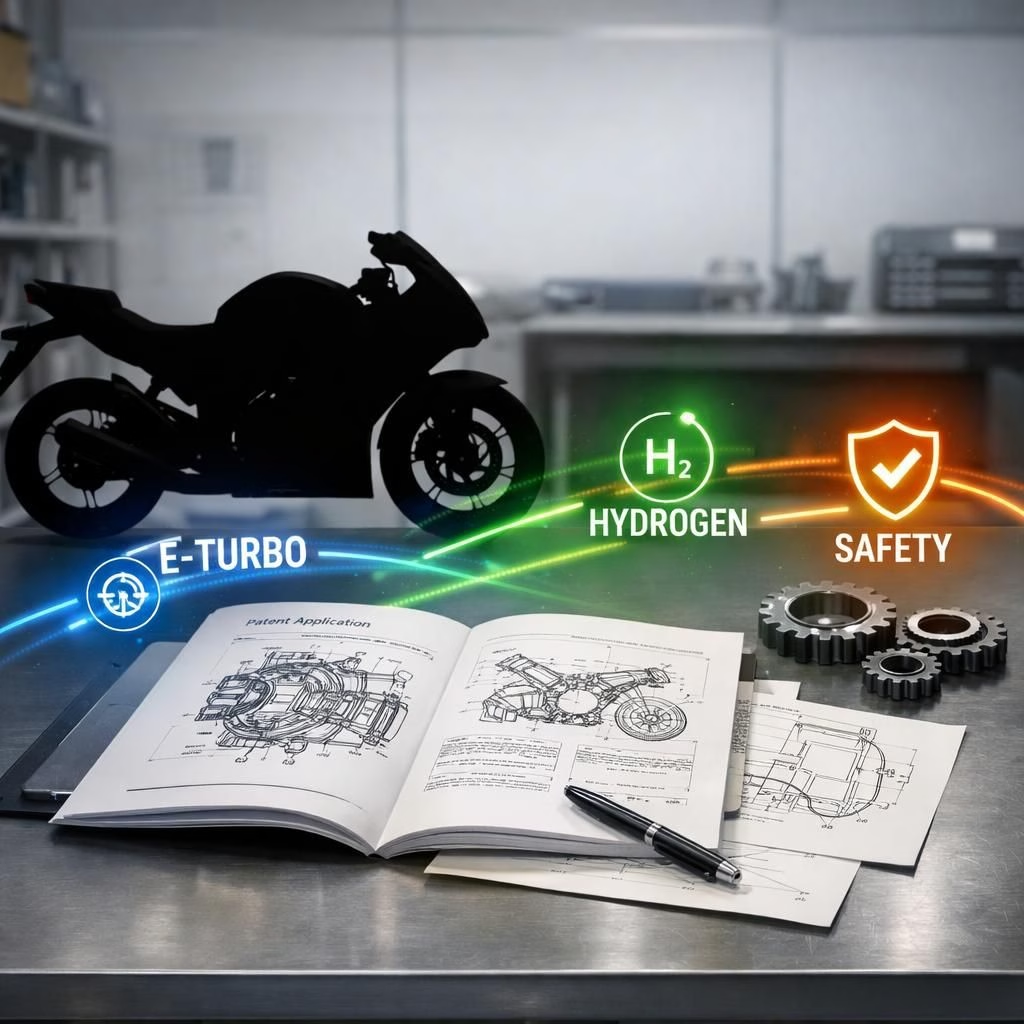
Patents and Motorcycles collide in 2026 as brands test E-turbos, hydrogen, range extenders and smart safety across the spectrum. This article acts as a central hub for readers who want to understand how patent filings map to real-world riding. The big idea is simple: patents reveal intent, and intent shapes the bikes we may see on roads later this decade. When a company files a detailed patent with diagrams, numbers, and reference models, it signals a concrete research path rather than a mere concept. In short, patents illuminate Motorcycles, and Motorcycles look to patents for tomorrow’s torque, aerodynamics, and safety tech. The discussion here translates dense legal sketches into a readable forecast, helping riders, builders, and enthusiasts spot where practice meets possibility. Expect electric assist, smarter aerodynamics, and safer riding to crop up long before the first production bike wears the new badges. The pattern is clear: thorough patent work often points toward plausible production paths, even if some ideas stay in the lab or on test benches for longer than expected.
Patents and Motorcycles: A 2026 Roadmap to E-Turbo, Hydrogen, and Safety
Kawasaki has shown that hydrogen bikes are not a sci‑fi dream but a research direction. A hydrogen motorcycle based on the H2 four‑cylinder engine has patents proposing extra tanks to extend range. The concept remains a demonstrator; production viability hinges on refueling infrastructure and the overall bike size. In parallel, Yamaha’s electrically assisted turbocharger, or E‑turbo, blends an exhaust gas turbine with an electric motor to drive the compressor at low engine speeds, dramatically reducing turbo lag. Yamaha traced a three‑cylinder prototype with 847 cc and 180 hp back in 2020, and the patent suggests a production‑ready path awaits the right balance of price, weight, and cooling. KTM counters with a hybrid compressor that marries crankshaft torque and electric drive to keep weight down while proving that a compact battery can support performance. These entries show that the industry tests multiple routes before choosing one path to mass production. For riders, this means multiple options could appear based on bike category, market, and infrastructure readiness.
Beyond these headline technologies, the patent ecosystem signals a broader shift: the industry experiments with how power, weight, and packaging interact. Hydrogen concepts emphasize range expansion, while E‑turbo ideas emphasize responsive throttle feel without the burden of large‑capacity fuel systems. In practice, this means manufacturers study how a bike’s center of gravity shifts with new propulsion or energy storage. They also test cooling strategies, heat management for compact electronics, and how to integrate control software with ride‑by‑wire interfaces. The result is a catalog of feasible steps toward cleaner or smarter propulsion, rather than a single silver bullet. This variety helps explain why you might see a hydrogen prototype on one brand’s stage and a compact electric compressor on another’s—both pursuing a common goal through different means.
Patents and Motorcycles: Hybrid and Electric Innovations in the Real World
Range anxiety does not vanish in patents, but manufacturers are borrowing clever tricks. KTM’s modular range extender attaches like a top case and can house a small internal combustion engine, a fuel cell, or extra batteries. That modular approach lets riders tailor range to use cases, from weekend rides to long trips in regions with sparse charging. Honda keeps costs in check with a simple electric motorcycle design: steel frame, front drum brake, removable battery—clearly aimed at price‑sensitive markets where reliability matters more than top speed. CFMoto pushes weight reduction with a load‑bearing battery that doubles as a structural element in a light sports bike. Yamaha goes further with a controversial idea: a “fake engine” in an electric motorcycle that generates vibration and exhaust‑like sounds using resonators to recreate that familiar riding feel. These patterns show how patents influence practical design choices, especially when engineers balance performance with manufacturability and serviceability.
Safety continues to rise inside patents. Honda’s active steering system detects an imminent collision using a camera and a controller, then supports or even takes over steering to steer away from danger. Yamaha explores smarter airbag systems with accelerometers placed both in front of and behind the center of gravity to detect crashes in fractions of a second. The visualizations in the patent drawings reveal how sensors, actuators, and control software could cooperate to protect riders without turning the bike into a rigid automated assistant. The end goal is a bike that feels intuitive to the rider while offering an extra layer of protection when the ride gets unpredictable.
Patents and Motorcycles: Aerodynamics and Chassis Innovations for the Future
Aerodynamics moves beyond simple winglets. BMW has filed patents for rotating Flettner rotors that adjust lift and downforce on demand. The concept uses the Magnus effect and can be turned off when not needed. Aprilia brings MotoGP influence to the street with leg wings that live near the rider’s legs. The aim is to improve stability and reduce drag in real riding situations, particularly at highway speeds or during aggressive cornering. In chassis tech, active swingarms, anti‑dive electronics, and carbon frames without a separate swingarm push the envelope. Yamaha’s swingarm with variable geometry can adapt traction and handling electronically, while BMW explores a one‑piece carbon frame with the swingarm integrated directly into the frame. These moves show how the bike’s skeleton can be re‑imagined to shave weight, tune rigidity, and improve feedback.
The patent landscape also reveals practical, sometimes quirky, designs. Zongshen works on hub‑center steering with servo drive, offering a different steering feel than traditional forks. Meanwhile, the industry continues to refine traditional engines: Honda’s pre‑chamber ignition concept promises higher efficiency in lean mixtures, and there are hints of a V4 revival for potential future models. Yamaha and others also signal a simplified semi‑automatic transmission that asks less of new riders while reducing drivetrain weight. This blend of high concept and grounded ideas shows why patents are both a compass and a catalog of what riders may notice on a daily ride without needing a full‑blown track day to realize the potential.
Not every patent becomes a product. Some functions exist mainly to protect IP or to block rivals. Yet the best patents tend to march toward production, especially when they land close to existing platforms. The more detailed the patent and the more it relates to a current model, the likelier a production concept will appear. The path from patent filing to showroom bike is rarely linear, but it happens with enough persistence and tested assumptions. In 2026, the trend lines clearly show Patents guiding Motorcycles across multiple trajectories: electrification, hybrids, hydrogen, and intelligent safety. Brands will experiment with different architectures, not just to gain speed or efficiency but to improve the entire riding experience. And if you’re curious about the big picture, remember that patents tell a story about what engineers believe is feasible—and which ideas will require more time and testing before hitting the street.
Original material and thanks to Motorcycles.News for the excellent source material: https://www.motorcycles.news/en/motorcycle-patents-future-technology/
We invite you to share your thoughts in the comments below and tell us which patent idea you’d actually like to see on your next ride.
Patents and Motorcycles in Practice
- Read a patent with an eye for how close it sits to an existing model or platform.
- Ask: would this tech require a new battery or a new cooling concept?
- Consider market readiness and the infrastructure needed to support a new propulsion path.
FAQ: Patents, Motorcycles and the road ahead
- What does a motorcycle patent actually mean for riders?
- It signals a research direction and shows what manufacturers are pursuing. It may become a feature in future bikes if tested, refined, and proven in markets with the right support infrastructure.
- Will all patents become production bikes?
- No. Many patents mark speculative concepts or defensive IP moves. Only those closely aligned with current platforms and proven in testing tend to reach showrooms.
- How can I gauge which patent ideas might hit the street soon?
- Look for detailed filings near existing models, close part numbers, and reference bikes. Those are stronger indicators of near‑term production paths.
References
- Original source: Motorcycles.News — https://www.motorcycles.news/en/motorcycle-patents-future-technology/
External sources for context on patents and innovation: