

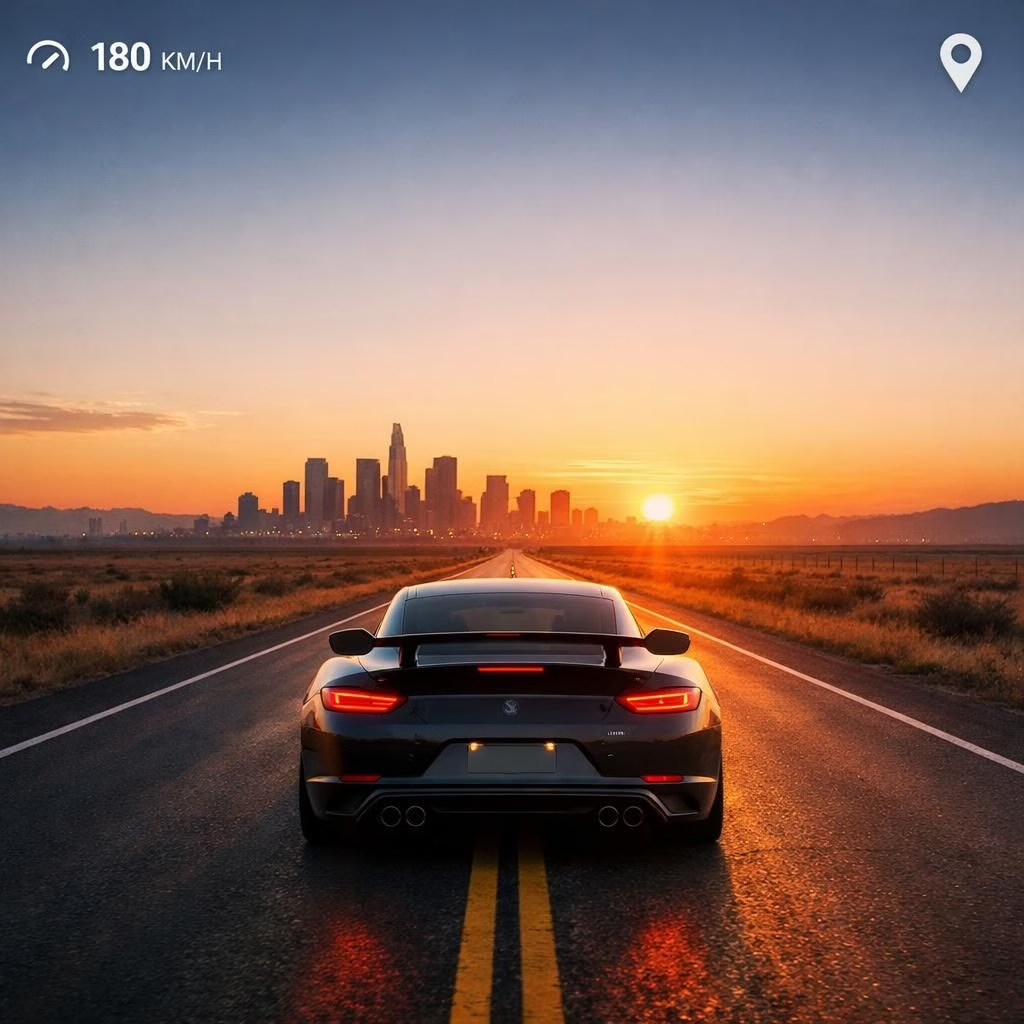
open-world racing returns with Clutch, a cinematic AAA title from an ex-Forza Horizon 5 director, arriving in 2027. This piece breaks down why the reveal matters, what we know so far, and how studios are reshaping the open-road sandbox into something both dazzling and snackable for gamers and publishers alike.
open-world Racing Clutch Steps Into the AAA Spotlight
Clutch is steered by a team with proven lineage in the genre, notably a former Forza Horizon 5 creative director at the helm. The project name signals ambition: a cinematic feel, a living world, and a driving experience that blends spectacle with something more grounded than a pure arcade sprint. Reports from Game Informer, Traxion.GG, The Drive, Pure Xbox, and IGN hint at a game that treats its open-world as a canvas rather than a backdrop. The emphasis isn’t just on speed; it’s on mood, pacing, and the feel of a world that responds to every nudge of the steering wheel. If you crave a racing experience with depth, Clutch aims to deliver while still providing the visceral thrill fans expect from a modern AAA title.
open-world Racing Vision: From Forza Origins to Clutch’s Open-World Scope
The shared threads across early coverage sketch a game that blends open-world exploration with precise driving. The ex-Forza Horizon 5 director’s new project leans into cinematic scope, using a defined narrative arc without abandoning the open world players love to roam. The discussions emphasize scale: a world that invites you to explore, take detours, and discover challenges that feel organic rather than seeded. This is not just a track day in a glossy environment; it’s a deliberate attempt to fuse place with the immediacy of a fast drive. The result could be a racing experience that rewards curiosity and experimentation as much as timing and reflexes.
In the context of 2026 game development, the timing also matters. The industry has spent the last few years redefining what an open-world game can be for a racing property. Studios experiment with weather systems, day-night cycles, and AI that behaves like a living city rather than scripted encounters. Clutch appears to be part of that wave, aiming to keep the action kinetic while injecting moments of strategic choice—whether you’re chasing a lead on a winding mountain pass or making a calculated sprint through a neon-lit downtown corridor.
From a design standpoint, the balance between open-world freedom and driving discipline is delicate. Too much freedom and you dilute the thrill of a clean lap; too much constraint and the world feels fictional or manufactured. The early disclosures suggest Clutch intends a middle path: a world that feels real enough to suspend disbelief, yet malleable enough to let your pilot’s voice come through. It’s a tough line to walk, but recent projects have shown that players respond to games that respect their agency while offering a cinematic tempo that stays memorable after the credits roll.
Several features often associated with modern open-world racing show up in rumors and early descriptions: varied biomes with distinct textures and challenges, dynamic weather that influences traction, and a city that breathes as you navigate it. The promise of a believable physics model adds credibility to the developers’ claims that Clutch will reward practice and experimentation. These are not formal promises; they are what the industry is testing as the baseline for next-gen racing experiences. If Clutch nails the physics, it could become a showcase for how an open-world can feel cohesive rather than sprawling for the sake of scale.
Beyond the technical aims, Clutch has a cultural hook that excites observers: a racing game where you also do crimes. The Drive’s phrasing invites curiosity about tone and narrative perspective. How will a crime mechanic integrate with driving duties? Will it be a mission-based detour, a side hustle that bleeds into your main grind, or a moral choice that shifts reputations and alliances in the world? A game that blends chase sequences with moral travel pauses promises a different rhythm from conventional racing games. If done well, this approach could broaden what people expect from a racing game in a cinematic era where a story and a sense of consequence carry as much weight as speed and control.
In practical terms, this means Clutch could be more than a showcase of visuals. The challenge is to keep the pace brisk while layering meaningful decisions into the road ahead. The balance matters because the driving segment must feel earned and not simply decorative. If the development team can keep the momentum while inviting players to explore, the title might set a new standard for how an open-world racing game can behave like a living movie rather than a static playground.
From a consumer perspective, players are hungry for experiences that blend spectacle with substance. The early chatter around Clutch suggests the team is listening—aiming for a product that respects the player’s time and intelligence. The project’s stated window of 2027 is ambitious, but the industry has shown resilience for big bets when the design aligns with player expectations. In a sense, Clutch embodies a broader trend: the desire to push AAA boundaries without sacrificing the human touch that makes a game memorable. If they pull this off, the result could be a racing experience that feels accessible on day one and deeply rewarding for veterans who crave nuance and risk-taking on the highway of virtual open-worlds.
For folks following the business side, this move sits at an intersection of franchise heritage and new-player onboarding. A former Forza Horizon 5 creative director returning to lead a new project signals confidence that the core audience will respond to a familiar language—tight controls, confident handling, and a glossy, cinematic veneer—while the open-world expansion offers fresh surfaces to discover. The potential cross-pollination with Xbox and partner studios could help Clutch reach a broad audience without sacrificing the craftsmanship that marks ambitious open-world projects. It’s a storytelling pivot as much as a gameplay one, and that matters in a marketplace that rewards both spectacle and thoughtful design.
As we watch 2026 unfold, industry coverage will likely refine how to present a title like Clutch to the public. The behind-the-scenes discussions emphasize polish, photorealistic textures, and a world that responds in real time to weather, traffic, and player decisions. The fascination isn’t simply the idea of a car navigating a city; it’s the sense that the world itself becomes a character with quirks, boundaries, and opportunities. If Clutch translates that energy into a playable experience, it could join a growing catalog of racing titles aiming to blend spectacle with substance.
In short, Clutch isn’t just about speed; it’s about storytelling velocity. The core premise—open-world, cinematic racing with a twist—has potential to stand out if the execution respects both the thrill of the drive and the player’s intelligence. Whether you’re a casual driver who enjoys a scenic detour or a veteran who spots soft spoilers along the road, Clutch promises a ride that could redefine what an open-world racing game can be in the mid- to late-2020s.
Thanks to early reporting from Game Informer, Traxion.GG, The Drive, Pure Xbox, and IGN, we have a strong sense of the ambition behind Clutch. The project will evolve, but the seed of a cinematic open-world experience is clearly planted. If you’re excited about a racer that treats the world as a stage and the road as a canvas, Clutch deserves ongoing attention as we approach 2027.
Source and gratitude: a big thank you to the original coverage from Game Informer, Traxion.GG, The Drive, Pure Xbox, and IGN for laying the groundwork on Clutch. Your reporting helps fans imagine what’s possible when a veteran director returns to shape a new kind of open-world racing game. See the original pieces linked below for more context and direct quotes: Game Informer, Traxion.GG, The Drive, Pure Xbox, IGN.
Have thoughts about Clutch? Share them in the comments below and let’s see how you’d balance open-world racing exploration with the thrill of the drive.
Open-World Racing Clutch image concept from the team’s vision will come alive on screen as the project nears release, inviting players to test the balance between freedom and form. For now, we celebrate the announcement and speculate about the road ahead—with optimism, a dash of humor, and a strong belief that the best open-world racing games feel personal as well as panoramic.
Special thanks to the original article coverage and the creative teams behind Clutch. A heartfelt thank you also to the source materials from Game Informer, Traxion.GG, The Drive, Pure Xbox, and IGN for offering a window into this exciting project.
Source attribution: Game Informer | Traxion.GG | The Drive | Pure Xbox | IGN.
External insights
References
- Game Informer — Studio Founded by Forza Horizon 5 Director Announces Open-World Action-Driving Game
- Traxion.GG
- The Drive
- Pure Xbox
- IGN