

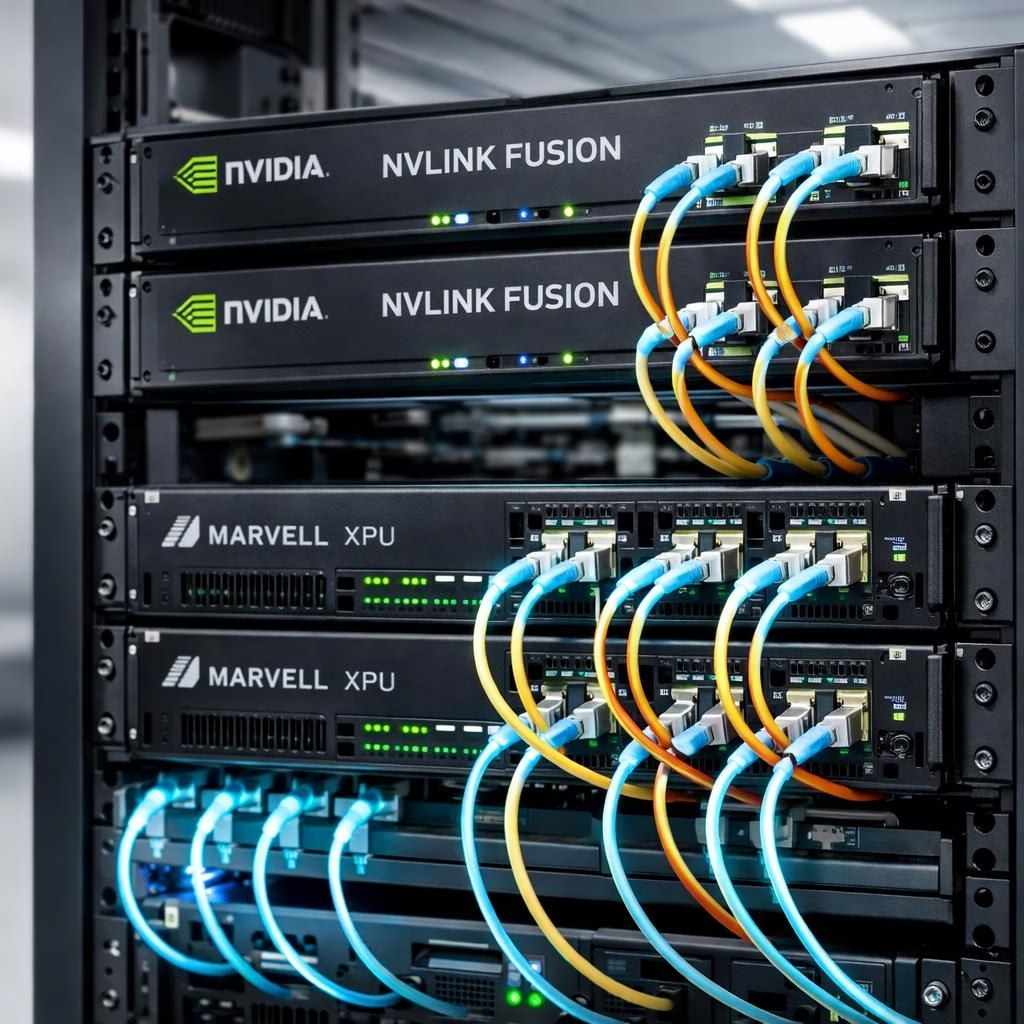
NVIDIA and Marvell announced a strategic partnership in 2026 designed to upgrade the AI data-center playbook. The idea is practical: NVLink Fusion stitches Marvell‘s XPUs to NVIDIA’s networking and CPU stack, making it easier for customers to assemble semi-custom AI infrastructure within the NVIDIA ecosystem. This isn’t a one-off hardware swap; it’s a deliberate, scalable collaboration where both companies bring their best chips to the same table, reducing compatibility drama at deployment.
The partnership centers on NVIDIA’s NVLink Fusion platform, a rack-scale approach that lets enterprises compose AI compute infrastructure with a mix of hardware while staying within a unified software and management layer. Under the arrangement, Marvell‘s XPUs and NVLink Fusion-compatible scale-up networking are contributed. NVIDIA supplies enabling technologies, including its Vera CPU, ConnectX network adapters, BlueField data processing units, NVLink interconnects, and Spectrum-X switches, so that customers can connect these parts without needing a chess master’s degree in system integration.
NVIDIA Marvell Collaboration: The NVLink Fusion Advantage
From a practical standpoint, the deal is about reducing friction and increasing performance density. By aligning Marvell XPUs with NVIDIA’s NVLink Fusion ecosystem, operators can expect faster time-to-value for AI workloads, smoother scaling for growing models, and a more predictable path for upgrades. The collaboration also makes it easier to design AI fabrics that mix general-purpose CPUs with specialized accelerators without rewriting the software stack. In other words, you won’t need to rewrite your entire AI training pipeline every time you add a new accelerator; you’ll just plug it in and let the software do the heavy lifting.
On the silicon side, the two companies talk up silicon photonics—optical interconnects that promise high-speed, energy-efficient data transmission. The optics lane is not a cosmetic add-on; it’s a critical piece of the performance puzzle when AI scales to multi-tenant, data-center-wide deployments. The synergy here is not merely theoretical: faster interconnects reduce bottlenecks between the accelerator pools and the storage or networking layers, which translates into tangible gains for inference throughput and training efficiency.
NVIDIA and Marvell XPUs, Photonics, and the Aerial AI-RAN Roadmap
Beyond the data center, the collaboration extends into telecommunications with NVIDIA’s Aerial AI-RAN platform for 5G and 6G infrastructure. The idea is to bring AI capabilities directly into the network edge, enabling smarter, more responsive mobile networks and easier orchestration of AI-powered radio access networks. This isn’t a fringe use case; it’s a signal that AI-enabled networks are moving from a nice-to-have to a must-have for service providers looking to deliver low latency, high-quality experiences at scale.
Jensen Huang, NVIDIA’s founder and CEO, framed the moment as an inflection point for AI inference—token generation demand is rising, and the world is racing to build AI factories. In his words, the partnership with Marvell helps customers leverage NVIDIA’s AI infrastructure ecosystem and scale to build specialized AI compute. Marvell’s chairman and CEO Matt Murphy echoed the sentiment, pointing to the growing importance of high-speed connectivity, optical interconnects, and accelerated infrastructure in scaling AI. The dual emphasis on connectivity and compute suggests a future where AI workloads can fluidly migrate across a fabric that remains seamless to the user, operator, and developer alike.
Market context matters here. The industry is eyeing a growing wave of AI infrastructure investment, with major players—Alphabet (Google) and Meta (Facebook) among them—expected to drive billions in related capex this year. Marvell itself has signaled a robust revenue trajectory, forecasting growth in the high single to low double digits for the near term and aiming for a substantial increase by fiscal 2028. These numbers aren’t promises; they reflect a sector-wide conviction that AI infrastructure is durable, expanding, not a sprint.
For developers and operators, the combination of Marvell XPUs and NVIDIA’s NVLink Fusion stack promises a more modular, future-proof architecture. The XPUs provide compute specialization where you need it most, while NVIDIA’s software and interconnects help ensure that those accelerators can be deployed, managed, and upgraded with relative ease. The silicon photonics work isn’t just a headline; it’s a practical effort to shrink latency across racks, which matters when you’re moving large language models or real-time AI workloads across a data center. In short, the NVIDIA Marvell alliance aims to deliver more speed, more efficiency, and more predictability for AI deployments, with a road map that looks increasingly productized rather than experimental.
From a governance perspective, the deal also signals a broader industry trend: the emergence of ecosystems around AI infrastructure that prioritize interoperability and scalable integration. As more vendors contribute specialized accelerators and high-speed interconnects, the value of a well-supported platform grows. The NVLink Fusion framework acts as a unifying layer, reducing fragmentation that often accompanies best-in-class components. This is good news for CIOs and data-center operators who want to avoid lock-in while still reaping the benefits of best-in-class hardware.
For customers, the practical upshot is straightforward: more options, more predictable performance, and a clearer upgrade path as AI models grow, evolve, and demand new kinds of compute. The collaboration between Marvell and NVIDIA isn’t about a single product release; it’s about a sustained architectural approach that respects the realities of complex AI workloads. It’s about turning ambitious AI goals into feasible, repeatable deployments that scale with business needs rather than outpace budgets.
To readers who follow the hardware heat: yes, the numbers and partnerships matter. But what matters more is how these pieces fit together in a functioning machine—the kind that can run complex AI workloads reliably, securely, and economically. The NVIDIA Marvell collaboration is a reminder that the best AI infrastructure stories aren’t about the loudest press release; they’re about the quiet, steady work of connecting accelerators, processors, and networks so that AI can actually scale in the real world.
We’d love to hear your take on this partnership. How do you see NVIDIA and Marvell shaping your AI initiatives in 2026 and beyond? Share your thoughts in the comments below.
Original article: A sincere thank you to the original source material for providing the basis of this rewrite. Full details and context can be found at the original article here: Original article (thank you to the authors and source).
Practical deployment steps
- Assess workloads and identify which AI tasks will run on Marvell XPUs and which on CPUs; align with NVLink Fusion capabilities.
- Map Marvell XPUs to representative models and data types; size the fabric accordingly.
- Design the network with NVLink interconnects and Spectrum-X switches; plan optical paths for multi-tenant traffic.
- Prototype in a pilot rack; measure throughput and latency; refine orchestration strategies.
- Prepare a staged upgrade plan for production, aiming for minimal downtime and smooth rollouts.
FAQ
- What is NVLink Fusion in simple terms?
- It’s a rack-scale framework that stitches accelerators, networking, and CPUs into a unified AI compute fabric, enabling easier scaling and management.
- What does the NVIDIA–Marvell partnership unlock for workloads?
- It enables faster deployment, better efficiency, and a clearer path to upgrade as models grow, while preserving software compatibility.
- Why are optical interconnects and silicon photonics important?
- They reduce latency and energy use between accelerators, storage, and networks, which matters for real-time AI tasks and multi-tenant data centers.
- When should organizations start piloting this approach?
- Early pilots can validate performance gains and interoperability; scale up as workloads mature and requirements solidify.
External sources
References
Times of India: https://timesofindia.indiatimes.com/technology/tech-news/nvidia-invests-2-billion-in-marvell-technology-to-make-custom-ai-chips-more-accessible-to-customers-read-ceo-jensen-huangs-statement/articleshow/129930942.cms