

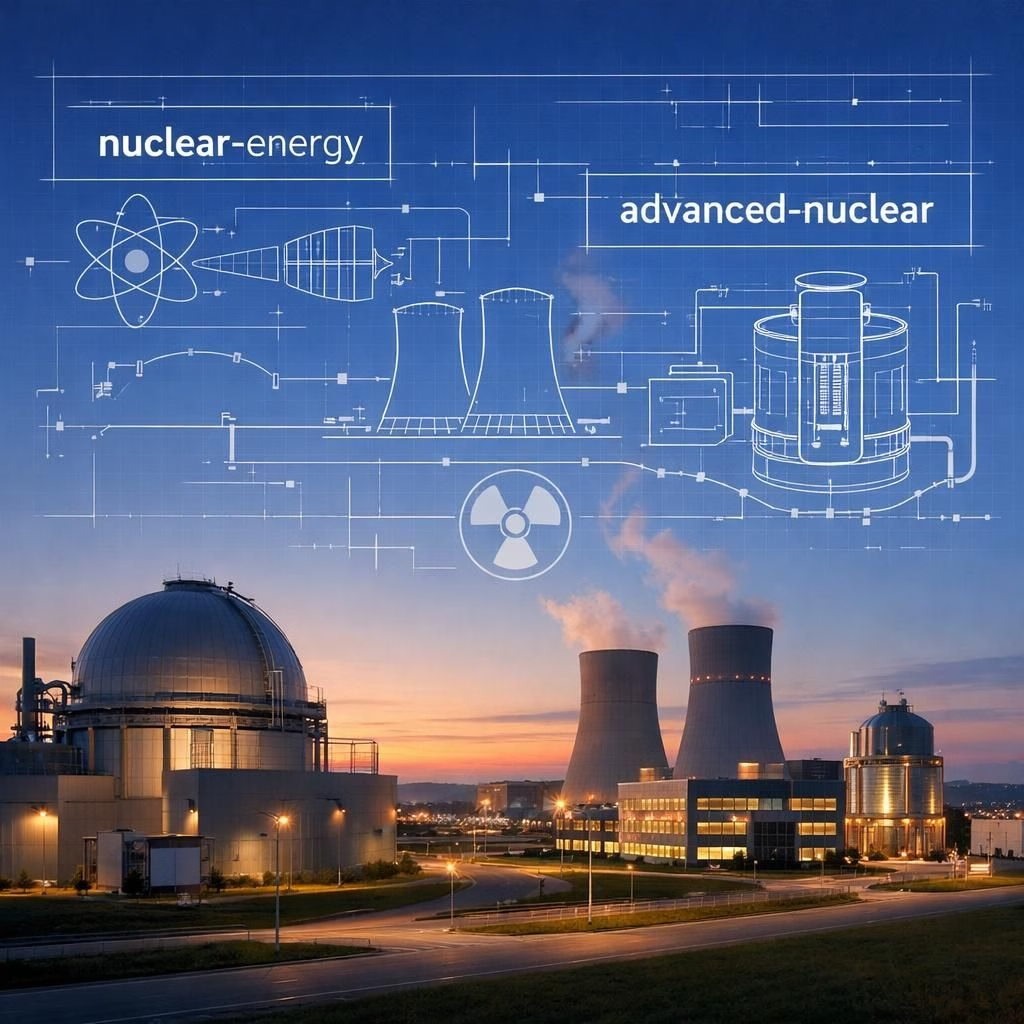
Welcome to a sunny, practical tour of how nuclear-energy and advanced-nuclear ideas are pairing private ingenuity with government know-how to move ideas from whiteboard to reality. This piece keeps the core truth intact: a smart Launch Pad can accelerate testing, regulatory alignment, and deployment of next-generation reactors and fuels. The mood is hopeful, the data is solid, and the tone is friendly enough for policy wonks and curious readers alike.
The platform helps private innovators by providing land, expertise, and regulatory support to bring next-generation nuclear solutions from concept to reality. It isn’t a fairy tale; it’s a carefully designed ecosystem that blends federal and non-federal resources so projects don’t stall on paperwork or site selection.
In collaboration with the US Department of Energy (DoE) and the National Reactor Innovation Center (NRIC), the Nuclear Energy Launch Pad was created to promote rapid development and deployment of advanced technologies by private industry. It builds on earlier programs, stitching together pilot experiences with scalable pathways to move ideas from demonstration to deployment with enough rigor to satisfy regulators and enough agility to keep pace with innovation.
nuclear-energy and advanced-nuclear Launch Pad: a private-public symbiosis
As one might expect, the Launch Pad centers on flexible, pragmatic frameworks. It couples technical testing with regulatory alignment, on both federal and non-federal lands, so developers can go from concept to a real-world facility more quickly than in traditional cycles. The goal is a robust ecosystem where success feeds more success, and where setbacks are treated as learning opportunities rather than deal-killers. Within this framework, the nuclear-energy landscape gains clarity and momentum.
Historically, the DoE has bundled pilot efforts into a cohesive path forward. The Reactor Pilot Program and the Fuel Line Pilot Program provide the scaffolding for testing and fuel supply assurance. Now, under the Launch Pad umbrella, these pilots evolve into a continuous, integrated process that keeps critical activities aligned—from siting to licensing to demonstration, with an eye toward eventual widescale deployment.
As of 2026, the initiative is designed to be practical and ambitious at once. DoE authorisation remains the anchor, while the NRIC focuses on evaluating and coaching applicants through a predictable, transparent process. This isn’t a one-off project; it’s a system designed to scale with the pace of private innovation while maintaining strong safety and regulatory standards.
In this new environment, the DoE has already welcomed a slate of pilot participants. The numbers reflect a growing appetite for responsible experimentation: eleven projects have entered the Reactor Pilot Program and nine into the Fuel Line Pilot Program. The aim is not to halt progress, but to extend the runway for testing, data collection, and regulatory feedback so developers can move from pilot authorisation to extended operational validation with confidence.
One participant captured the spirit: “The Launch Pad represents a significant evolution in the ecosystem for advancing nuclear technologies from concept to deployment.” The idea is straightforward but powerful: an 890-square-mile federal site with decades of reactor testing experience, ready infrastructure, and direct access to national nuclear expertise can dramatically shorten the path from demonstration to deployment. In practical terms, this means developers can focus more on technical breakthroughs and less on piecing together a compliant regulatory roadmap from scratch. For the broader advanced-nuclear deployments, the approach is equally enabling.
Two clear pathways exist for developers—Launch Pad Idaho National Laboratory (INL) and Launch Pad USA. INL offers access to over 2,000 acres spread across multiple plots, supporting advanced reactors, fuel fabrication, recycling, enrichment, and related innovations. The USA pathway builds on prior DoE pilot successes, enabling on-site authorisation for reactor and fuel-cycle facilities beyond INL’s fences. This dual-track approach widens opportunities and keeps competition healthy, while preserving safety and accountability.
INL’s leadership has been explicit about the value proposition. The director described the Launch Pad as providing unprecedented access to a national laboratory ecosystem: a large federal site with long-standing reactor testing experience, existing infrastructure, and streamlined regulatory pathways. All this is designed to accelerate deployment while keeping risks and timelines manageable for developers and communities alike.
advanced-nuclear pathways and policy-innovation ready to scale
The NRIC’s role is to nurture applications and ensure fair competition. Applications will be welcomed on an annual cadence, with review criteria harmonised to mirror those used for the DoE Reactor and Fuel Line Pilot Programs. The intent is simple: those who have already navigated pilots should be able to transition smoothly into Launch Pad activities without reapplying from scratch. The overall design minimizes redundancy and keeps momentum high while preserving rigorous oversight.
Funding details are clear and pragmatic. DoE does not provide direct funding to selected participants; instead, it supplies resources through the application process and through the broader regulatory and technical ecosystem. Participants bear the appropriate costs for any DoE authorisation work or NRC licensing, with agreements spelling out responsibilities. If a project chooses to engage INL or other national laboratories, those costs are borne by the participant. This model aligns incentives: accountable innovation that moves toward deployment rather than a perpetual cycle of proposals and extensions.
From a policy-innovation standpoint, the Launch Pad is an exercise in practical optimism. It demonstrates how thoughtful policy, real-world testing, and robust infrastructure can cooperate to create a sustainable energy future. It also emphasizes that a larger, more capable domestic nuclear supply chain is attainable when government and industry work with shared purposes and clear milestones.
Looking ahead, the NRIC will continue to solicit proposals and assess how well each project aligns with the Launch Pad criteria. The process is designed to be transparent, repeatable, and scalable so that private developers can plan with confidence. As we move through 2026, the hope is that more technologies will move from concept to demonstration with fewer red tapes and more green lights for progress.
Developing a safer, more secure energy future means embracing practical, tested approaches. The Nuclear Energy Launch Pad offers a credible pathway to shorten timelines and reduce regulatory uncertainty—without compromising safety, security, or environmental stewardship. The result is a more capable domestic nuclear sector that can respond to energy needs faster and more reliably.
We invite readers to share their thoughts in the comments and to join the conversation about how policy-innovation and advanced-nuclear energy can intersect for a cleaner, more secure energy future.
Original source linkback: https://www.neimagazine.com/news/doe-unveils-nuclear-launch-pad/
References
- Original article: DOE unveils Nuclear Launch Pad
- DOE: Nuclear Energy Launch Pad
- NRIC: National Reactor Innovation Center