

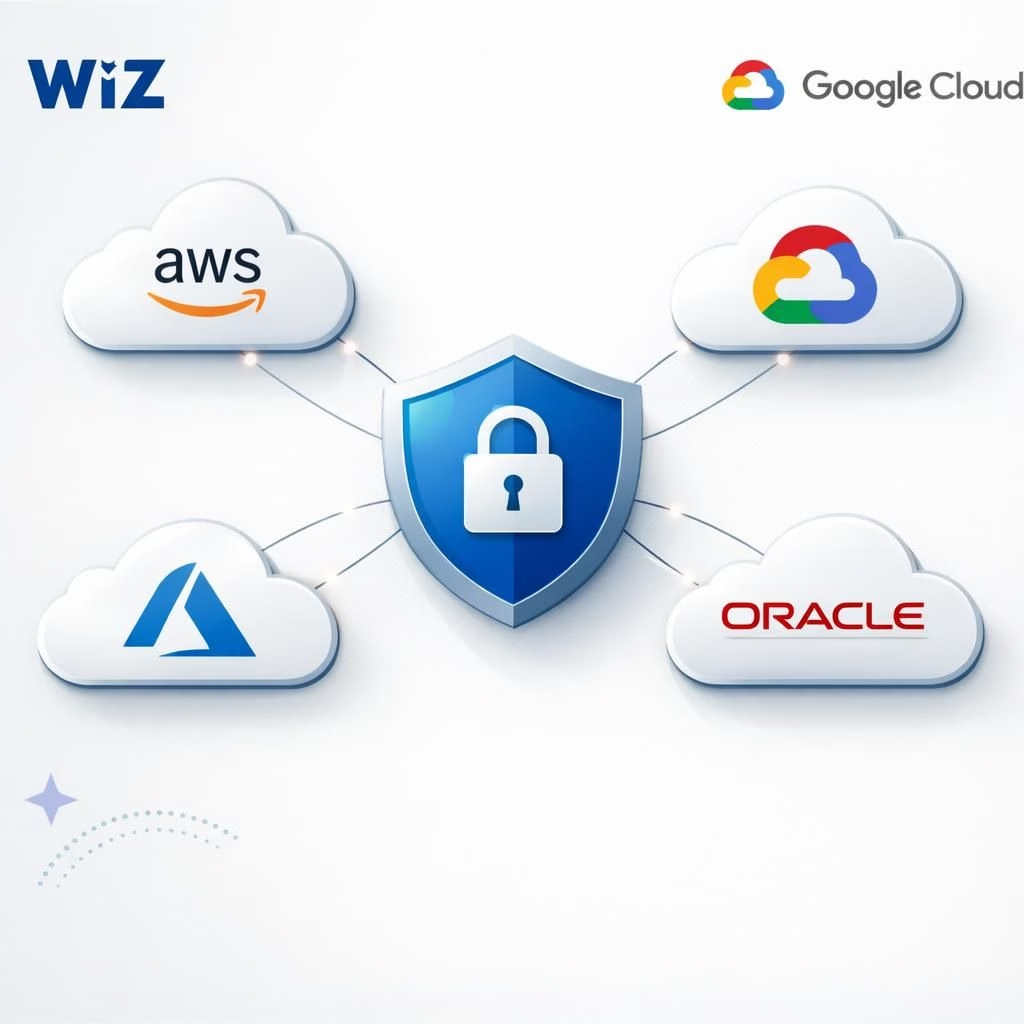
Google has just sealed the Wiz acquisition for $32 billion, a record-breaking move that dwarfs the company’s past landmark buys, including Motorola Mobility in 2012. In 2026, this all-cash deal signals a bold pivot toward stronger cloud security across Google Cloud. The move explicitly targets multicloud security and AI security, aiming to shield customers as they ride a wave of rapid cloud adoption.
multicloud security: Google’s bold bet
The plan is straightforward: deliver a unified, enterprise-grade security platform that works across clouds. Owning Wiz lets Google Cloud secure data on AWS, Azure, Google Cloud, and Oracle Cloud, reducing friction for teams that manage diverse environments. This is more than a slogan; it’s a practical shift toward true multicloud security that scales for government and business needs. By prioritizing multicloud security, Google aims to ease cloud transitions and prevent vendor lock-in.
With Wiz in the mix, expect a single pane of glass approach—coordinated protection across code, infrastructure, and runtime. The synergy turns a patchwork security stack into a cohesive engine, making multicloud security tangible rather than aspirational.
AI security in practice: threat detection at machine speed
Wiz’s platform leverages AI to connect code, infrastructure, and runtime into a single, digestible view. Instead of waiting for an alert, the system hunts signals in real time and uses models to forecast risky patterns. Google Cloud and Wiz aim to unify security so that detection, prevention, and response happen faster than traditional setups. The goal is to help security teams scale as enterprises grow and attackers become more agile.
As AI becomes central to business operations, the integration improves visibility into AI security threats and attempts to manipulate models. This isn’t fantasy; it’s practical, AI-enabled defense for enterprise workloads. The promise is that AI security will help defenders stay ahead of threats that use AI to accelerate breaches and bypass static rules.
The practical upshot is a platform that surfaces threats across the application stack—from code to containers to cloud services. Wiz’s threat-detection at machine speed translates into faster hunting, faster containment, and faster learning for security teams. It’s about turning data into actionable, timely defense rather than sifting through dashboards.
The broader picture: adoption, automation, and access for all
Large organizations rarely stay with a single cloud vendor. By bringing Wiz into Google Cloud, Google can offer a credible multicloud security story that does not require clients to rip out existing infrastructure. The combined platform promises to automate routine security tasks, scale security operations centers, and help smaller businesses protect themselves against increasingly sophisticated threats. It’s easy to caricature the deal as a techy romance between two giants, but the real value lies in practical protection that travels across clouds and multicloud security platforms.
Security now looks less like a fortress with a single drawbridge and more like a dynamic, orchestrated defense that travels with the workload. The Wiz integration will continue to support AWS, Google Cloud Platform, Microsoft Azure, and Oracle Cloud through partnerships, ensuring that customers do not have to abandon familiar ecosystems. The result is a more resilient, flexible security posture that keeps pace with rapid cloud adoption and AI security-driven development.
As Google emphasizes, this is about enabling organizations to build fast and securely across any cloud or AI security platform. It is not about replacing existing tools but about unifying them under a comprehensive security umbrella that can evolve with the tech landscape.
Readers, what do you think about this bold bet on multicloud security and AI security? Do you see this as a practical path forward for enterprises, or a headline-grabbing move that will take time to prove? We invite you to share your thoughts in the comments.
For additional context and perspectives on cloud security, you can explore industry analyses from credible sources like Cisco and IBM. Cisco’s multi-cloud security overview and IBM’s AI security learn page offer practical background.
Original source for context: Times of India
multicloud security benefits for teams
Adopting Wiz through Google Cloud can translate into clearer roles, automated policy enforcement, and streamlined incident response. For security teams, the goal is to shrink response times and expand coverage across cloud environments. That means more consistent protections, even as workloads shift between AWS, Azure, Google Cloud, and Oracle Cloud.
Practical steps for shaping your security posture
- Map existing cloud workloads to a unified security framework to reduce gaps across clouds.
- Pilot automated security playbooks that cover code, containers, and runtime environments.
- Validate AI security controls by simulating threat scenarios and testing responses.
- Engage with partners and solutions that offer cross-cloud compatibility to avoid lock-in.
FAQ
- What does this acquisition mean for current Wiz customers?
- Expect continued support across major clouds with an integrated security platform that simplifies management and scales security operations.
- Will Wiz continue to operate on all cloud platforms?
- Yes, Google emphasizes continued operation across AWS, Azure, Google Cloud, and Oracle Cloud as part of a unified security offering.
- How does this affect security teams today?
- The integrated platform aims to speed up detection, prevention, and response, helping security teams automate routine tasks and focus on higher-value work.
- How does this relate to AI security?
- The deal strengthens AI security by enabling real-time threat detection and model integrity protections across multicloud environments.