

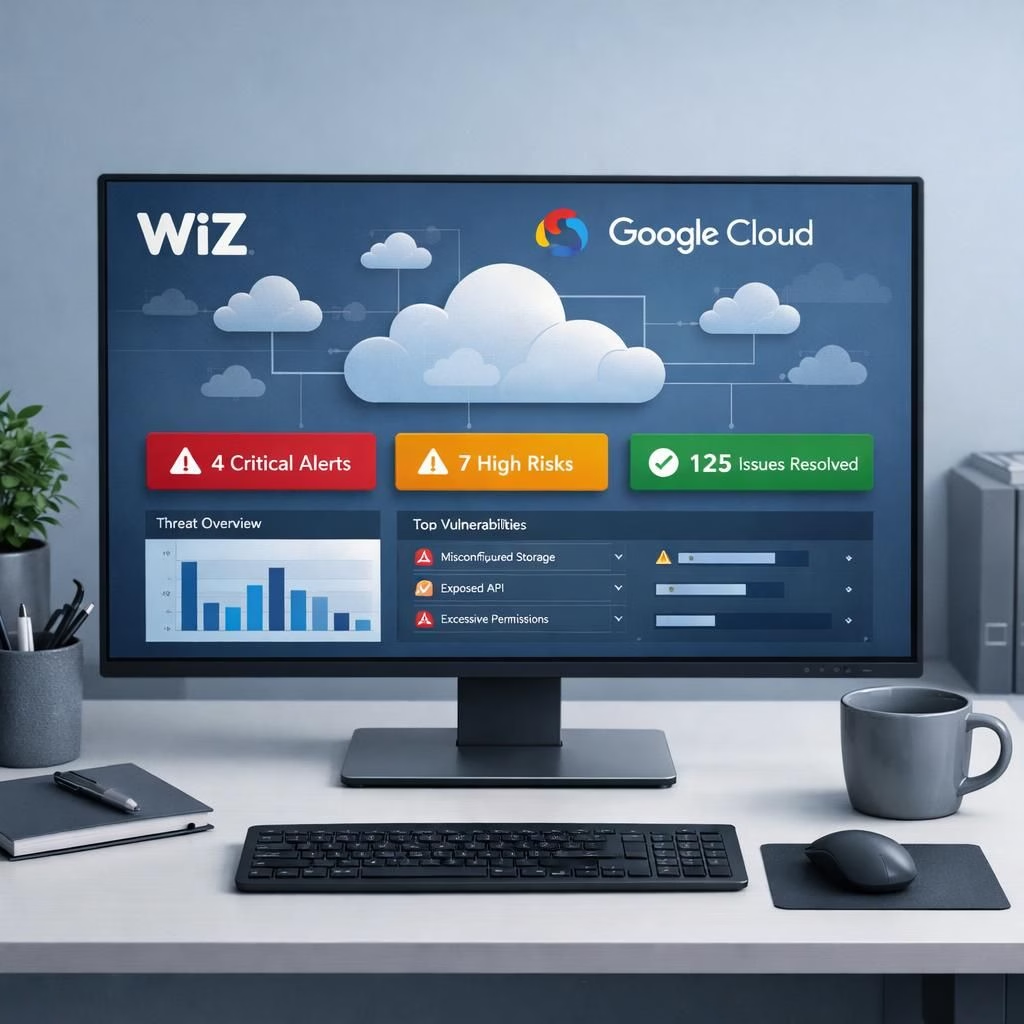
In an era of multi-cloud strategies, a bold security-platform bet is reshaping how large organizations think about risk, compliance, and uptime. Google has completed a cash acquisition of Wiz for $32 billion, signaling that security is moving from buzzwords to budget discipline. Wiz is known for a cloud-native security-platform that protects leading cloud environments, helps detect threats quickly, and coordinates responses before the alarm becomes a crisis. If you’ve built a patchwork of tools across AWS, Azure, Google Cloud, and other clouds, you might finally get a user-friendly console that makes sense of the noise.
multi-cloud security-platform momentum
Google says the Wiz integration positions Google Cloud to defend security-platform across multi-cloud and AI-driven workloads. The company will join Google Cloud, but Wiz will keep its brand and commitments to protect customers across all cloud environments, not just Google’s. Wiz’s security-platform is designed to see risk across AWS, Azure, Google Cloud, and others in one view, which matters as enterprises spread across multi-cloud environments rather than clinging to a single vendor. In practice, you can think of it as a single pane of glass for security-platform across disparate clouds.
Wiz reportedly surpassed $1 billion in ARR in 2025, a milestone that makes the deal feel like an upgrade rather than a rescue mission. The news helps justify a hefty premium and silences the skeptics who fear security tooling will stay expensive and fragmented. The ARR figure underscores that Wiz is not merely a clever product; it’s a sizable business with real customer momentum behind it across multiple cloud footprints.
security-platform roadmap and benefits
Google frames this as an investment in strengthening cloud security and enabling organizations to build quickly and securely on any multi-cloud or AI platform. The ambition is to give enterprises a single security-platform across clouds, not a disconnected toolkit. That said, the deal isn’t just about catching up with competitors; it’s about practical, scalable security construction that reduces the time to detect, investigate, and remediate threats.
With large corporations operating across Google Cloud, AWS, Azure, and Oracle Cloud, Wiz’s addition is a strategic move to attract enterprise customers through a true security-platform across clouds. The aim is to create a single security-platform that neutralizes tool sprawl and helps security teams orchestrate defense in depth. In this vision, defenders can respond to threats faster when data and signals from every cloud ecosystem are aligned under one dashboard.
Timeline and regulatory steps have also tuned the narrative. Early in 2024, Google approached Wiz with an offer of about $23 billion, a figure Wiz declined. Negotiations resumed in early 2025, culminating in the March 2025 announcement of a $32 billion purchase. The US and EU cleared the deal in a stepwise process—first with US antitrust review in November 2025, then with EU approval in February 2026—after standard investigations. The approvals reflect a growing consensus that cloud security is essential infrastructure, not a luxury perk.
Beyond the money, the collaboration aims to deliver a ‘single security-platform‘ capable of surfacing threats faster, correlating signals across clouds, and accelerating response times. The chemistry here is not about replacing your favorite tools but about curating them into a coherent defense. It’s about converting complexity into clarity for security teams who sleep better when the dashboard glows with less confusion and more actionable insight.
Tech observers note that the move comes in a moment when the AI era amplifies both opportunity and risk. As enterprises lean into AI services, the attack surface grows, and a unified security-platform that spans cloud environments becomes increasingly valuable. Wiz’s perspective on cross-cloud coverage aligns with Google’s broader strategy to promise developers a secure, scalable playground where innovation isn’t blocked by security bottlenecks. The combination should help reduce the need for point products that each require their own training and maintenance.
Ultimately, this deal signals more than a corporate marriage; it signals a shift in how enterprises think about cloud risk, compliance, and resilience. The market will judge whether a single security-platform can truly harmonize data from multiple clouds and speed incident response. For now, the outlook is optimistic: stronger protection, clearer tactics, and a clearer path to building in public across a multi-cloud world. The long-term payoff, in theory, is a safer, faster, more predictable cloud journey.
Want to weigh in about how you see the Wiz integration shaping cloud security in 2026? Share your thoughts in the comments below. And if you’re curious about the original reporting and how this story evolved, a link is included for reference.
Original article: TechCrunch. Thank you for the detailed reporting and for the foundational coverage that inspired this piece.
Source and updates: This story has been updated with new information about the deal and Wiz’s 2025 financial data.
Practical steps for enterprise adoption
- Audit your current security tooling across multi-cloud and identify gaps that the security-platform could fill.
- Consolidate threat signals from AWS, Azure, Google Cloud, and Oracle Cloud into a single dashboard powered by a security-platform.
- Develop cross-cloud incident response playbooks and training for security teams, aligned to common governance across clouds.
- Plan phased migrations to reduce tool sprawl and simplify compliance reporting, with progress tracked on the unified security-platform.
FAQs about the Wiz deal
- What does this deal mean for multi-cloud security? It signals a push toward a unified security-platform that can correlate signals across clouds and AI workloads, reducing tool fragmentation.
- Will Wiz continue to operate under its own brand? Wiz will join Google Cloud while preserving its brand and commitments to customers; the aim is a seamless, cross-cloud security experience.
- When did regulators approve the deal? The transaction moved through US antitrust review in November 2025 and EU approval in February 2026, reflecting confidence in cloud security as essential infrastructure.
- What happens to Wiz customers currently using other clouds? The plan is to extend protections and policy controls across all major clouds, enabling a unified defense rather than isolated tools.
Conclusion
In short, the Wiz acquisition marks a strategic bet on a security-platform approach that spans multi-cloud environments. For enterprises, the practical takeaway is to begin planning around a single security view that can speed detection, reduce tool sprawl, and improve resilience as AI workloads expand the attack surface.