

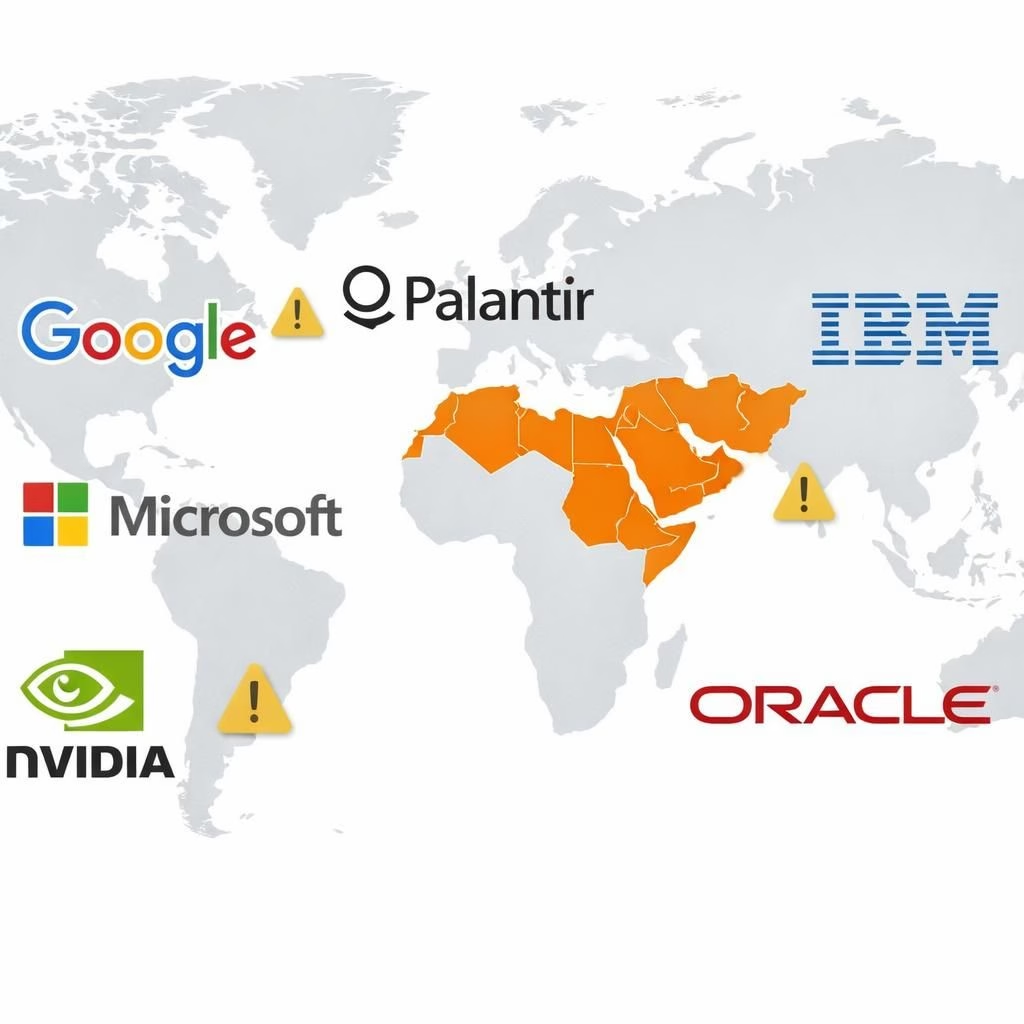
New Delhi — Iran has signaled a shift in how conflicts are fought, highlighting TechInfrastructure as a strategic arena. In a landscape where Iran’s state-linked media name Google, Microsoft, Palantir, IBM, Nvidia, and Oracle as potential targets, the word “Iran” sits alongside TechInfrastructure in today’s geopolitical calculus.
TechInfrastructure and Iran: Signals from a Global Tech Front
The story frames a widening conflict where the lines between military assets and economic weight of technology are thinner than ever. Tehran’s messaging shifts the battlefield from bases to data centers, with state-linked outlets calling Google, Microsoft, Palantir, IBM, Nvidia, and Oracle possible targets for TechInfrastructure. The aim isn’t to predict a cyber Armageddon, but to signal that TechInfrastructure now sits at the core of strategic calculations.
Analysts caution that these claims originate from state-linked media and should be read as signaling rather than a fixed plan. For Iran, the statements signal a broader strategy that ties tech assets to national security. Still, the suggestion that tech offices could be targeted underscores how intertwined the technology sector is with diplomacy and security. When you consider Google operations in Israel and Dubai, and Microsoft’s footprint in Israel and Abu Dhabi, you see a map of commercial and research centers rather than a simple market footprint. The message emphasizes that the broader security conversation touches on the tech sector, not merely a private enterprise concern.
Beyond offices, Tehran’s rhetoric also targets financial infrastructure tied to the US or Israel. The country has pointed to banks and economic centers as potential targets, a reminder that economic power and TechInfrastructure sit on the same stage. An earlier incident described by state media reported a bank in Tehran with casualties, a grim counterpoint to the idea of a purely digital conflict. This context has real-world implications for investors and policymakers watching the Gulf region with caution.
The energy angle cannot be ignored. Tehran’s actions to block the Strait of Hormuz have rippled through global energy markets. Energy security becomes a broader concern for economies like China and India, which depend on stable supply routes. The cross-pressure between digital TechInfrastructure fragility and energy transport routes makes the global system more fragile and complex. The takeaway is not doom-porn but a sober reminder that global networks—digital and energy—are deeply linked and sensitive to disruption.
Iran and TechInfrastructure: Balancing Security and Global Markets
What does this mean for everyday readers? It means the risk environment around major tech firms is more kinetic than the last decade suggested. The cloud and other TechInfrastructure assets reinforce the need for resilience in both the public and private sectors. For the tech sector, it is a call to bolster resilience—cyber hygiene, diversified supply chains, and robust contingency planning. For governments, it is a reminder to balance deterrence with diplomacy, ensuring that the pursuit of strategic goals does not spill into unintended harm for civilians or commercial ecosystems. And for ordinary users, it is a reminder that your favorite cloud tools sit on a web of decisions that stretch across borders and politics, a web that can fray if tensions rise.
In practical terms, the story invites a calmer, informed perspective: these assets are valuable and sensitive, but they are also protected by a mix of policy, insurance, and defensive tech. The international community has reason to monitor, talk, and negotiate, while companies should stay transparent about risk and invest in redundancy. The result is not a crash course in war, but a practical guide to risk management that keeps everyday digital life running smoothly even when headlines are loud.
As always, readers are invited to engage, reflect, and share their thoughts in the comments. For researchers and professionals, this moment is a chance to revisit how policy and security intersect with commerce, and to ask: how can we protect critical infrastructure without stifling innovation?
FAQ
- What is TechInfrastructure and why does it matter?
TechInfrastructure refers to the digital and physical networks that support major platforms. Disruptions here can ripple across economies and everyday life.
- Should consumers worry about US tech firms being targeted?
Immediate risk to consumers is low, but the situation highlights the need for resilient cloud services and data flows.
- What can companies do to protect critical infrastructure?
Focus on cyber hygiene, diversified supply chains, redundancy, and transparent risk communication with stakeholders.
External sources: