

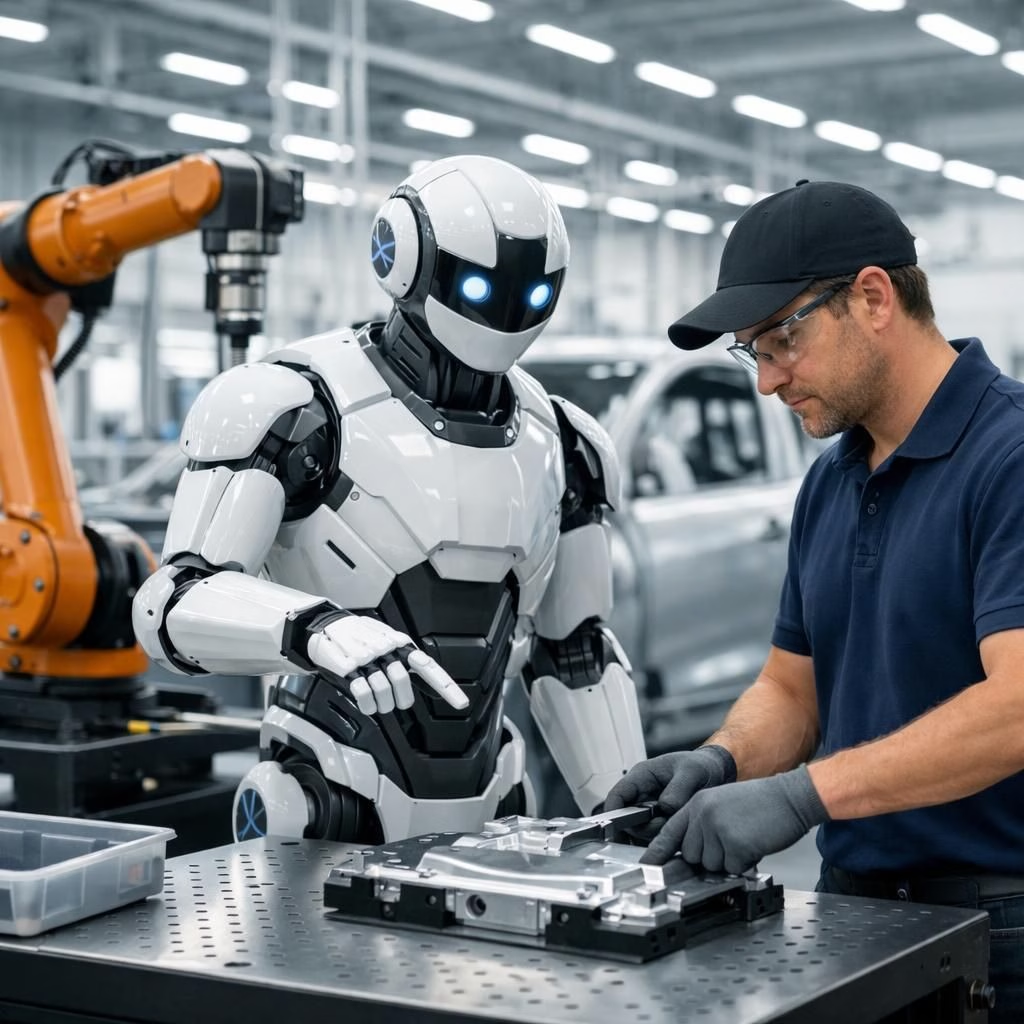
In 2026, humanoid-robotics meets industry-trends on the shop floor with a calm coffee in hand. The chatter about deployments and forecasts is loud, yet the real conversation stays practical, data-driven, and oddly hopeful.
humanoid-robotics on the shop floor: what is real?
Headlines trumpet huge figures, but the evidence remains anchored in pilots and partner sites. Tesla has never published an Optimus production count, audited or otherwise. The company consistently frames progress as learning and data collection rather than a mass rollout. Musk himself has said Optimus is not yet a production workhorse, particularly in factories, and that the early units exist mainly to learn and improve the system. Outside observers track hours, cycles, and configurations, yet those numbers rarely come straight from the source, which keeps the narrative lively and imperfect.
In late 2025 and early 2026, the market watched a tug-of-war between hype and reality. The Q4 2025 earnings call featured a candid admission: Optimus was not being used in a material way in Tesla factories, and the program stood more in the realm of learning than productive output. This honest stance contrasts with headlines that imply a fully mature, mass-produced fleet. The distinction matters because it reframes the debate from whether robots exist to how they contribute to training and data collection on active lines.
That nuance matters for capital allocation. The humanoid sector drew about 4.3 billion dollars in startup funding in 2025, part of roughly 8.5 billion poured into robotics overall. Analysts from Goldman Sachs and Morgan Stanley project massive future markets, with Goldman banking on 38 billion by 2035 and Morgan Stanley pushing to 152 billion by 2040. Those numbers are seductive for headlines, yet the real story is a slow, measured ramp rather than a sprint. The current reality is a handful of pilots and a handful of ships, not a sea of deployed humanoid units.
industry-trends shaping funding and expectations
Note: industry-trends is a fast-moving field where investors chase a mix of hardware reliability and software maturity. The call for scalable, cost-effective humanoid-robotics solutions remains strong, but the path to scale is studded with supply chain quirks, long design cycles, and the stubborn fact that building a flexible, dexterous humanoid is harder than it looks on a whiteboard. The track record at the upper end of the market reads like a cautionary tale about misaligned milestones and optimistic timelines.
Figure AI’s work at BMW Group Plant Spartanburg is a rare, well-documented example of genuine integration on an active assembly line. The Figure 02 robot completed more than 1,250 operating hours, moved over 90,000 sheet-metal parts, and supported production with high accuracy. It wasn’t a factory takeover; it was a well-timed assist that demonstrated the potential for real, measurable gains without pretending to replace every worker. BMW’s own Center of Competence for Physical AI in Production signals a future where humanoid-robotics play a targeted role within a broader production system.
Agility Robotics pushes the envelope with its Digit platform, which has logged tens of thousands of hours across multiple customer facilities. The company highlights a pragmatic approach: robots that operate in collaboration with humans, handling repetitive tasks without promising to erase the need for human labor. In parallel, Unitree’s price-sensitive strategy shows how value levers—lower cost, higher volume—can win in markets where customers want to pilot before scaling. This triad of strategies—pilot-first deployments, collaborative tasks, and price-conscious scalability—embodies the industry-trends in the humanoid-robotics space.
Despite strong venture activity, nobody has yet delivered a clean blueprint for mass production at scale. A handful of programs show progress, but most of the market continues to ride a spectrum from pilot to partial deployment. The historical lesson from early robotics ramps—Model 3 era in 2017–2018, for instance—is that ramping a complex, multi-component humanoid with a novel hand design and many custom parts takes longer than optimistic press cycles allow. The industry-trends analysis remains skeptical about headline shipments versus the reality of controlled, incremental deployment.
There is a clear divide between hardware that ships and hardware that meaningfully replaces a human. The strongest deployment evidence tends to come from firms that do not seek flashy headlines but rather steady, verifiable gains on the factory floor. The market response has been swift, however: a handful of high-visibility projects, a few early wins, and a lot of commentary about future volume. That gap between the hype and the current state explains why the next hard checkpoint—Q2 2026 results from major players—will be read with a more cautious lens. The July update cycle could provide fresher signals about whether the Fremont ramp is following a new curve or continuing the old pattern of delays and adjustments.
The broad market narrative often treats humanoid-robotics as a single, unified trend. In reality, it is a cluster of distinct programs with varied maturity, design philosophies, and business models. Some focus on industrial reliability and precise pick-and-place tasks. Others aim for broader dexterity or outdoor or household use. This diversity helps explain why the market commands strong valuations in some corners while remaining practical in others. The industry-trends here point toward careful, evidence-based growth rather than sensational M&A-style explosions.
As the year progresses, observers will watch whether the 22 July 2026 earnings call offers more clarity on production curves and whether the market’s optimistic projections hold up against real-world data from plants around the world. The pattern to watch is simple: if a program can demonstrate repeatable, safe, cost-effective gains on an active line, it becomes real in investors’ eyes; if it merely touts potential, it remains a bet on a future that may still need a few more quarters to prove itself.
Ultimately, the story of humanoid-robotics in 2026 is a measured, often entertaining, look at how a high-tech dream meets a stubborn manufacturing reality. The strongest takeaways are not about a sudden mass deployment but about identifiable pilots delivering tangible benefits, while the broader market tests new business models, new materials, and new ways to measure value beyond pure headcount avoidance.
Join the conversation: what are your thoughts on the balance between hype and reality in humanoid-robotics and the latest industry-trends? Share your insights and questions below.
Special thanks to the original article material for inspiration and context. Original source: https://example.com/original-article — we appreciate the thoughtful groundwork and data it provided.
humanoid-robotics in practice: practical takeaways
- Prioritize real-on-line pilots over promises of a factory takeover; track metrics like cycle time, placement accuracy, and hours logged.
- Separate hardware milestones from data-collection value; investors should distinguish between installed units and learning assets on active lines.
- Watch for ramp signals in production lines rather than press coverage of orders; a slow, steady ramp is more credible than a rush to mass deployment.
FAQ
-
Are humanoid robots actually replacing human workers?
Not yet. As of mid-2026, most deployments are collaborative, assisting with repetitive tasks rather than replacing workers en masse.
-
What is the status of the Fremont ramp?
As of mid-2026, production had not begun on the Fremont line. Management has signaled a cautious outlook, with initial output expected to be slow and uncertain in scale during early cycles.
-
Why is there so much hype around the humanoid market?
Venture funding and optimistic projections attract attention, but real deployments remain limited and staggered, which tempers expectations.
-
What should readers watch in the next earnings calls?
Look for concrete production numbers, line-level deployment data, and any signs that ramp plans are stabilizing or changing course.
External context and further reading
- Tesla Q4 2025 quarterly results — investor relations
- BMW Center of Competence for Physical AI in Production — BMW Group
- Agility Robotics — Agility Robotics
References
- Original source: Humanoid robots in 2026: what is actually deployed?