

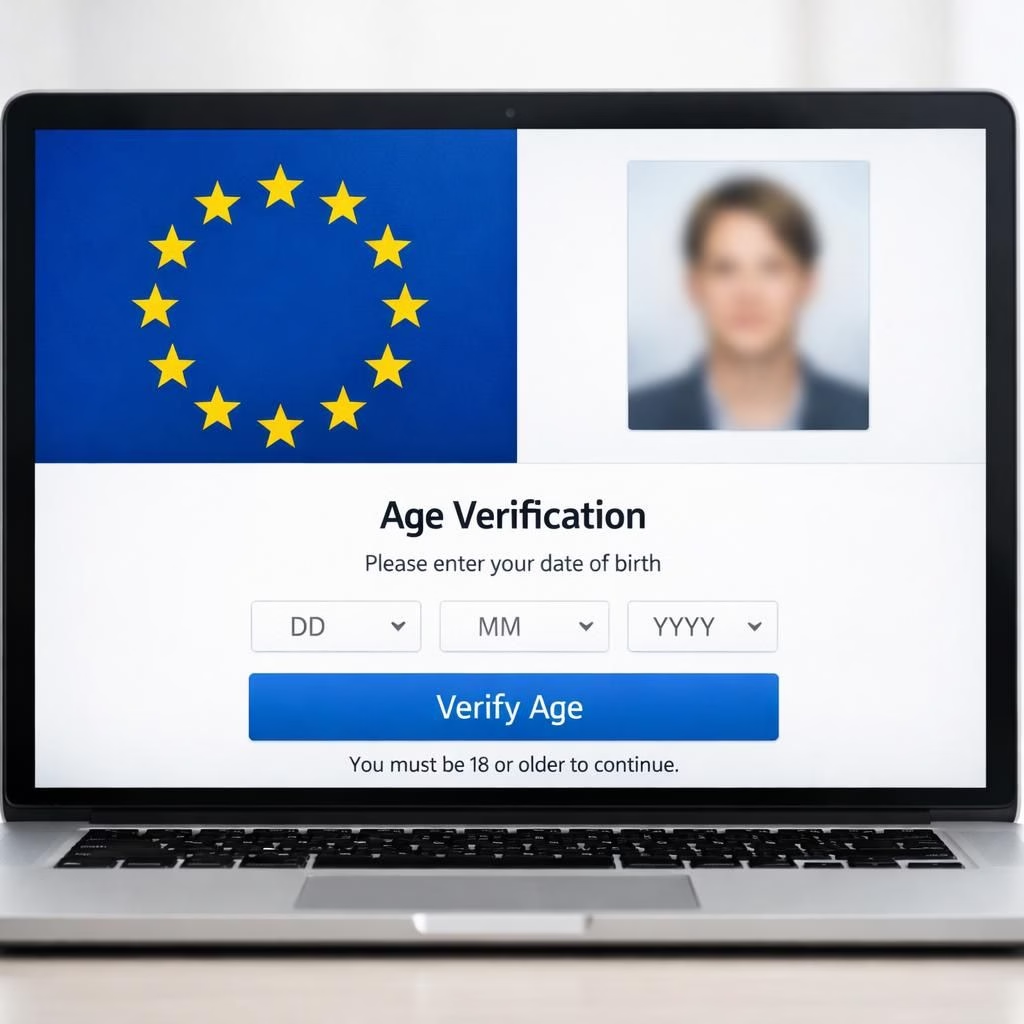
Across Europe, the EU Age Verification project is pitched as a protective shield for children, standardizing how age is checked online. Yet the Privacy angle keeps nagging: how much data travels, who sees it, and who audits the trust. In 2026, these questions still matter, and the debate blends policy bravado with practical skepticism.
This article breaks down what the EU aims to achieve, what critics worry about, and what a real-world rollout would require to stay functional and fair. The design is ambitious, even noble, but ambition without testing invites trouble, especially when millions of users carry their personal data on a device they carry everywhere. We will translate technical shorthand into a readable map of the terrain, from threat models to everyday decisions that shape public Privacy trust.
On the surface, the EU Age Verification framework seeks to standardize checks across platforms while preserving a smooth user experience. In 2026, that promise collides with real-world concerns about data exposure and the risk of misfires in age gating.
EU Age Verification in Practice
In a detailed demonstration, security researcher Paul Moore claims to have hacked the app in under two minutes. He points out that passport photos are stored unencrypted and that a PIN can be bypassed with a simple text editor. The claim is not just sensational; it highlights a real risk: the system can report that the user is over 18 without confirming who that user actually is. The app relies on a remote, cross-device flow, which makes it hard to bind an attestation to a single person. The architecture thus invites practical bypasses, especially when the verification path travels through third-party wallets or services. Critics argue that the threat model used by the architects undervalues user-driven risks and overemphasizes external attackers. The outcome could be a scenario in which websites see a result that says yes, over 18 while the underlying identity remains uncertain. This isn’t just a tech curiosity; it touches how we enforce age limits and who is responsible when enforcement fails. As this debate matures in 2026, the conversation centers on what proof really means in a world where devices roam and data flows cross borders. Privacy advocates note that such architecture can erode trust and blur lines about who accesses biometric data.
Privacy Challenges for Cross-Device Age Checks
From a Privacy perspective, the project promises a harmonised approach, but the reality feels messy. The architecture promises to minimize data sharing, yet the remote cross-device presentation and lack of session binding complicate accountability. The EU’s own architecture and reference framework discuss external threats and mitigations like zero-knowledge proofs, but the chosen threat model still misjudges who the protected party is: the child, or the system’s own incentives. The result is a system that protects against external criminals while leaving internal or user-driven bypass risks largely unaddressed. The tension is existential: do we protect Privacy by limiting data exposure, or do we insist that the truth about age must be verifiable on a per-use basis? The critique doubles as a reminder that every security decision involves trade-offs between convenience, Privacy, and enforceability. In plain terms, the more you try to anonymize the process, the harder it gets to prove age when it matters. This is not just a technocratic quarrel; it affects families, platforms, and the broader digital economy.
In a practical sense, what happens when a system replaces I am over 18 with someone is over 18 and no one can pin down who that someone is? The answer is: we risk misalignment between intent and outcome. The architecture may be technically sound on paper, yet it can fail when real users try to verify quickly on a smartphone, or when a verifier relies on a remote attestation that could be redirected. The discussion is not just about fingerprints or PD data; it touches how we balance child safety, consent, and practical user experience. For policymakers, the case illustrates why a robust threat model must consider the user as a potential adversary as well as a beneficiary. For developers, it’s a reminder to design with testable, measurable guarantees rather than theoretical protections. In 2026, the lesson remains that Privacy and security are inseparable from usability and trust. In short, EU Age Verification and Privacy intersect here.
Please share your thoughts in the comments below.
For readers curious about the architecture and threat modeling, see the EU Architecture & Reference Framework doc and the Electronic Frontier Foundation’s Privacy resources. EU Architecture & Reference Framework (GitHub) · EFF Privacy.
Original article: Thank you to the original author for the source material.