

Code Verification in AI-Coded Future
January’s CMU study pulls back the curtain on AI that can generate code, and the key idea is Code Verification: can AI-generated code be checked for bugs the way mathematicians prove theorems? It also hints at Transfer Learning, showing how skills learned proving math can transfer to detecting coding errors.
Startups see the chance to convert proofs into quality checks. Axiom’s mission phrase is simple: prove the code is correct. Their Lean-based approach aims to translate math-style assurance into software assurance. The idea is to use Transfer Learning to port math-proving skills to code verification, hoping to reduce bugs and speed up shipping.
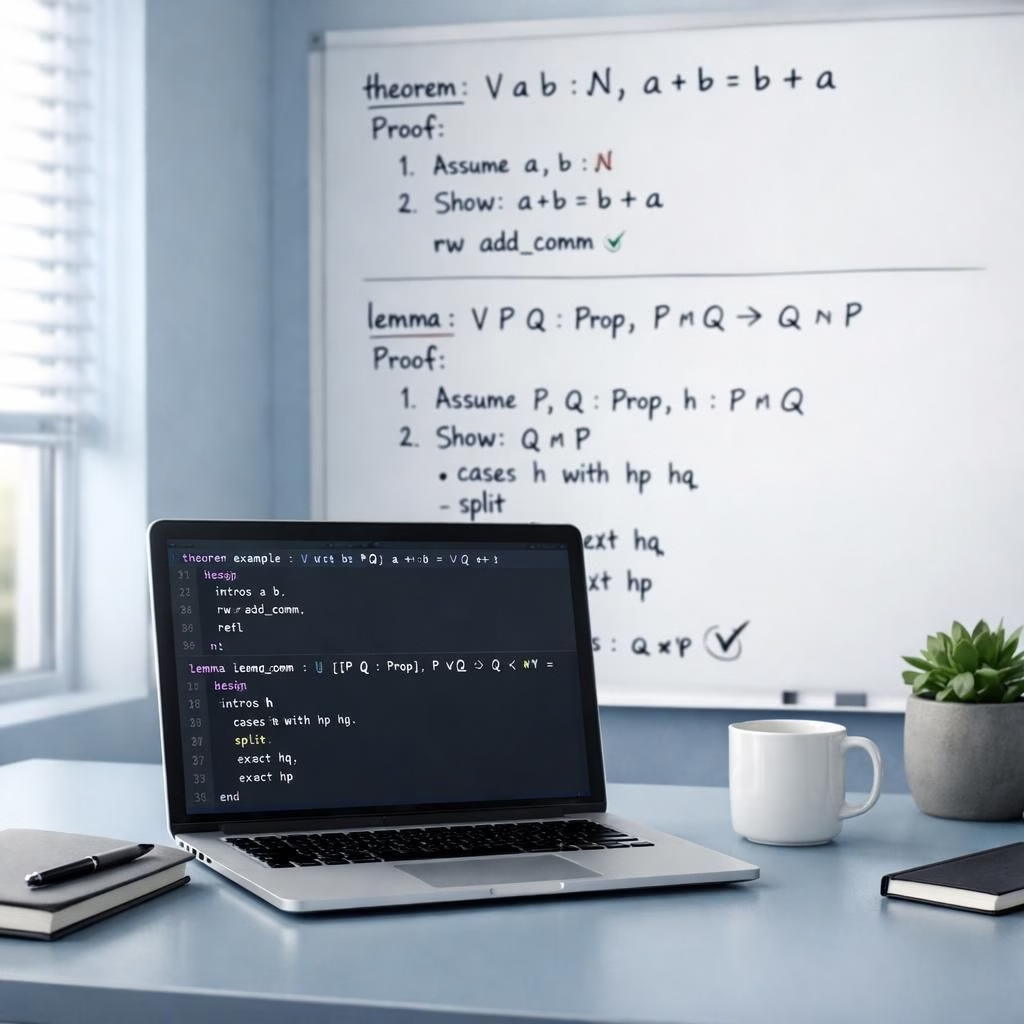
Like its rival Harmonic—valued at about $1.45 billion after its latest funding—Axiom began as an effort to solve math problems. In December, its technology, called AxiomProver, achieved a perfect score on the Putnam Exam, signaling that math-trained systems can tackle abstract reasoning. The AI systems that drive chatbots often make mistakes, but when the subject is mathematics, technologies like AxiomProver can eliminate those mistakes. Axiom has built technology that can formally prove whether an answer is right or wrong. It does this using Lean, a language created more than a decade ago for proving mathematical statements. Lean was originally a tool for mathematicians. Now, systems like AxiomProver are using Lean to prove math problems. The hope is that these systems can use the same technique to verify the quality of computer code, advancing Code Verification in real-world software.
Transfer Learning Across Code and Math
Harmonic has followed a similar path and reached a unicornish valuation on the bet that Transfer Learning can make AI understand code like a human auditor does. The idea is to let a model learn the discipline of proof in math and then apply that discipline when it inspects code. AxiomProver, the company’s tool, earned a perfect score on the Putnam Exam. That achievement is more than bragging rights; it shows that a system trained on math can generalize to logic tasks in programming. Lean, a language built long ago for proofs, now underpins the verification work of AI systems. The narrative goes like this: learn to prove, then apply proof skills to prove that code is logically sound. This is the heart of the Transfer Learning concept, and it shapes how investors view the next wave of AI tools for software.
Beyond the hype, there is a sober note. Translating math-proof rigor to everyday code is not a magic wand. Real software runs in unpredictable environments, with concurrency, latency, and user-generated chaos. Bogdan Vasilescu of CMU warns that you cannot always specify what it means for code to be correct. The best you can do is define many useful properties and verify those. Still, Transfer Learning concepts are being explored to make verification more practical. Even a partial Code Verification system can warn about risky patterns, catch obvious bugs earlier, and provide a pathway to safer automation. The optimism remains tempered with realism as teams experiment with transfer-enabled verification across languages and platforms.
Financial momentum matches technical excitement. Axiom announced a $200 million round, placing its valuation near $1.6 billion and cementing Palo Alto as a hotbed for the math-to-code verification idea. Harmonic has a similar tone, carrying a valuation around $1.45 billion after its latest funding. These numbers signal venture capital belief that the approach could yield durable improvements in software reliability. The idea is simple to describe, but hard to perfect in practice: give AI a mathematical backbone so it can prove enough about code to make developers confident enough to ship faster. Developers adopting these tools can expect tighter feedback loops, earlier bug detection, and better readability for future code reviews.
Founders emphasize learning from math, not replacing human judgment. Logical Intelligence joins the chorus, exploring how verification methods can scale to large systems. Their approach blends automated reasoning with pragmatic engineering. The goal is to help teams distinguish when an algorithm is trustworthy, especially for complex services like social networks and e-commerce platforms. The result could be a toolkit that blends math-style proofs with test automation, static analysis, and smarter compilers. In other words, the dream is not a cure-all but a durable improvement that makes AI-assisted coding feel more like engineering and less like guessing. The Transfer Learning concept informs this toolkit, guiding practical progress.
For developers wrestling with this trend in 2026, the practical takeaway is to treat Code Verification as a collaborative tool rather than a silver bullet. Start by identifying critical components where formal guarantees would be most valuable, such as payment processing, data integrity layers, or security-sensitive modules. Then align your learning path with Transfer Learning principles: use math-proofs to train verification heuristics, but always pair them with human-reviewed test suites. The result is a hybrid workflow where AI and humans complement each other, producing faster iterations without sacrificing clarity or safety. The narrative shift is encouraging: we are moving toward a software practice that acknowledges risk, invites formal methods, and keeps developers in the loop rather than sidelining them with opaque AI edits.
And yes, this path comes with caveats. Risk remains that a formal proof about a small portion of code does not guarantee the whole system’s correctness. The design must avoid over-reliance on automated proofs. Still, the balance is hopeful. The industry is not abandoning exploration of AI-generated code; instead, it is layering verification techniques on top of generation. This synergistic approach may yield cleaner, more maintainable code that stands up under load and scales with user demand.
In sum, the future of AI-assisted software rests on a blend of Code Verification maturity and Transfer Learning agility. The field is lively, optimistic, and a touch playful about the math-to-code journey. The key is to maintain clear goals, publish transparent benchmarks, and celebrate small wins along the way. Code Verification becomes a practical partner for developers, while Transfer Learning fuels smarter, safer code checks that learn from proven math strategies. It is not a guarantee of perfection, but it is a meaningful stride toward better code and faster delivery for teams around the world.
We invite readers to share their thoughts on how Code Verification and Transfer Learning might reshape your workflow in 2026. Do you see these tools as helpful teammates or just clever gimmicks? Your experiences can help others decide when to adopt or skip these techniques. And as always, keep the dialogue constructive and curious. Please share your thoughts in the comments.

Special thanks to the original CMU study and related reporting for material inspiration. Thank you to the source article for providing a foundation that informed this rewrite. For more context, you can read the original article here: Original article.
External readings
- Lean Prover: formal verification for math proofs
- Transfer Learning overview
- Formal verification in software development