

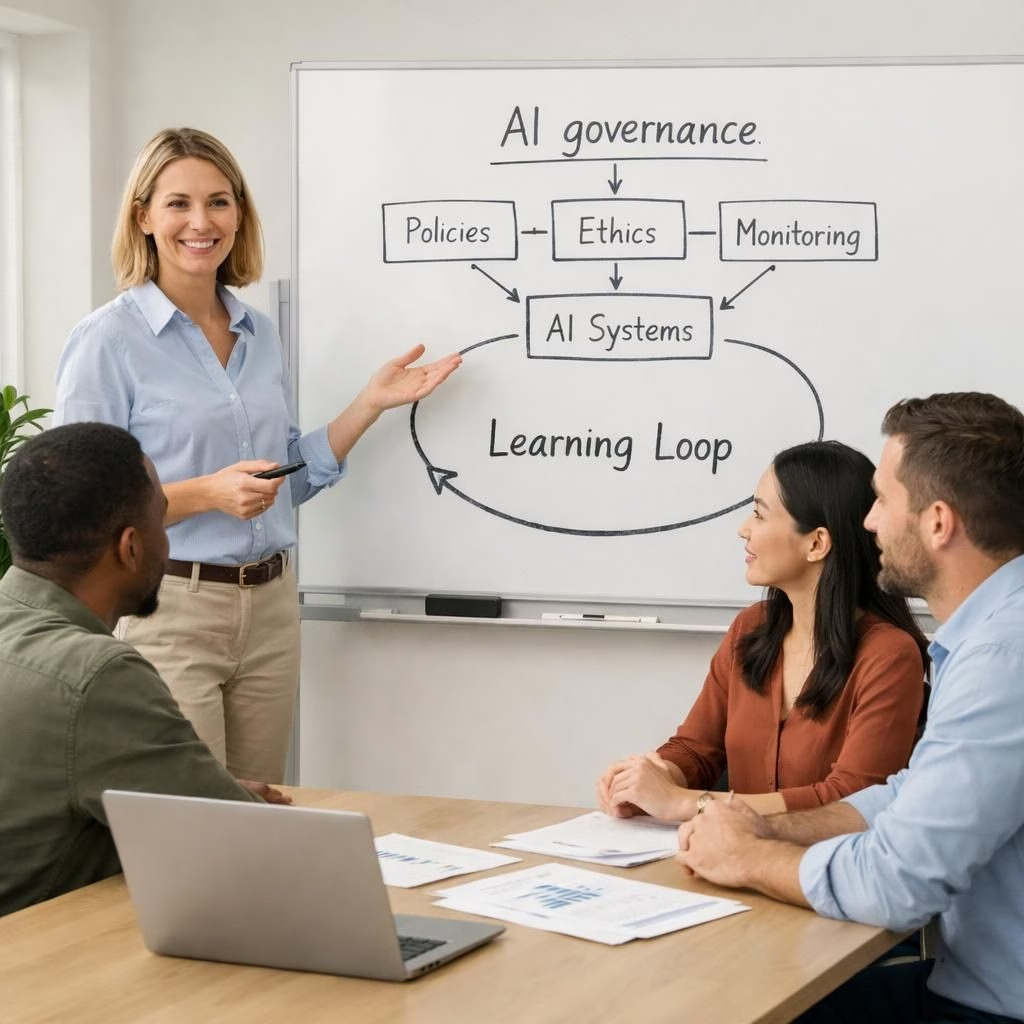
Like a blazer-wearing headline grinder, 2026 arrives with IPO chatter and frontier-model bravado, yet the real plot thickens around people and process. In this spin, AI governance and the learning loop steal the spotlight. Satya Nadella nudges us away from the single-model trophy toward a living system that learns from a company’s own work, judgment, and memory. The frontier model is the engine; the car is what you build around it. The message lands with a wink: your moat is less about the model and more about the loop that turns experience into proprietary know-how. AI governance and the learning loop should be household names in boardrooms, not footnotes in data sheets.
AI governance and learning loop in practice
Two kinds of capital exist, Nadella argues: human capital and token capital. AI governance sits at the center by coordinating humans and machines. Human capital is the people, their judgment, relationships, and pattern recognition. Token capital is the AI capability a firm builds and owns. The mistake is assuming token capital erodes human capital. Instead, human capital grows more valuable as token capability scales, if steered by strong leadership. The learning loop binds them. It captures interactions, corrections, and outcomes, then feeds them back to sharpen the AI for your business. A sales team example helps visualize it: the AI drafts proposals; people review and tune, price logic flows, and the learning loop compounds the experience. After many cycles, the draft quality converges toward a level that needs almost no edits. That accumulated judgment becomes proprietary IP that competitors cannot swipe. Nadella calls it a “hill climbing machine.” It compounds value over time, not a subscription that must be renewed.
The practical punchline is simple: you don’t just deploy a model; you design a learning loop that learns from your world. In a real organization, the learning loop behaves like a living SOP, growing sharper as teams correct errors and surface patterns they didn’t know existed. This is where AI governance earns its keep. It isn’t a drone of compliance; it’s a partner that amplifies judgment while keeping the company aligned with its mission. When teams implement a true learning loop, AI governance becomes a governance of growth rather than a cage around risk. The two concepts—AI governance and learning loop—turn from buzzwords into practical playbooks you can point to in meetings.
AI governance and learning loop: a modern moat
The political wrinkle is where Nadella draws a line from the first globalization wave to today’s AI moment. He cautions against a future where a handful of models capture most value and hollow out other industries. AI governance sits at the center by shaping how value is created and shared. His stance is that if value concentrates too narrowly, political economies will push back with resistance. The argument is tidy and, to some ears, self-serving: Azure becomes the backbone for enterprises building these learning loop, tailoring data centering and fine-tuning in a way that makes switching expensive. Yet the logic remains compelling. The moat of the future is not the best model alone; it is the combination of a tuned model with a robust learning loop that captures unique, company-specific knowledge over time. In other words, the loop is what prevents the moat from eroding the moment you switch vendors, because the real treasure sits in the gathered insight and proprietary patterns the loop accumulates.
Critics push back. OpenAI’s counter-bet is simple: keep the base model good enough, and invest in prompts and governance instead. Building a true learning loop is hard work. It demands a robust infrastructure to capture live data, disciplined governance to turn private conversations into clean training material, and a steady check that the model is genuinely improving rather than memorizing. Many teams rush to fine-tune, rent GPUs, and discover a sharper prompt would have sufficed by lunch. Nadella’s framing pushes teams to think bigger: not just how to tune a model, but how to tune a business for continual improvement. The result is a healthier balance between token capital and human capital, a balance that can survive the bumps of IPOs and market swings. This is not a hype train; it’s a practical upgrade to how you operate at scale.
The notion of “tokenmaxxing”—throwing the most powerful model at every problem—gets a polite shove. Nadella urges teams to apply frontline models where they shine and reserve frontier models for tasks that truly require deep contextual understanding or long-range memory. It’s a counterintuitive stance in a market that worships scale, but it makes sense to those who want durable value. The real moat, he suggests, is the cumulative advantage of your own learning loop—your own data, your own corrections, your own institutional memory—things a rival can’t simply download from a website. This is the most persuasive part of his case: the loop creates a proprietary iceberg that grows under the waterline, while the visible iceberg above remains your product and brand.
In practice, the frontier model is a spark, and the learning loop is the furnace. The blend of AI governance and ongoing feedback builds a platform that can outlearn competitors and outlast market storms. The more teams contribute to the loop, the more the system tailors itself to your unique workflows, pricing logic, and customer conversations. The result is not just a better model; it is a smarter organization. The learning loop becomes a cultural asset, a living repository of institutional craft that cannot be copied at scale by a single vendor. And yes, the whole thing plays nicely with Azure and the broader ecosystem, which some observers see as a strategic advantage rather than a necessary evil.
For skeptics who worry about complexity, the answer is gradualism with intent. Start small: map a single process, capture not just outcomes but corrections, then extend the loop to related tasks. If you do this right, the AI governance framework you’ll build will pay for itself in reduced errors, faster proposals, and happier customers. The learning loop then shifts from an abstract concept to day-to-day practice, shaping decisions, dashboards, and even hiring priorities. In short, AI governance plus learning loop is not a silver bullet, but a durable compass that helps you navigate the AI era with less drama and more momentum.
Original article: Times of India technology analysis. A big thank you to the original source material for providing thoughtful context on these ideas.
Want to share your thoughts on the AI governance and learning loop debate? Tell us in the comments below and join the conversation about how to build a smarter, more resilient organization in 2026.
Note: If you’re seeking the latest technology news and updates, download the TOI App for a broader view of the landscape.
Practical steps to build the learning loop
- Map a single core process and capture not just outcomes but corrections to show where the model falls short.
- Institute governance rituals: weekly reviews, data-quality checks, and decision logs to ensure continuous improvement.
- Quantify impact with simple metrics such as time-to-proposal, win rate, and pricing accuracy to gauge progress.
- Scale gradually by extending the loop to related tasks across departments to preserve consistency.
- Foster a culture that values institutional memory and shared learning as a competitive edge.
FAQ: AI governance and the learning loop
- What exactly is a learning loop?
- A learning loop is a feedback process that collects interactions, corrections, and outcomes, then uses them to retrain and refine AI systems tailored to a company’s needs.
- Why is AI governance important alongside the learning loop?
- AI governance provides the rules, guardrails, and accountability that ensure the loop learns in ways that support a company’s mission and values.
- Can a company start small with this model?
- Yes. Begin with one process, document lessons, and expand the loop step by step as benefits prove themselves.
- Is frontier AI necessary for every task?
- No. Nadella argues you should reserve frontier models for tasks needing deep memory or context, while using stronger governance and prompts for routine work.
References
- European Commission: The AI policy landscape
- NIST: AI Risk Management Framework
- OECD: Principles on Artificial Intelligence
- Times of India technology analysis: original article