

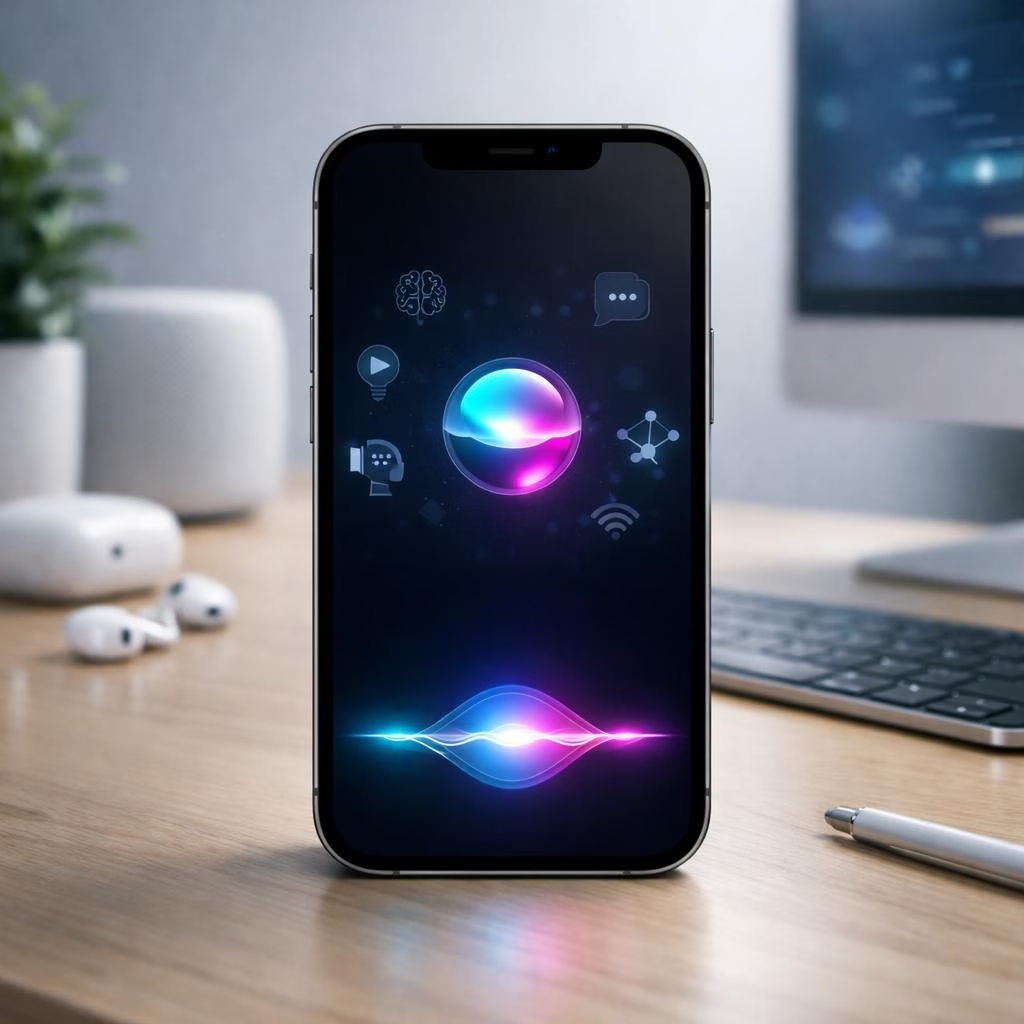
Welcome to a sunny, rational take on Apple and Siri in 2026. iPhone 17 is the headline star, but the system is more about balance than fireworks. The iOS 27 features teased by outlets will likely arrive in a staged cadence. Hardware constraints—chip power, memory bandwidth, thermal limits, and battery life—shape the rollout. Apple is not waving off progress; they’re calibrating progress for real-world use. This overview stitches perspectives from 9to5Mac, Bloomberg, WSJ, Apple, and CNN to explain what fits today and what waits for a friendlier hardware cycle.
Apple and the iOS 27 landscape
When people talk about top-tier features, the headline act is often on-device AI, smarter automation, and cross-app smarts. The iPhone 17, though capable, has to respect power budgets. The result is a thoughtful feature set that favors reliability over razzle-dazzle. In practice, you’ll see better background processing, improved app continuity, and more predictable performance, rather than sudden dramatic changes on day one. Apple’s engineers have to balance chip warmth, battery drain, and user comfort. The plan isn’t to disappoint; it’s to deliver meaningful improvements that don’t trade speed for stability. The reporting consensus from 9to5Mac, Bloomberg, WSJ, Apple, and CNN helps frame the reality: ambitious software plans are only useful if hardware can sustain them.
Behind the scenes, hardware power remains the gatekeeper. Chip power, memory bandwidth, and thermal envelopes limit what can run continuously. The iPhone 17’s silicon and cooler design push core features to run quietly in the background, so you don’t notice the boundary between a great experience and a device that needs a recharge. Apple is not chasing a single showpiece; instead, it is building a robust baseline that ages well. The consensus across outlets is pragmatic: iOS 27 arrives with careful, incremental improvements that stay reliable as new software arrives over time.
Siri and the AI brain upgrade
Siri’s new brain is designed to be faster and more private. The aim is to handle reminders, messages, and context-aware tasks more smoothly. Apple Intelligence aims to deepen this synergy without compromising privacy. In day-to-day use, you’ll notice snappier responses, more natural phrasing, and offline capabilities that still feel smart. The broader AI arc emphasizes user control and transparent updates, so you’re not left guessing what data moves where. The iPhone 17 becomes less about a single showpiece feature and more about a steady swell of improvements across the OS. Siri stays helpful, and AI features land in a way that makes sense for daily routines, from voice notes to photo organization to travel planning.
Of course, the story remains pragmatic. Apple is laying groundwork for a future where AI assistants learn from your patterns without becoming data hogs. The hardware frame supports this with smarter neural processing and better memory management. You get more useful in-device actions, less reliance on cloud ping-pong, and tighter integration with apps you actually use. That translates to a smoother experience across calls, messages, health tracking, and navigation. The Siri leap isn’t a one-off fireworks show; it’s a set of incremental, user-focused enhancements that compound over time.
For tech watchers, the ecosphere matters as much as the device. Apple’s approach to iOS 27 and Siri AI signals trust-building: fewer surprises, clearer privacy options, and more predictable updates. You’ll see practical AI tools like smarter dictation, better translations, and stronger on-device processing that respects your data. In the real world, the iPhone 17 should feel like a dependable partner that learns at a comfortable pace and adapts to your day, not a clever gadget that demands constant attention. The result is a device that ages gracefully, confident in its fundamentals while still offering something fresh for curious power users.
To close, this outlook isn’t a melodrama about “delays” but a realistic forecast of how software and hardware align. Apple isn’t retreating; the company is refining the cadence so features land when they truly shine. Siri remains a helpful guide rather than a glitch-prone navigator, and AI upgrades appear where they benefit everyday tasks. The iPhone 17, in this light, becomes a dependable platform that sustains momentum through 2026 and beyond, with Apple Intelligence gradually expanding its orbit around your daily life.
As you digest this, keep in mind that progress often looks incremental and elegant rather than explosive. The tech press may call out headline gaps, but the practical impact on your day-to-day use matters more. If you value privacy, battery life, and a smooth user experience, you’ll likely appreciate the measured improvements that accompany iOS 27 and the evolving Siri AI brand. This is a story of patience with purpose, humor with honesty, and a future where Apple keeps delivering sensible, humans-in-the-loop innovation.
Original reporting sources: 9to5Mac, Bloomberg, WSJ, Apple Newsroom, and CNN. A big thank you for the original material that inspired this synthesis.
Practical takeaways for everyday use
- Try enabling offline dictation in Settings to experience faster Siri responses for messages and reminders.
- Use on-device processing to minimize cloud data and improve privacy.
- Explore new automations that leverage Siri for everyday tasks like travel planning and reminders.
FAQ
- Q: Will Siri be the headline feature of iOS 27?
- A: Not a single showpiece; expect a mix of on-device AI features rolling out over time to balance performance and battery life.
- Q: Does Apple prioritize privacy when expanding Siri capabilities?
- A: Yes. The rollout emphasizes privacy controls and on-device processing to minimize data exposure.
- Q: When can you expect broader availability of on-device AI improvements?
- A: The cadence aims for a staged, year-long rollout that broadens with newer devices and software updates.
Bottom line
The iPhone 17 and iOS 27 bring measured, practical improvements that balance hardware limits with meaningful software upgrades. If you value privacy, battery life, and a steady, intelligent experience, this cadence can feel like the right kind of progress—sustainable, predictable, and useful over time.
References
External references
- Bloomberg technology coverage
- WSJ technology coverage
- MIT Technology Review on AI trends
- IEEE Spectrum on on-device AI