

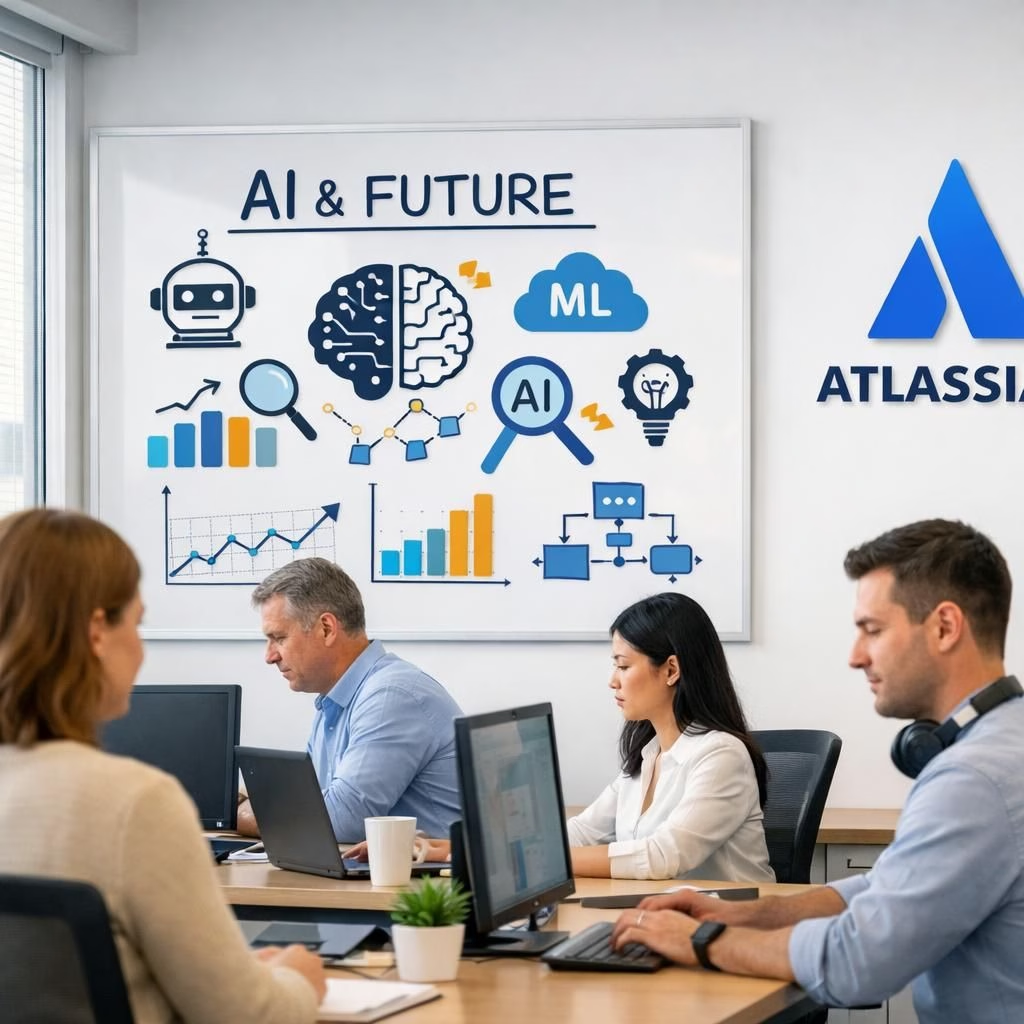
In 2026, Atlassian announced a significant recalibration of its workforce: a 10% cut, about 1,600 roles, as the company pivots around AI-driven changes in required skills and the number of roles. The news lands with a mix of pragmatism and newsroom-worthy drama, because even software darling companies must adapt when the tech behind the product evolves. The company’s chief technology officer, Rajeev Rajan, will depart, with leadership framing this as more about shifting the skills than a blunt headcount reduction. CEO Mike Cannon-Brookes underscored that AI changes the mix of skills and the number of roles in some areas, and that this is a deliberate move to fund the next wave of AI investments and enterprise sales. The punchline is simple, even if the execution isn’t: this is modernization in a suit, not a curtain call for human workers.
Atlases of change often come with maps, and Atlassian’s map is a system of work — a structured way to align people, skills, and processes with what AI and customers actually need. The company emphasizes that the restructuring is not about replacing people with code, but about rebalancing capabilities so that the team can move faster and learn faster. In the current climate of rapid AI development, the company argues, the right skills mix is the difference between guarding a steady cadence and sprinting toward market opportunities. It is a positive-sounding shift, with a wink to resilience and a belief that focusing on the right skills is more sustainable than clinging to old job “labels.”
AI-driven restructuring and the skills mix
The root cause, according to the official statements, is an AI-driven need to rethink which capabilities actually drive value. The leadership paints a picture where AI does not annihilate jobs but reframes them. They point to a future where fewer people in some roles can handle more complex, AI-assisted tasks, while new roles emerge that center on governance, integration, and human-AI collaboration. The first big takeaway is that the talent system must mirror the new technology stack: data literacy, adaptive product thinking, and cross-functional collaboration rise in importance. The company stresses that this is less about layoffs and more about recalibrating the workforce to meet AI-enabled demand. In practice, this means reorganizing teams, consolidating some functions, and elevating roles that add strategic value that AI cannot easily replicate—like nuanced customer conversations, ethical oversight, and creative problem-solving.
From the perspective of workers and managers, the shift signals a re-prioritization exercise: you want people who can teach AI new tricks, interpret its outputs, and translate technical insights into business outcomes. The AI lens has to be applied across product, sales, and services, which means different skills will bubble up to the surface. While some roles will disappear or shrink, others will grow in importance—particularly those that can bridge between machine intelligence and human judgment. The company indicates this is a systemic rebalancing rather than a piecemeal staff cut, and that the charge to fund future AI investments remains central to the plan.
AI and skills in 2026: funding the future through a system of work
Regionally, Atlassian’s cuts fall unevenly, with 40% of the reductions concentrated in North America, 30% in Australia, and 16% in India. It’s a geographic reminder that labor markets respond differently to AI-driven optimization, with cost and capability mixes shaping where changes land hardest. The company says the financial impact will show up in charges totaling roughly $225 million to $236 million, and that most of the restructuring should be wrapped by the end of June 2026. Importantly, severance packages exceed the bare legal minimum, providing a minimum of 16 weeks in many cases. These numbers are not mere accounting; they reflect a real-world calculus about risk, liquidity, and the desire to remain financially nimble as AI becomes more woven into Atlassian’s product and customer strategy.
Rajeev Rajan, Atlassian’s chief technology officer, will depart with his exit effective March 31. The leadership notes his departure as a bridge between a legacy tech stack and a future fueled by AI-enabled decision-making, all while acknowledging the personal weight such changes carry for the individuals involved. This is not a victory lap for AI per se; it’s a candid acknowledgment that leadership must steer a company through a period of transition where the relative value of different skill sets shifts. The narrative aims to project a calm, forward-looking tone, even as the human implications remain significant. The AI shift, the skills realignment, and the system-of-work reorganization are all presented as coordinated steps toward a stronger, more adaptable Atlassian in 2026 and beyond.
For investors and market watchers, the message is clear: Atlassian intends to self-fund its AI ambitions and expand enterprise sales by tightening the organization around a more efficient system of work. The company argues this approach should improve speed to market, increase leverage against competitors, and reinforce financial resilience in a sector where AI is quickly becoming a barometer of potential. It’s a plan that embraces AI not as a panacea, but as a tool that, when paired with the right human skills, can unlock more value than a simple headcount reduction would allow.
What does this mean for the day-to-day experience of teams left standing? Expect more targeted training, clearer career paths tied to AI-capable skills, and a stronger emphasis on collaboration across product, engineering, and customer-facing functions. The goal is to build teams that can harness AI to augment human judgment, not replace it. The leadership stresses that culture, ethics, and governance remain central to any AI-enabled transformation. In short, the plan is to create a more capable, more adaptable Atlassian—one that satisfies customers, supports employees, and keeps partners confident in the long run.
Before wrapping up, a quick note on transparency and communication. Atlassian has attempted to balance candor with optimism, presenting the restructuring as an opportunity to accelerate the company’s competitive edge. The emphasis on a robust system of work, better alignment of skills with AI capabilities, and a forward-facing investment thesis signals a strategy designed for long-term viability rather than a short-term cost-cutting spree. It’s a narrative that invites employees to grow with AI, rather than compete against it, and it invites readers to interpret the changes as a natural evolution of a software company navigating a swiftly changing tech landscape in 2026.
For broader context, see the 2026 technology predictions piece from this site: 2026 technology predictions.
Readers are invited to share their thoughts and experiences as this transition unfolds. Your insights help illuminate how AI and skills shifts play out in real workplaces, not just in headlines.
Original reporting and materials that informed this article come from Reuters. Thank you to Reuters for the comprehensive coverage that helped shape this synthesis: https://www.reuters.com/technology/atlassian-cuts-10-percent-workforce-2026-ai-updates-2026-03-xx/
Practical steps for teams adapting to AI-driven change
- Audit current work to identify tasks that can be augmented by AI, and map out the skills that will be needed.
- Launch retraining programs aligned with AI-enabled roles and governance requirements.
- Set up cross-functional squads that bridge product, engineering, and customer success to operationalize AI outputs, focusing on the skills.
- Establish clear criteria for performance, ethics, and governance in AI-enabled workflows.
Frequently asked questions
- Q: Why is Atlassian cutting jobs? A: The company argues the layoffs are part of a broader shift to align the workforce with AI-enabled needs and to fund future AI investments, not a simple headcount cut.
- Q: Will jobs disappear entirely? A: Some roles will change or shrink, while others will grow, especially those that connect machine intelligence with human judgment and governance.
- Q: What is the system of work about? A: It’s a framework to align people, processes, and governance around AI-enabled capabilities for faster, more reliable delivery.
- Q: How generous are severance packages? A: The company says severance exceeds local requirements, with a minimum of 16 weeks in many cases.
Conclusion and takeaways
The 2026 plan positions Atlassian to invest in AI while reshaping the talent landscape around a more adaptive system of work. The changes emphasize capability over labels, governance over guesswork, and speed to market alongside responsible AI use. For employees and customers, the key takeaway is a future where the right skills support smarter decisions rather than simply shrinking the headcount. For investors, the strategy is to fund growth through efficiency, with a focus on sustainable, AI-enabled product and service delivery.
References
- Reuters: Atlassian cuts 10% of workforce to fund AI strategy
- Atlassian Newsroom
- Times of India: Atlassian lays off 1,600 workers