

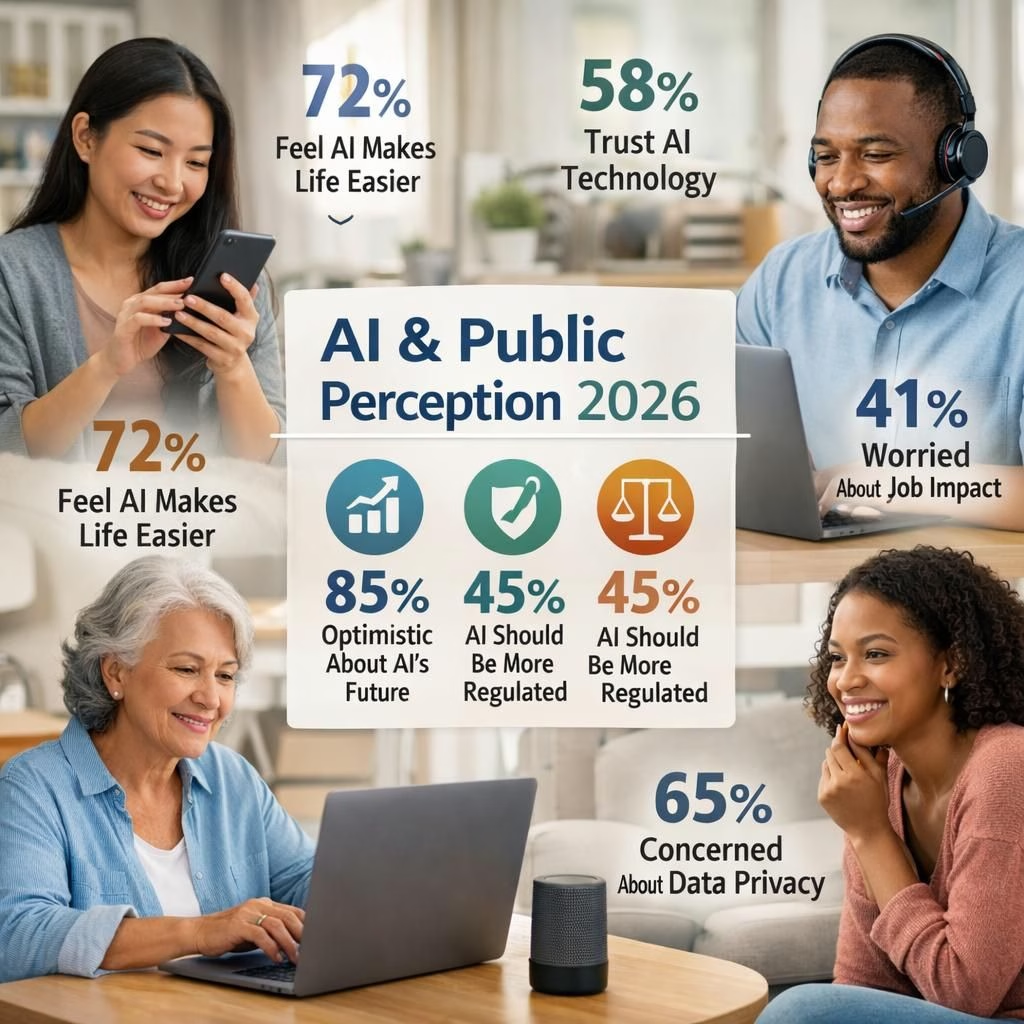
AI and Public Perception in 2026 blend caution with curiosity, turning a serious topic into a conversation that even your coffee mug can enjoy. This upbeat tour through Pew Research Center findings keeps the core truths intact while adding a dash of humor and practical insight for readers who want to understand not just the numbers, but the people behind them. The goal here is to translate a sophisticated data set into relatable takeaways that help you navigate a world where AI is increasingly visible in daily life.
AI and Public Perception in Everyday Life
Public awareness of AI has moved beyond the tech-nerd corner. In June 2025, nearly all Americans had heard or read about AI, and 47% said they had heard a lot about it. That signal shows the technology has entered everyday vocabulary, not just headlines. People remain cautiously optimistic: many view the technology as tools for forecasting weather or analyzing large datasets, while they fear downsides in creativity, relationships, and daily judgment calls. AI is now part of daily life, and many of us try to keep up with the soundtrack while sipping coffee.
Another telling stat: 31% of Americans interact with AI at least several times a day. Younger adults show a higher cadence, but the pattern holds across age groups, suggesting AI-enabled routines are becoming normal — think smarter phones, smarter assistants, smarter scheduling, and the occasional nudge toward better decisions. The takeaway for Public Perception is that AI is not a distant rumor; it’s a practical companion that people use, trust, and occasionally fear in equal measure. This nuanced view helps explain why people may cheer the benefits in data analysis while bristling at feared consequences in jobs or education.
Across the country, attitudes vary by task. Americans are more open to AI for data analysis than for creative or relational ambitions. About half think AI will hinder creative thinking and meaningful relationships, while fewer expect it to sap those abilities. Yet there’s optimism about AI’s potential to support medical care and other vital sectors—areas where the public tends to be more forgiving of growing automation, provided it proves reliable and patient-centered. This split reflects Public Perception at its best: thoughtful, task-specific, and evidence-driven rather than blanketly pro- or anti-AI.
AI and Public Perception in Work, Education, and Health
In the workplace, AI presence is rising, but the majority of workers remain cautious. A September 2025 survey showed 21% of U.S. workers report that some of their work is done with AI. That’s up from 16% in 2024, but 65% still say they don’t use AI much or at all in their job. The message in this data point is not doom; it’s a signal that adoption is incremental and often tied to specific tasks, tools, and training. For Public Perception, this means the workforce is testing the waters with guardrails, rather than leaping into uncharted automation.
Education and healthcare trends are similar: people see potential benefits in medical care and data-driven decision support, while expressing caution about changes to jobs and the human touch in education and care settings. NIST’s AI Risk Management Framework offers guidance on responsible deployment. OECD AI Principles provide additional context for governance and accountability.
Public Perception also reflects a generational dynamic. Around half of adults under 50 report daily or near-daily AI interactions, while older adults are somewhat less likely to do so. This pattern aligns with workplace exposure and comfort with technology, reinforcing the idea that AI literacy matters for practical adoption. The data suggest that when AI is embedded into everyday routines—at work, in schools, or in home devices—the public’s trust grows more from lived experience than from abstract promises.
On the education front, opinions are mixed. While 24% of respondents foresee a positive impact of AI on education, 23% anticipate a negative effect on jobs, and a similar share are uncertain. These numbers hint at a broad, cautious optimism: many people are willing to explore AI’s role in education as long as safeguards, transparency, and human oversight are maintained. Importantly, a sizable minority remains unsure about AI’s impacts across all domains, reminding us that Public Perception thrives on clear, trustworthy information and practical demonstrations of benefit.
Public Perception, Information Sources
One striking finding is awareness of AI’s reach in information ecosystems. Only a small fraction of adults get their news from AI chatbots—9% say they do so at least sometimes, and 75% report never using chatbots for news. This suggests that while AI is everywhere in tools and services, the habit of turning to AI for news hasn’t taken hold for most people. When errors appear in AI-generated information, it can erode trust, so accuracy and transparency remain essential in shaping Public Perception. The safest path forward is a combination of reliable outputs paired with traditional, human-verified reporting—at least until AI chatbots gain a track record of consistency and accountability. For context on reliability, see NIST AI RMF.
Design representation also plays a role in public trust. About 40% of adults think designers take White experiences somewhat into account; smaller shares recognize representation for Asian, Black, or Hispanic groups. The data show that representation in AI design remains uneven, and that people worry about who shapes these systems. This is not a partisan issue but a practical one: diverse design teams tend to produce more inclusive tools, which in turn strengthens Public Perception by building trust across communities.
When it comes to governance, trust in regulation varies by political affiliation. About 44% of Americans express a lot or some trust in the U.S. to regulate use well, while 47% say they have not too much or no trust. The split is sharper along party lines: 54% of Republicans and Republican-leaning independents express higher trust than 36% of Democrats and Democratic leaners. This isn’t a call for partisan harmony alone; it highlights the need for clear, evidence-based policies that can earn broad public legitimacy and improve Public Perception across communities.
Public Perception, Teens, and Everyday AI Use
Teens are especially interesting for Public Perception as early adopters. In fall 2025, about two-thirds of U.S. teens aged 13 to 17 said they have used an AI chatbot. Teens use AI chatbots for information gathering and school assistance at high rates, with more than half relying on them for these tasks. Many teens (about 42%) also use AI to summarize text or videos, and 38% to create or edit images or videos. Yet only a minority use chatbots for personal reasons like casual conversation (16%) or emotional support (12%). These patterns highlight that youth often see AI as a tool for productivity and learning, not a replacement for human connection, which shapes how Public Perception views the tech in education and social life.
Concern about academic integrity is evident: around six-in-ten teens report that students at their school use chatbots to cheat at least somewhat often. This is less a condemnation than a signal that schools and families need clear guidelines and support for responsible AI use. The balance, in Public Perception terms, lies in promoting effective AI literacy while safeguarding fair learning environments. The goal is to help students leverage AI as an assistant rather than a shortcut, strengthening both outcomes and trust in technology.
Public Perception in the Era of Experts and Everyday Tools
Public Perception and the experts diverge on their levels of optimism but converge on the desire for control. In 2024, a Pew survey found 56% of AI experts predicted a positive impact on the U.S. over the next two decades, compared with just 17% of the general public. Yet both groups acknowledge limited control over daily use, with more than half seeking greater control. This tension—between potential benefits and the fear of losing control—frames Public Perception as a dynamic dialogue rather than a single verdict. The path forward involves empowering individuals with understanding, giving workers and students practical tools, and maintaining robust oversight that keeps AI aligned with human values.
Another facet of Public Perception concerns accuracy and reliability. Just 9% of adults reported getting news from AI chatbots at least sometimes, while 75% say they never do. When AI outputs are used, inaccuracies are common enough to warrant caution. This reality underscores the importance of critical thinking and human-in-the-loop verification in any AI-enabled workflow. People are not rejecting the technology; they are asking for responsible, accountable tools that respect truth, context, and human judgment.
In the broad landscape of AI design and representation, the public’s voice matters. A sizable share remains unsure about how well different groups are represented in AI design, suggesting a need for more transparent processes and inclusive teams. The end goal is not to placate the public with slogans but to build tools that reflect diverse experiences and support better decision-making across sectors—education, healthcare, business, and public services.
Looking to the future, Pew’s findings suggest a cautious but hopeful trajectory. Americans are increasingly aware of AI’s capabilities and limits, and they desire governance, transparency, and practical benefits. The public’s stance is not radical opposition or uncritical enthusiasm; it’s a mature, evidence-based posture that values both innovation and responsibility. AI in 2026, when paired with thoughtful policy and clear communication, can amplify human strengths rather than eclipse them. The key is clarity, accountability, and continual learning.
To all readers: we invite you to share your thoughts on how AI should fit into your daily life, work, and learning. What worries you most about AI, and what excites you about its potential? Your perspectives help shape a more constructive Public Perception around this evolving technology.
Special thanks to Pew Research Center for the original analysis that inspired this article. You can learn more about the Center’s research here: Pew Research Center.
Thank you for reading. If you found this overview helpful, please consider sharing your thoughts in the comments to continue the conversation about AI and Public Perception in 2026.
Image credits on the next line: An approachable, simple image concept for illustration is provided below.
Attribution note: This article is built as a reader-friendly, slightly satirical yet insightful take on the Pew Research Center findings, preserving core truths while making the data accessible and engaging for a broad audience.
Practical takeaways
- Use AI as a productivity ally, not a substitute for critical thinking or human oversight.
- Verify important information with trusted sources before acting on AI-generated results.
- Communicate clearly about how tools are used in work, school, and care settings to preserve trust.
Frequently Asked Questions
-
What does Public Perception say about AI’s impact on jobs?
People express cautious optimism about productivity gains while worrying about job displacement. Most favor safeguards, transparency, and human oversight to keep human judgment central.
-
Will AI improve education?
Public views are mixed: about a quarter see positive effects, while roughly the same share anticipate negative impacts on jobs. Clear guidelines and oversight are widely seen as essential.
-
Is AI reliable for news and information?
Only a small share of adults get news from chatbots, and accuracy concerns mean human verification remains important for trustworthy reporting.
-
What should policymakers do?
Focus on transparency, accountability, and inclusive governance that reflects diverse communities and practical benefits.
References
- Pew Research Center. Key findings about how Americans view artificial intelligence. https://www.pewresearch.org/short-reads/2026/03/12/key-findings-about-how-americans-view-artificial-intelligence/