

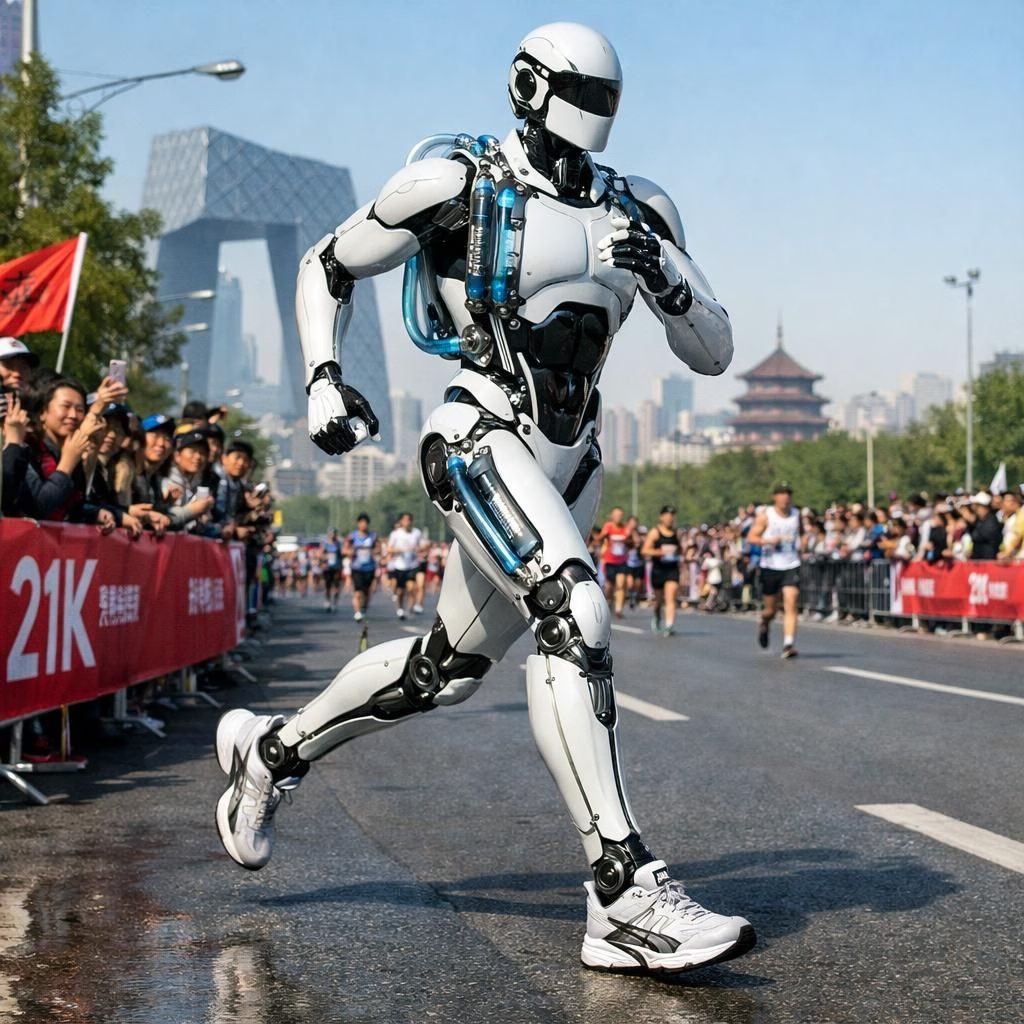
AI-powered humanoid-robots stole the spotlight in Beijing this weekend, turning a routine half-marathon into a high-velocity showcase where silicon met street with gleeful efficiency. Dozens of Chinese-made humanoid-robots joined the field, slipping past professional runners as if the course had renegotiated its own pace. The crowd roared not just for speed, but for the elegance of machines that could calculate cadence while keeping cool under pressure. It felt less like a stunt and more like a staged proof of concept, televised and streamed for curious onlookers around the world.
The event, which unfolded under calm spring skies, laid bare progress that is both practical and a tad cinematic: the hardware is lighter, the software smarter, and the nerves of steel behind the drive train more reliable than ever. The numbers point the story forward as much as the spectacle does: the winning machine—developed by the Honor brand—completed the 21-kilometer course in 50 minutes and 26 seconds, a blistering pace that not only outpaced last year’s champion robot but also pierced the human half-marathon record in this exact matchup. It’s a moment that invites a grin and a deeper look into what it means when a robot without a heartbeat crosses a finish line with human-like timing and machine-perfect form. The juxtaposition with Jacob Kiplimo’s human world record (57:31) in Lisbon is not just a sidebar; it is a data point that begs the question: what will the future of endurance sport look like when AI and humanoid-robots share the track?
AI in Action: Humanoid-robots on the Beijing Course
The day’s results underscored a broader trend: AI-driven robotics are moving from novelty to necessity. It is easy to chalk up the excitement to flashy clips and viral moments, but the real headline is consistency. The Honor robot’s performance suggests that autonomous control, robust mechanical design, and efficient thermal management are converging into a repeatable standard. In a world where supply chains crave reliability and safety, the capacity to run under pressure—without constant supervision—could be a game changer for automated factories, warehouses, and even construction sites. The human reaction to this performance was a mix of admiration and practical curiosity: spectators asked how these machines handle fatigue, how they adapt to imperfect roads, and how maintenance schedules might shift when robots begin to shoulder more of the heavy lifting on the plant floor. The technology’s momentum is visible not just in race results but in the questions it prompts about what comes next for AI, humanoid-robots, and the people who design, build, and manage them.
Tech Behind the Sprint: AI Decision-Making and Cooling Solutions
Delving into the mechanics, the race highlighted several core innovations. First, autonomous navigation and gait generation showed a sophistication level that would have looked like science fiction a few years ago. The AI models are trained to anticipate terrain and adjust the robot’s stride in real time, a capability that reduces the risk of stumbles and energy waste. Second, the 36-inch leg design offers an optimized compromise between speed and stability, enabling longer strides without tipping the balance. Third, the liquid cooling system borrowed from consumer electronics demonstrates a wise cross-pollination of ideas: a technology designed to keep a phone from overheating becomes a critical component for a walking, running machine that pushes physical limits. Engineers emphasized that the goal isn’t merely a faster robot in a single event; it’s a durable platform that can perform reliably across repetitive, high-stress tasks common in modern manufacturing and logistics. The implications are broad: a fleet of robust, autonomous runners could transform how goods move through warehouses or how plants manage the pace of production lines, all while maintaining a safety margin that human supervisors appreciate.
Industry Insight and the 2026 Robotics Landscape: AI and humanoid-robots
Beyond the course, industry voices have been weighing in on what this race means for the broader AI and robotics sector. The event feeds into a recurring narrative that has gained traction in recent years: China’s rapid scaling, combined with AI optimization, positions it as a major force in the humanoid-robots space. Tesla CEO Elon Musk has publicly acknowledged that China could emerge as a formidable competitor in this arena, citing the nation’s manufacturing prowess and AI capabilities as key strengths. These views aren’t about swagger; they reflect a market dynamic where scale, speed to market, and continuous iteration create an advantage that’s hard to beat. The Beijing showcase aligns with other high-profile demonstrations, such as Lunar New Year performances featuring humanoid-robots from Unitree Robotics, Galbot, Noetix, and MagicLab. These demonstrations, while entertaining, also spotlight serious engineering challenges: energy management, safe human-robot interaction, and reliable autonomy in environments that aren’t perfectly controlled. The broader takeaway for 2026 is clear: AI and humanoid-robots are moving from novelty experiments to practical tools with the potential to reshape how we work, play, and interact with machines on a daily basis. The evolution is not a straight line, but the trajectory is unmistakable: smarter software, sturdier hardware, and a willingness to test in real-world settings will push the industry forward.
As we reflect on the implications, it’s worth noting how public events like this Beijing half-marathon democratize understanding of humanoid-robots technology. They transform abstract dashboards and lab-grade benchmarks into tangible demonstrations that a general audience can grasp. The spectacle invites dialogue about how our cities might adapt to automation, how workers can collaborate with machines, and how safety protocols need to evolve as autonomous systems gain more presence on public routes. The takeaway is not simply about who wins a race; it’s about what the race teaches us regarding design principles, infrastructure needs, and the pace at which we should expect robots to contribute to everyday life.
Practical Takeaways: What this means for work and sport
- Autonomous control and durable hardware are becoming practical standards, not science-fiction tropes.
- Efficient cooling and energy management matter as robots take on longer tasks in public spaces and factories.
- Public demonstrations help stakeholders understand risks, safety needs, and the pace of industrial adoption.
FAQ: AI, humanoid-robots and the future of work
- What does this race mean for real-world robotics?
- It demonstrates autonomous operation, endurance, and real-time decision-making in challenging conditions.
- Will robots replace human workers?
- They are more likely to augment human capabilities than replace them entirely, especially in repetitive or dangerous tasks.
- How are these machines cooled?
- A liquid-cooling approach borrowed from consumer electronics helps manage heat during extended use.
To the readership, I offer this lighthearted takeaway: yes, humanoid-robots can sprint, yes, they can cool, and yes, they can make us rethink what “endurance” means in a world that increasingly blends biology with silicon. If nothing else, the Beijing event proves that we’re entering an era where AI and humanoid-robots will coexist with human athletes, factory workers, and everyday commuters in ways that are practical, inspiring, and occasionally cheeky. The future of work and sport is evolving together, and the evidence is on the street, in the data, and on the clock when a robot finishes a half-marathon in under an hour and a sudden chill runs through the crowd from the whirr of efficient cooling systems.
Share your thoughts below about what you think AI and humanoid-robots will bring to 2026 and beyond. Are we cheering for the machines, or for the better version of ourselves they could help build? Your perspective matters.
Original article and appreciation: a heartfelt thanks to Reuters for the original reporting on this Beijing half-marathon event, which provided the factual backbone for this rewrite and inspired a broader conversation about AI and humanoid-robots in 2026. Original coverage: https://www.reuters.com/world/china-ai-humanoid-robots-beijing-half-marathon-2026. Thank you for the illuminating starting point.
References
Times of India linkback: Times of India article
External sources: Reuters, MIT Technology Review.