

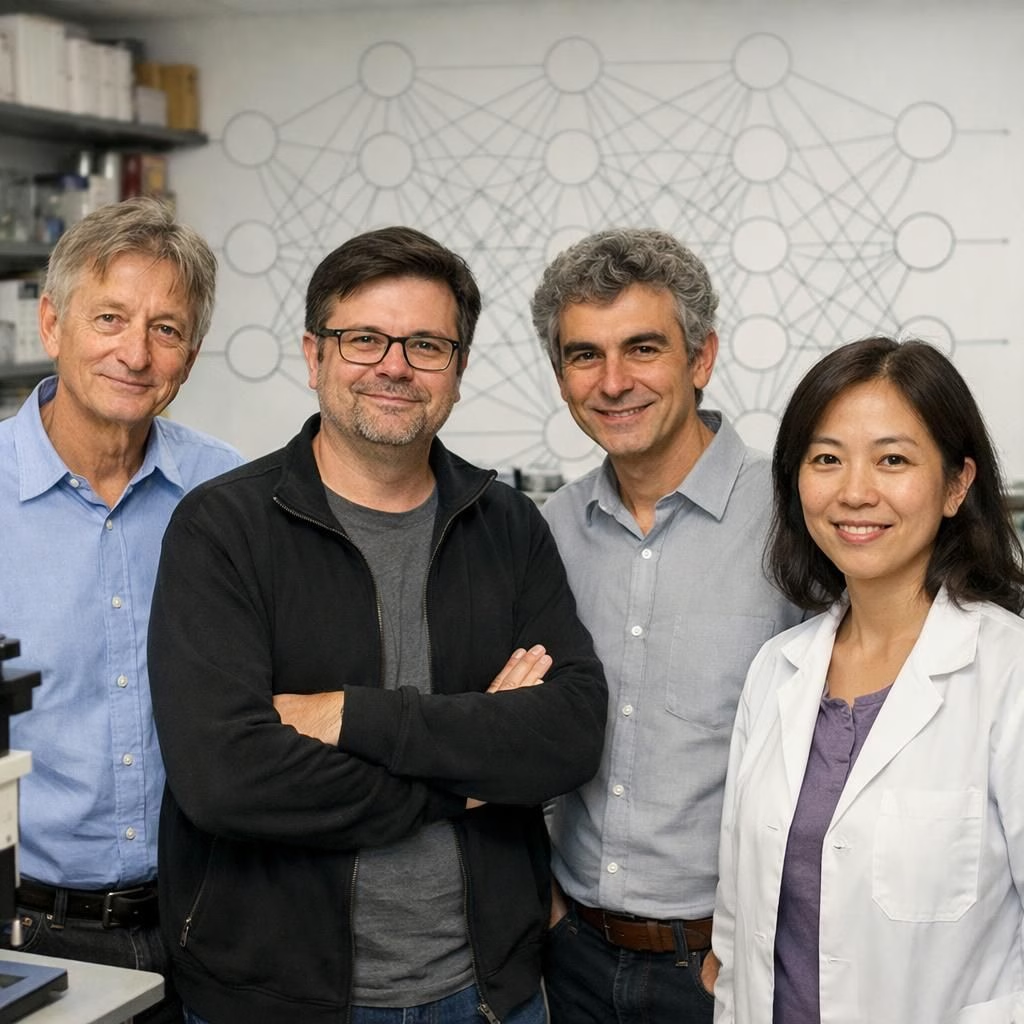
Long before buzzwords and hype cycles, the AI story began in quiet university offices, in underfunded labs, and in research groups most people wrote off as dead ends. TheGodfathers — Geoffrey Hinton, Yann LeCun, Yoshua Bengio — were joined by Fei-Fei Li, often called the Godmother, in a quiet rebellion of curiosity. They believed machines could learn from data the way brains learn from experience, and they kept the flame alive when funding flickered. Through decades of near-silence they published papers that read like whispers, trained students on techniques other teams dismissed, and asked questions that peers found too abstract or too ambitious. From this patient stubbornness grew deep learning, a family of neural networks that learn from examples rather than follow rigid rules. The world began to see with machines, to hear with software, and to rely on systems that improve as they practice.
AI Godfathers: Origins, Obstacles, and Outcomes
Deep learning rests on artificial neural networks that mimic brain circuits. They learn by adjusting connections as they see data, a process trained with exposure to examples. In the early days, some bet on symbolic AI and others moved quickly to flashy demos. The four pioneers refused to abandon the idea; they pressed forward, turning skepticism into a testbed for robust ideas. In the 1980s and 1990s, progress was slow, but the seeds of backpropagation and deep belief networks began to sprout. The turning point came in 2012 when AlexNet demonstrated the power of deep convolutional networks on ImageNet. Li’s data-centric approach helped the field shift from tricks to scalable learning. The results are widespread: smarter search, better medical imaging, more capable translation, and computer vision that touches everyday devices. The story of the AI Godfathers is a reminder that patient curiosity sometimes outlasts hype.
Geoffrey Hinton — AI momentum behind neural networks
Geoffrey Hinton believed layered networks could model the world by learning from data. Born in 1947, he pursued studies in Britain before joining research centers in North America. In 1986, his collaboration with David Rumelhart and Ronald Williams demonstrated backpropagation, showing how errors could travel backward through a network to adjust weights. This insight became the backbone of countless breakthroughs, even when peers doubted the approach. He mentored a generation of researchers, including Alex Krizhevsky, whose 2012 AlexNet victory on ImageNet signaled a turning point for the field. In 2018, he, LeCun, and Bengio received the Turing Award for foundational work in deep learning. In 2023 he left Google and began speaking openly about AI risks, urging careful governance as capabilities expanded. His career proves that relentless curiosity can pair with persistent responsibility.
Yann LeCun — AI vision and world models
LeCun built LeNet in the 1990s, a convolutional neural network that could read handwritten digits. The key idea was to look for local patterns—edges, textures, shapes—rather than treating each pixel in isolation. This insight made modern computer vision practical for banks and postal services. LeCun later joined NYU and led AI at Meta, where he argued that large language models do not automatically imply true intelligence. He proposed world models and structured internal knowledge as a path forward. He shared the 2018 Turing Award with his fellow pioneers. The balance of theory and hands-on testing helped shape a field that remains hungry for practical, responsible progress.
Yoshua Bengio — The conscience of the field
Bengio stayed with neural networks when others moved on. He tackled the vanishing gradient problem, explored recurrent networks for sequence data, and helped push language modelling forward. His 2003 paper on neural probabilistic language models introduced word embeddings, a concept now central to how machines understand language. He founded MILA and helped draft the Montreal Declaration for Responsible AI. Bengio’s calls for safety and ethics keep pace with capability, reminding us that progress must be tethered to humanity. The AI Godfathers and Li shaped a culture that values rigor as much as novelty.
Fei-Fei Li — AI’s eyes on the world
Li grew up in Beijing and rose through Princeton and Caltech to lead Stanford’s AI lab. Her ImageNet project turned data into shared knowledge, showing that enormous, well-organized datasets power learning. The 2012 AlexNet triumph proved that scale plus data can beat clever tricks alone. Li has championed diversity in AI, co-founding AI4ALL to broaden access and opportunity. She argues that who builds AI shapes what it does and whom it serves, a reminder that social benefit should sit beside technical achievement. Li’s work gave the world a practical, scalable way for machines to see the world, a cornerstone of modern AI.
Today the AI Godfathers story reads like a blueprint for long‑term thinking: stay curious, collaborate across disciplines, and test ideas even when they go against the current. Their legacy shows that a research community can endure winters with resilience, and the payoff can transform how we search, diagnose, translate, and relate to the world through cameras and screens. For readers curious about the future, the takeaway is simple: experiment boldly, but with humility. If you enjoyed this look at the AI Godfathers, please share your thoughts in the comments below.
Original sources and thanks
Special thanks to Encyclopaedia Britannica for Fei-Fei Li’s biography, and to Dinis Guarda and Tom Eck for their insightful articles. See: Fei-Fei Li — Britannica; The AI Godfather Who Stayed in the Wilderness for 20 Years; Getting to Know The Godfathers of AI.
Practical guide: how learning works in practice
- Data collection: gather diverse examples to reflect real-world variation.
- Model design: choose an architecture capable of capturing patterns across inputs.
- Training: optimize parameters using a method like backpropagation with labeled data.
- Evaluation: test on separate data, measure, and iterate to improve performance.
FAQ
- Who are the AI Godfathers? Geoffrey Hinton, Yann LeCun, Yoshua Bengio, and Fei-Fei Li are widely recognized as pioneers who helped build modern deep learning and computer vision.— their work spans theory, systems, and real-world impact.
- What is deep learning? It is a set of techniques that trains layered neural networks to learn from data rather than follow fixed rules.
- Why were AI winters important? They tested resilience in the field and forced researchers to reassess goals, approaches, and governance as capabilities grew.
- What is ImageNet? A large, annotated image dataset used to benchmark visual recognition systems and drive advances in computer vision.
References
- Times of India — 4 biggest voices who helped shape AI technology
- Fei-Fei Li — Britannica
- The AI Godfather Who Stayed in the Wilderness for 20 Years
- Getting to Know The Godfathers of AI
- Stanford CS231n notes on CNNs and visual recognition