

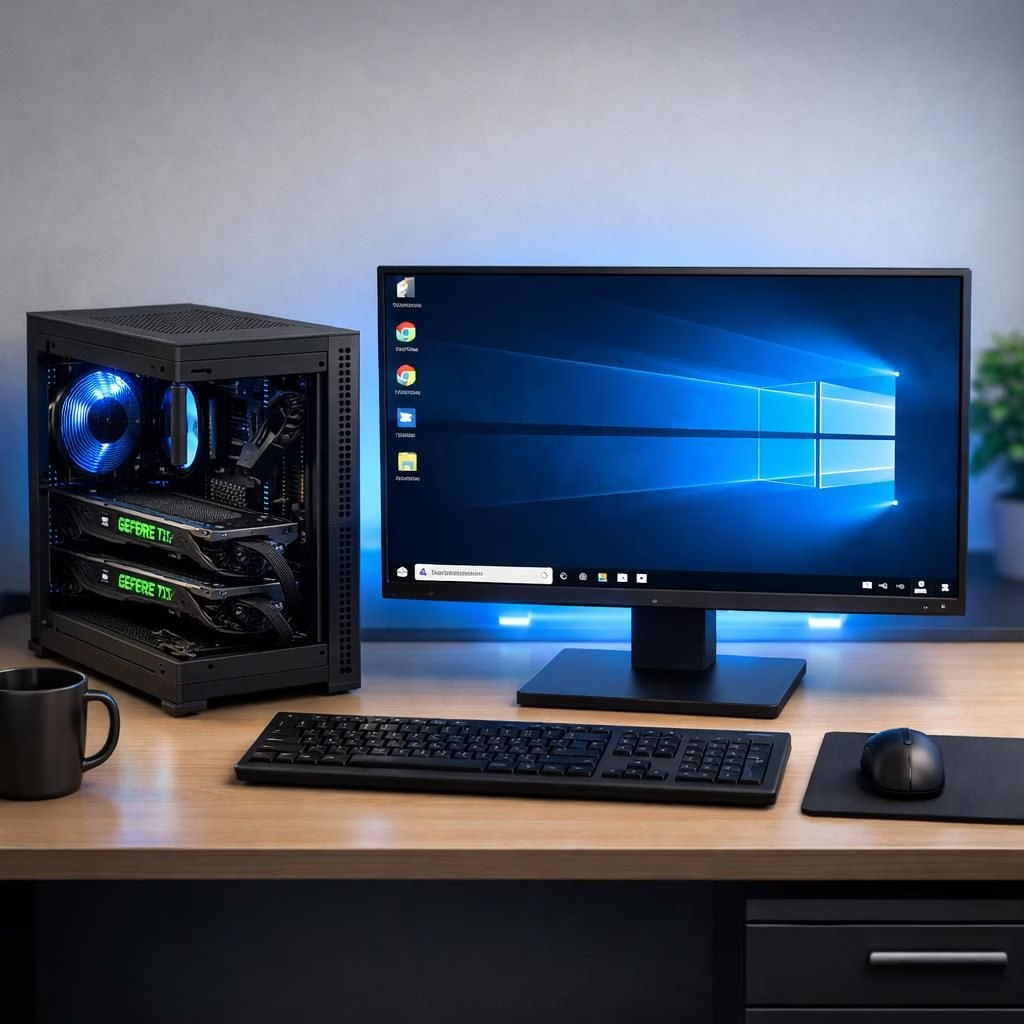
AI and Computex 2026 share the spotlight as Nvidia unveils a desk-side AI supercomputer designed for Windows, promising to process up to 1 trillion parameters locally and to plug directly into business workflows. The presentation style was upbeat, a little cheeky, and absolutely confident that the future of compute would not be outsourced to the cloud alone. The move felt less like a gimmick and more like a nudge toward practical AI at scale—the kind of nudge that makes IT teams start budgeting in fiscal quarters instead of in dream-tickets.
AI Desk-Top Power at Computex 2026
At the heart of the buzz was Nvidia’s DGX Station for Windows—a compact desk-side AI supercomputer touted to rival some small data-center setups. The pitch is simple: bring high-end AI capabilities closer to where people work, not off in some distant rack. The DGX Station is framed as a bridge between “one-click AI magic” and “hard-core enterprise rigor,” with a focus on direct connections to mission-critical applications and workflows. This isn’t a rumor; the claim is that a single desk-friendly unit can handle large parameter spaces locally, reducing latency and the need to bounce data across clouds for every inference task. In a world where milliseconds matter, that edge is more than a luxury; it’s a practical necessity for on-prem AI programs that must stay within corporate governance and data residency rules.
The Computex moment sits alongside parallel GTC 2026 announcements, creating a narrative that on-prem, enterprise AI workloads aren’t an afterthought but a core strategy. The message is consistent: you don’t need to pick cloud or local—start with local, then selectively extend to the cloud where it makes sense. That balance matters for teams worried about data sovereignty, privacy, and the economics of running dozens of fine-tuned models across thousands of agents. The DGX Station’s promise of up to 1 trillion parameters locally suggests a new level of capability at the desk, with the potential for faster iteration in deployment pipelines and a more seamless loop between model updates and live business processes. The emphasis isn’t just on raw horsepower; it’s on how that horsepower connects to the tools teams actually use every day, reducing friction and accelerating time to value for AI initiatives.
Computex Momentum for AI: Windows-Ready, On-Prem, and Local Fine-Tuning
HP, Dell, MSI, ASUS, and Supermicro joined the stage with related systems that push the same envelope: substantial memory and strong FP4 compute to support enterprise workloads, not just flashy demos. HP’s ZGX Fury GB300, for instance, is positioned as a companion to the DGX Station narrative, offering up to 784GB of coherent memory and robust FP4 performance. In practical terms, this means more room for running and fine-tuning multi-billion-parameter models close to the data, with data locality reducing the need to shuttle sensitive information across networks. The combined ecosystem is a signal that enterprise-grade AI is moving from the cloud’s halo to the desk’s reach, blending governance, speed, and control in ways that are unlikely to be dismissed by CIOs looking for predictable capex and operational expenses.
Pricing expectations are steep, which should come as no surprise given the target audience. DGX Station-like configurations have historically carried six-figure price tags, and early indications suggest the same trajectory for the newer desk-side options. The underlying point isn’t frivolous spending; it’s a readiness investment. Enterprises are weighing the total cost of ownership of cloud-based AI against on-prem deployments that can deliver consistent performance, predictable latency, and the ability to tune models in-house using local data. The implications extend beyond hardware: it’s about a procurement and maintenance strategy that respects enterprise realities—security, compliance, and the need to update models without waiting for a cloud provider’s release cycle.
Alongside memory and compute, the ecosystem emphasizes robust networking and integration capabilities. The idea is to connect AI workloads directly to enterprise apps, data stores, and security tooling so that AI components can operate as first-class citizens in existing environments. You don’t want an AI layer that requires a separate, parallel IT stack; you want a model that sits inside the current Windows-based PC and workstation world, muting friction and amplifying productivity. The windows integration horizon is real enough to spark conversations among operations teams who have spent years aligning AI pilots with company policies and procurement guidelines. If Windows is already the common denominator in many enterprises, then this strategy reduces the barrier to entry for AI at scale and invites a broader audience to consider AI-enabled transformation.
What This Means for the Enterprise: A Practical Path to Local AI
The practical implications are nuanced and hopeful. For teams wrestling with data privacy and regulatory constraints, on-prem AI with strong hardware baselines and a clear path to local fine-tuning offers a credible alternative to constant cloud reliance. For developers and data scientists, the ability to push multi-billion-parameter models closer to the endpoint means faster feedback loops during experimentation and testing, which translates into more iterations per sprint and fewer policy roadblocks. It’s not just about raw speed; it’s about the reliability and predictability that enterprises crave when moving from hype to habit. An AI workflow that can plug into existing business applications reduces the cognitive load on engineers, enabling them to focus on refining models rather than re-engineering pipelines for every deployment. The long-term impact may be a shift in where AI infrastructure sits—closer to desks, closer to decisions, and closer to the realities of day-to-day business processes.
The broader message is one of balance: cloud services will remain valuable for scale, updates, and elasticity, but the case for localized AI at the edge of the enterprise grows stronger every quarter. For organizations that need responsive AI with governance, the combination of DGX Station-like systems and enterprise-focused hardware platforms offers a compelling mix of capability and control. And while the price tags may be steep, the strategic benefit—quicker iterations, tighter data governance, and closer alignment with business workflows—can justify the investment when viewed through the lens of long-term AI maturity and operational resilience.
As Computex unfolds this year, watch for real-world deployments and case studies that demonstrate how these desk-top AI powerhouses perform under continuous workloads and multi-user scenarios. Expect to see more partners enabling plug-and-play integration with Windows-based enterprise stacks, and more vendors tuning their configurations for enterprise-grade reliability, serviceability, and support. The trend is clear: AI infrastructure is moving closer to the desk, not just closer to the data center.
If you’ve been curious about what this means for your organization, drop a comment with your questions and experiences—your insights help illuminate how AI touches everyday work and strategy.
As Computex continues to shape the conversation around enterprise AI, the path forward blends governance with agility, on-prem strength with cloud flexibility, and a steady hand on data residency.
Next step: consider a small pilot to evaluate latency, governance, and model updates in your Windows-based environment.
External links and references below provide context for trusted, real-world sources.
External references
Practical steps to adopt local AI
- Assess workloads that benefit most from on-prem inference and tight data residency.
- Map data flows to minimize cloud egress and latency in critical processes.
- Plan a phased rollout with Windows-ready hardware and scalable storage options.
- Establish governance and model update cycles aligned with security policies.
AI at the Edge: Computex momentum in practice
Early pilots should emphasize integration with existing enterprise apps and data stores to minimize disruption and maximize value.
FAQ
- What is the DGX Station for Windows capable of?
It is designed to run large parameter spaces locally, enabling near-desktop latency for enterprise AI workloads. - Why would an organization choose on-prem AI vs cloud?
On-prem provides governance, data residency, and predictable latency, which can lower long-term risk and cost for sensitive workloads. - What are typical cost considerations?
Initial hardware investments are significant, but ongoing cloud egress and latency savings can shift total cost of ownership in favor of on-prem for certain use cases. - How does this affect data governance?
Local inference simplifies compliance by keeping data within the enterprise perimeter and enabling tighter model version control.
Conclusion
In short, desk-side AI power echoes a broader trend: enterprises want fast, controllable AI with governance and predictable performance. The practical path forward involves careful planning, a phased deployment, and clear metrics to measure impact on workflows and risk.
References
Original source: TechRadar coverage of Computex 2026 AI announcements