

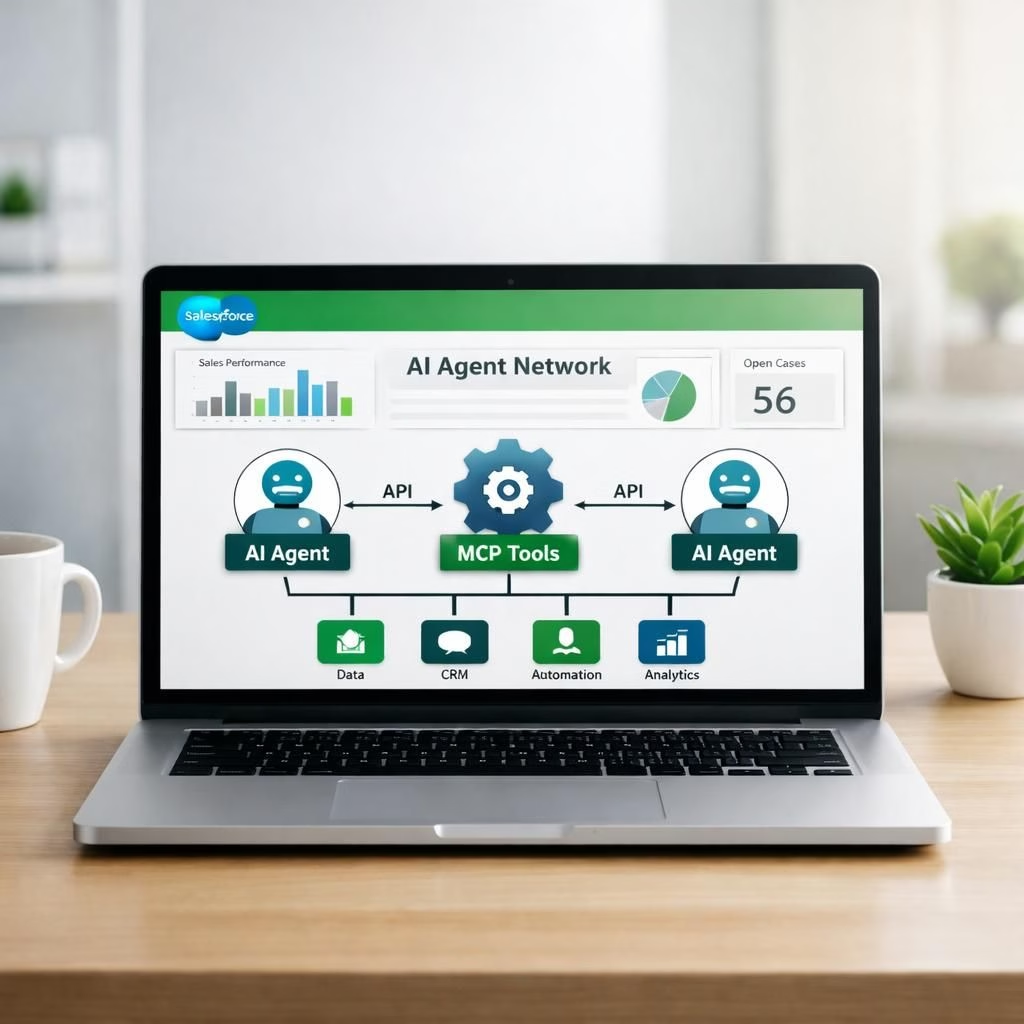
Forget the days of staring at API manuals like a detective in a data fog. Salesforce just rolled out Headless 360, a shiny toolkit that lets AI agents plug into its data without building a maze of custom connectors. The goal is simple: empower customer support and Salesforce teams to orchestrate workflows by calling APIs, MCP tools, or CLI commands from any Salesforce interface. In plain terms, you can run third-party AI agents—think Microsoft Copilot, Google Gemini, or Anthropic’s Claude—inside your Salesforce world. This is part of a broader push toward an open ecosystem where you choose your preferred AI navigator rather than being locked into a single UI. The tech press loves a good acronym, but the real win is speed and flexibility for operators who crave reality over rhetoric. AI agents in Salesforce may sound sci‑fi, but the payoff is practical: faster responses, cleaner data, and less time wrestling with integration kilobytes.
AI agents in Salesforce: Headless 360 in action
Headless 360 brings more than 60 MCP tools and 30+ coding skills. Developers can wire AI agents like Claude Code, Cursor, Codex, Windsurf, and other agent personas to live inside a customer’s data, workflows, and business logic. The platform promises a cockpit where agents and humans share the workload, with the system enforcing safety and observability. The result is a programmable Salesforce where you can swap in an AI navigator without rewriting a single interface. Early adopters report faster ticket routing, smarter case triage, and workflows that scarcely break a sweat. And yes, this is all done while you stay in familiar Salesforce surfaces, not in some stand-alone AI dashboard. If you squint, it looks like a future where your favorite AI agent is your coworker, your co-pilot, and your compliance enforcer all at once.
- MCP tools and coding skills: Headless 360 ships over 60 MCP tools and 30+ preconfigured coding skills that let developers give their AI agents like Claude Code, Cursor, Codex, Windsurf, and others live access to data, workflows, and business logic.
- Experience Layer: A new UI service that separates what an agent does from how it appears, generating interactive components like flight status cards, rebooking workflows, decision tiles, and data layouts. These components can be rendered natively inside Slack, and across Mobile, ChatGPT, Claude, Gemini, Teams, or any client that supports MCP apps, Salesforce said.
- Tools to control AI agents: Headless 360 also offers new tools that give users control over how agents behave in production, before launch and after, across every stage of the agent lifecycle. It includes Testing Centre, Custom Scoring Evals, Agent Script, Observability and Session Tracing, A/B Testing, Agent Fabric, and more.
Salesforce further announced AgentExchange, which brings together 10,000 Salesforce apps, 2,600 Slack apps, and 1,000 Agentforce agents, tools, and MCP servers from partners including Google, Docusign, and Notion, “discoverable through AI-guided search and activated in one click.” The idea is to knit a bigger, friendlier ecosystem where you can mix and match tools without getting lost in a labyrinth of connectors.
This is part of the broader shift toward an open ecosystem that emphasizes programmable experiences over fixed UIs. The exact pricing details remain under wraps, but analysts expect usage-based fees tied to how much work AI agents perform within Salesforce rather than a flat UI license. In practice, that means ops teams can scale automation with confidence, while vendors compete on capability, governance, and safety rails. The result could be a more resilient, adaptable enterprise stack where AI agents handle routine tasks and humans focus on strategy and oversight.
Salesforce: open ecosystem and the AI agents future
That sounds like a mouthful, but the takeaway is clear: the ecosystem grows beyond a single vendor’s UI. As investors debate the SaaS future sometimes nicknamed the SaaSpocalypse, Salesforce argues the opposite: tools, not mere interfaces, will drive productivity. Nvidia’s Jensen Huang has pointed out that AI agents will complement, not annihilate, software ecosystems. The idea is simple: aggressive tooling plus agent intelligence completes complex tasks without forcing users to switch contexts endlessly. In practice, that means support reps can pull data, run cross-system tests, and push decisions forward directly from Salesforce screens, while the AI agents handle rote chores in the background.
More than a flashy demo, Headless 360 signals a business model shift. Pricing will likely reward real usage, not just access to a shiny UI. For teams, that can translate into a direct link between automation and measurable outcomes—faster resolutions, higher client satisfaction, and more consistent governance across apps and data sources. The AgentExchange concept also invites a marketplace vibe: discoverability, one-click activation, and a spectrum of compatible tools from trusted partners. It’s a pragmatic approach to AI adoption, not a tech theater show.
In a year like 2026, Salesforce is betting that the platform itself becomes the programmable surface rather than a fixed page in a single app. That shift brings both promise and responsibility: better automation, but with careful governance and clear cost controls. If done well, enterprises will enjoy lighter manual workloads and more intelligent workflows—without sacrificing security or data integrity. If done poorly, the same tools could spawn a tangle of duplicate processes and unclear ownership. The balance will be in good setup, strong auditing, and thoughtful rollout plans.
What does this mean for you? If your team loves to experiment with AI agents, Headless 360 offers a playground where you can test integrations, tune workflows, and measure impact all inside Salesforce. If you’re cautious about governance, you can frame guardrails early and watch usage like a hawk. Either way, the trajectory is clear: more capabilities, more automation, and a future where AI agents collaborate with humans rather than replace them.
What are your thoughts on this shift? Share them in the comments below to keep the conversation going and help others navigate this evolving landscape.
FAQ
- What is Headless 360? A set of APIs, MCP tools, and CLI commands that lets third-party AI agents operate inside the Salesforce data and workflows without building custom UI layers.
- Which AI agents can be used? Popular options include Copilot, Gemini, and Claude, among others, integrated through the Headless 360 toolkit.
- How is pricing determined? Early signals point to usage-based fees tied to the amount of work agents perform inside the platform, rather than a flat UI license.
- What about governance and safety? Salesforce emphasizes observability, testing, and governance rails to keep automation predictable and auditable.