

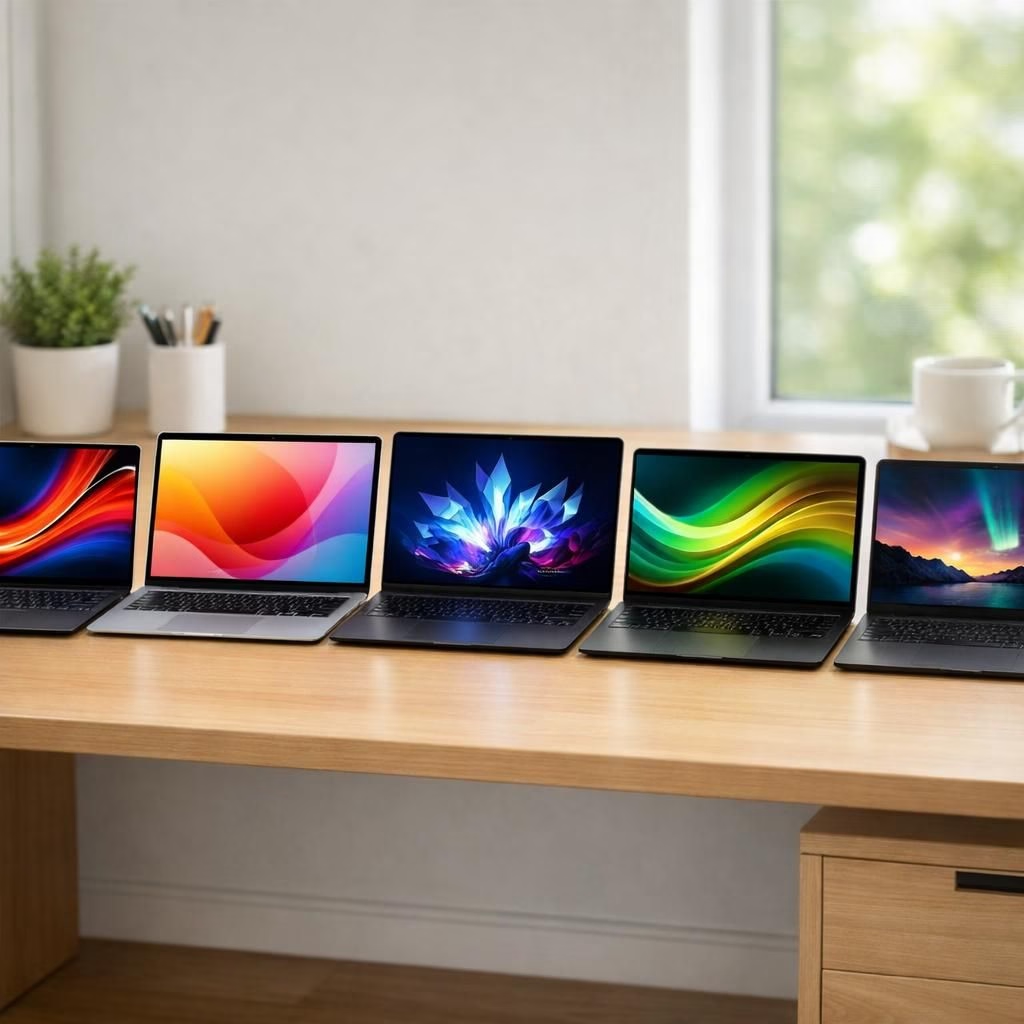
Ultra-thin AI-enabled devices now stand at the confluence of couture and code, delivering featherweight aesthetics with real horsepower. In 2026, many laptops under 15 mm prove that slim can be serious without sacrificing style. The result is a category where design meets performance in a way that makes engineers grin and travelers cheer.
Ultra-thin AI-enabled design shines in real-world tests
The ASUS Zenbook S14 leads the charge in this evergreen parade of elegance and endurance. It sits at about 1.1 cm thick and weighs roughly 1.2 kg, a feat achieved with a premium material the makers call ceraluminum. The internals ride on Intel Core Ultra processors, offering AI acceleration up to 50 TOPS, which translates into smoother AI-assisted workflows and snappier app previews. Its 3K 120 Hz OLED display bathes content in rich color and buttery motion, making both design previews and binge-watching a pleasure. A 77Wh battery keeps the lightness useful all day, and a smart cooling setup prevents the little engine from throwing a tantrum under heavy load. For professionals who want style without surrendering horsepower, the Zenbook S14 makes a persuasive case. Price on Asus’s official site: around Rs 1,30,990.
But ultra-thin has a broader story. The hobbyists and power users who crave both aesthetics and capability will find that AI-enabled tuning and software features push these machines beyond mere pretty faces. The hardware is not just fast; it’s self-aware enough to optimize fan curves and thermal behavior in real time, which keeps performance steady during long sessions. This is not futurism; it is practical optimism wearing a metallic frame.
OLED displays and portability redefine productivity
Apple’s MacBook Air M5 follows the tradition of slender, fanless efficiency. The chassis is around 1.13 cm thick and tips the scale at roughly 1.23 kg. The M5 chip brings a 10-core CPU and up to a 10-core GPU, combined with a 16-core Neural Engine for accelerated AI tasks. Memory is fast, and media processing is hardware-accelerated for crisp video edits and smooth rendering. Battery life remains astonishing; Apple advertises up to 18 hours of practical endurance on a single charge, which proves generous for a laptop this light. The latest MacBook Air M5 is available for Rs 1,19,900 on Apple’s site. Despite the elegance, there is no fan noise to chase, which some users will love and others might miss for thermal headroom, depending on workload.
In this discussion about OLED and portability, the MacBook sits as a contrast to Windows rivals. The OLED-laden screens are not universal in every ultrabook, but when you find one, the color discipline and deep blacks are unmistakable. The weight stays friendly for travel, and the thin body emerges as a highly portable workhorse when paired with long battery life and fast storage. The price tag remains a premium but justifiable for developers and content creators who value quiet performance and an ecosystem that just works.
The Samsung Galaxy Book 6 Pro expands the flavor of ultra-thin with a strong emphasis on display quality. It is about 1.16 cm thick and 1.24 kg, which keeps it sleek without asking for a compromise on usability. The device pairs an Intel Core Ultra X7 358H with Intel Arc B390 graphics and an NPU to accelerate AI tasks on the fly. The 14-inch Dynamic AMOLED 2X panel delivers a resolution of 2880×1800 with anti-reflection coating, ensuring vivid color even in bright light. You’ll see 32GB of LPDDR5X RAM and a roomy 1TB NVMe SSD ready for big projects. The Galaxy Book 6 Pro carries a price of Rs 2,12,790, a sign that premium components still demand a premium ticket.
Acer Swift 14 AI stands out for practical AI performance without exaggeration. It houses an Intel Core Ultra 7 256V with an AI Boost NPU that can deliver up to 47 TOPS. The 14-inch IPS touchscreen at 1920×1200 is bright and legible, with a matte finish that fights glare in mixed lighting. With 16GB LPDDR5X (expandable to 32GB) and a 1TB PCIe Gen4 SSD, multitasking feels brisk. At around 1.3 kg, this is still a pocket-friendly workhorse for travellers and students who want responsive apps and long battery. Connectivity leans into modern standards—USB4, HDMI, and Wi-Fi 7—while the sizable 65Wh battery ensures a full day without a pit stop. Flipkart lists it at Rs 81,990, a value proposition that still respects the device’s performance envelope.
Lenovo Yoga Slim 7 rounds out the group with a balanced mix of features and portability. It ships with an 11th Gen Intel Core i7 and Iris Plus graphics, and an option for a NVIDIA GPU if you need a touch of GPU heft for light creative work. The 14-inch display can reach 4K UHD with up to 500 nits brightness, delivering crisp images and respectable color fidelity. With 16GB RAM and 1TB PCIe SSD, multitasking remains smooth, and the 1.4 kg body makes it easy to carry between meetings. Extras like Rapid Charge Pro, Thunderbolt, and Dolby Atmos speakers give it presence in both productivity and media enjoyment. You can find the Yoga Slim 7 on Croma for Rs 88,990.
ultra-thin, AI-enabled performance on the move
Final thoughts and practical tips: ultra-thin laptops excel when portability, aesthetics, and day-long usability matter. They are ideal for travellers, students, freelancers, and professionals who want a computer that looks as good as it runs. If your workload includes heavy video editing, 3D rendering, or gaming, a bulkier, better-cooled machine might still be the smarter choice. Remember that a slim chassis can limit ports, upgradability, and sustained peak performance if cooling lags. The right choice aligns with your tasks, your workflow, and your tolerance for fan noise during creative bursts.
We invite you to share your thoughts in the comments about these ultra-thin, AI-enabled laptops and tell us which features matter most to you when choosing a portable powerhouse. This article includes a courtesy nod to the original source for inspiration and material. The Indian Express original article—thank you for the thoughtful reporting and the ideas that sparked this write-up.
Image inspiration note: If you want to see a simple, realistic render of this lineup, describe it to DALL·E 3 with a scene that shows five sleek ultralight laptops on a clean desk, open to reveal bright OLED screens and slim profiles, bathed in soft daylight.
Practical buying tips for ultra-thin laptops
Use this quick checklist to refine your choice before purchase.
- Clarify your primary tasks and battery needs to balance mass with endurance.
- Assess thermal performance and fan behavior for long sessions.
- Review ports (USB-C/USB4, HDMI) and potential for future connectivity.
- Decide between OLED and LCD based on color accuracy and brightness preferences.
- Check upgrade options and service support for the model you choose.
FAQ
- What defines an ultra-thin laptop?
- Typically under 15 mm in thickness with a focus on portability and long battery life.
- Are AI-enabled features worth it for everyday use?
- They can improve efficiency in daily tasks, but assess whether the software benefits align with your workflow.
- Can these laptops handle intensive workloads?
- Some models balance cooling and performance well; for heavy editing or gaming, consider a larger chassis with better cooling.
- How long does battery life usually last?
- Many ultrabooks deliver all-day use, but real-world endurance varies with brightness, tasks, and cooling efficiency.
References
- https://indianexpress.com/article/technology/tech-news-technology/top-thin-and-light-laptops-under-1-5kg-you-can-buy-right-now-10648493/
External context: for broader context on ultrabooks, see CNET’s Best Ultrabooks and TechRadar’s Best Ultrabooks.