

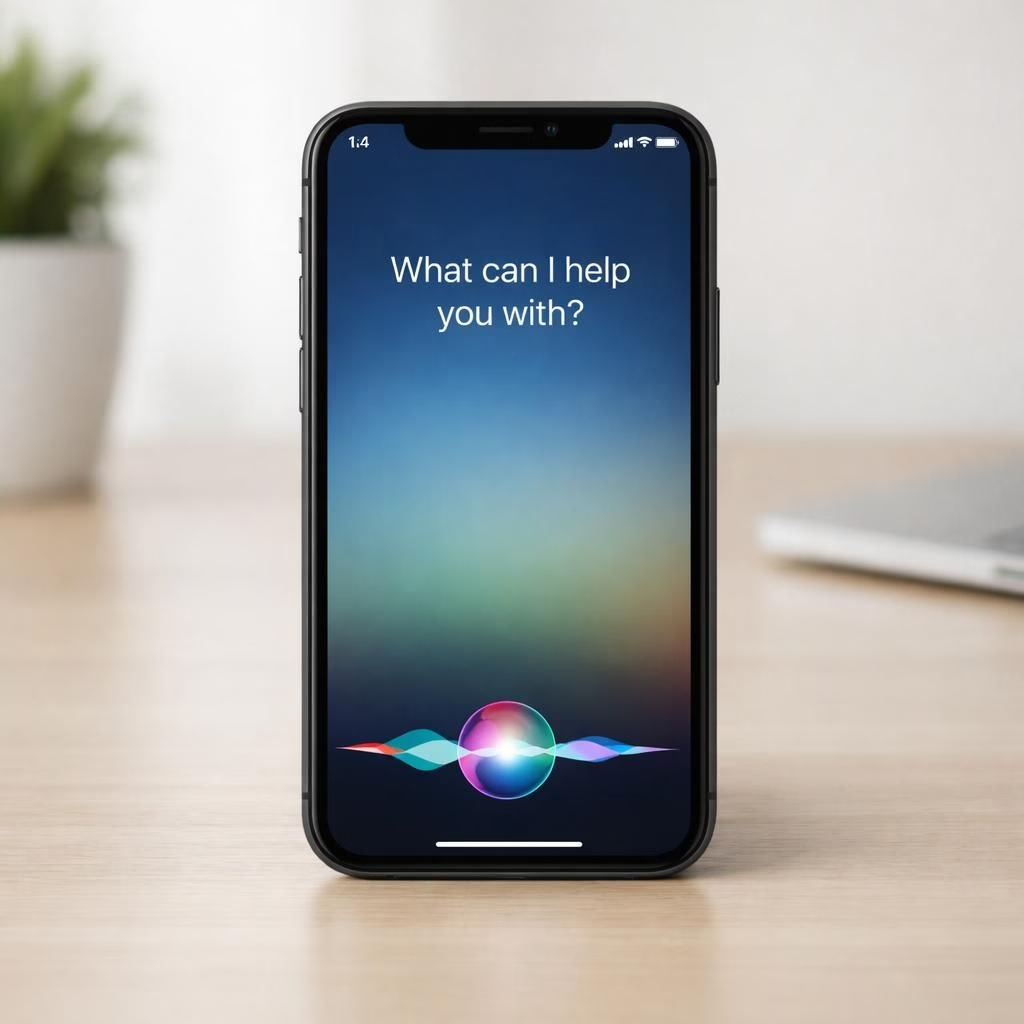
AI and Apple step into 2026 with a Siri makeover that feels less like a confident rumor and more like a well-timed upgrade. The core truth remains: Apple’s voice assistant is expanding its on-device thinking, tightening privacy, and swapping hype for practical smarts. Early commentary from The Verge and The Economist framed Siri as a dark horse in the AI race, and this piece doubles down on that idea—with a smile. We’re not chasing a sci‑fi oracle here; we’re chasing a reliable teammate who knows when to talk and when to zip its lips.
The shift is subtle, but it matters: more capable foundation models, smarter local processing, and a few quiet wins that stack up in daily life. The goal isn’t to shout about every improvement but to demonstrate how small, measured steps can yield real, repeatable benefits for Apple users across the globe.
AI-powered changes to Siri in 2026
Let’s unpack what the upgrade actually brings to the table. First, the third-generation foundation models promise better nuanced understanding. Siri can pick up on subtle cues in tone, phrasing, and user habits, which translates into more natural and helpful interactions. You say, and Siri hears you more clearly, not louder. This is the kind of improvement that quietly improves daily life: fewer misinterpretations, more precise reminders, and more relevant suggestions that don’t feel pushy. The shift is especially meaningful for hands-free scenarios, meetings, and quick queries while cooking or commuting. The AI behind Siri is designed to learn from patterns while keeping your data on-device as a default. In practice, that means fewer round-trips to the cloud and less data to worry about, without sacrificing the depth of responses you expect from a modern assistant.
Second, Apple’s private cloud compute ambitions are on display, but with a twist: the emphasis is on Confidential Computing to protect both the data and the code doing the computation. NVIDIA’s collaboration in this space hints at a future where heavy-lifting for tasks like language understanding and on-device reasoning can happen securely in a controlled environment. The practical outcome? Siri can perform more advanced analysis locally, offer richer contextual awareness, and still keep your sensitive information shielded behind robust encryption and secure enclaves. The public takeaway is a win-win: smarter responses when you’re closest to your device, and stronger privacy guarantees when your data would otherwise travel across networks.
Apple privacy meets AI performance in the new Siri
From a user’s perspective, the most compelling aspect is how Apple blends AI power with privacy by design. Siri’s 2026 iteration is not a celebrity endorsement of cloud supremacy; it’s a practical recalibration toward on-device intelligence that respects user control. You’ll notice faster command processing, fewer lags, and more accurate contextual memory—like Siri remembering your preferred wake words for certain tasks or suggesting routines based on your daily rhythm. The design philosophy is straightforward: you own your data, and the device does the heavy lifting. This approach aligns with Apple’s broader stance on privacy, and it’s where AI becomes genuinely useful rather than merely impressive. The on-device focus also supports offline capability, which matters in areas with limited connectivity or when you’re offline for long stretches. In short, Apple-enhanced AI can be both capable and discreet, a combination that makes the experience feel less like a sci‑fi demo and more like a daily helper you can actually trust.
Third, developers get a more robust sandbox for innovation. With stronger foundation models and a privacy-first mindset, Apple can push more ambitious features without compromising user trust. This is where the nuance matters: AI capabilities don’t automatically translate into louder, louder, louder features. They translate into smarter, more context-aware interactions that feel less robotic and more human, while still honoring user preferences and consent. The result is a polished balance between helpfulness and restraint, a trait that distinguishes Siri from some flashy competitors. If you value AI that respects your boundaries, this is a development you’ll welcome and rely on in the long run.
AI Apple Siri upgrade: a practical upgrade for daily life
Beyond the headlines, what does this mean for everyday use? You’ll notice fewer interruptions, more proactive but non-intrusive assistance, and better multi-step task handling. Siri can manage a sequence of actions—set the playlist, adjust the thermostat, and queue a quick call—without needing to ping the cloud for every micro-step. This is AI that feels like a teammate who knows your routine and your limits. The improvement also extends to third-party app integrations, where Siri’s on-device reasoning can offer shortcuts that feel natural rather than forced. The vibe is friendly competence: warm, helpful, and never pushy. With AI at its core, Siri’s responses stay crisp, and Apple’s privacy guardrails stay firm, giving users the best of both worlds. And yes, there’s still room for wit. The best moments are the ones where Siri—a little too earnest—delivers a practical answer with a touch of humor that doesn’t derail the task at hand.
Security and performance, of course, aren’t abstract buzzwords here. Apple’s partnership with Nvidia for Confidential Computing signals a technical roadmap that emphasizes secure enclaves, encrypted processing, and accountable AI routines. This means you can trust Siri to handle sensitive information—like calendar details, location hints, and personal reminders—without inadvertently exposing it to the wider internet. The takeaway is simple: AI progress that doesn’t demand surrender of privacy. In 2026 the balance tilts toward utility with a responsible, privacy-conscious backbone, and that’s a trend worth cheering for. For those following the coverage from The Verge, The Economist, and Apple Machine Learning Research, the message is consistent: Siri’s evolution is incremental, credible, and designed for real use cases rather than flashy demos.
AI Apple Siri upgrade: staying curious about the future
As with any AI journey, this is not a finish line but a waypoint. The combination of on-device learning, improved foundation models, and confidential computing sets a practical stage for what comes next. Expect more natural dialogue, smarter predictions, and fewer moments where Siri interrupts you just because it can. Expect also tighter privacy controls that make you feel in charge of your own data. The dialogue around AI and Apple isn’t about replacing human judgment; it’s about augmenting it with reliable, respectful assistance. The future of Siri looks less like a war between human and machine and more like a partnership between you and a well-trained, well-behaved digital assistant who knows when to speak and when to listen.
Thanks to the original articles and coverage from The Verge, The Economist, Apple Machine Learning Research, NVIDIA Blog, and WIRED for inspiring this thoughtful rewrite of the Siri story. If you enjoyed this take, you can explore the broader WWDC 2026 roundups and Apple’s public messaging in these sources linked below.
We’d love to hear your take on Siri’s 2026 journey. Do you notice a real difference in how often Siri talks back, or how well it respects your privacy? Share your thoughts and experiences in the comments. Your feedback helps shape the future of AI assistants in a way that stays friendly, practical, and human.
Image source and attribution: a simple, realistic photo concept that shows an iPhone screen with a friendly Siri interface on a clean desk with soft daylight.
Image prompt: A realistic, simple image of an iPhone displaying Siri on a clean wooden desk with soft daylight, minimal clutter, and a calm background, suitable for a tech blog post.
Image filename: AI-Apple-Siri-2026.jpg
Original article linkback and thanks: WIRED – Everything Apple Announced at WWDC 2026. Thank you for the source material and inspiring coverage.
References
- The Verge: Apple’s Siri AI chatbot personality
- WIRED: Everything Apple Announced at WWDC 2026
- Apple Privacy
- NVIDIA Confidential Computing