

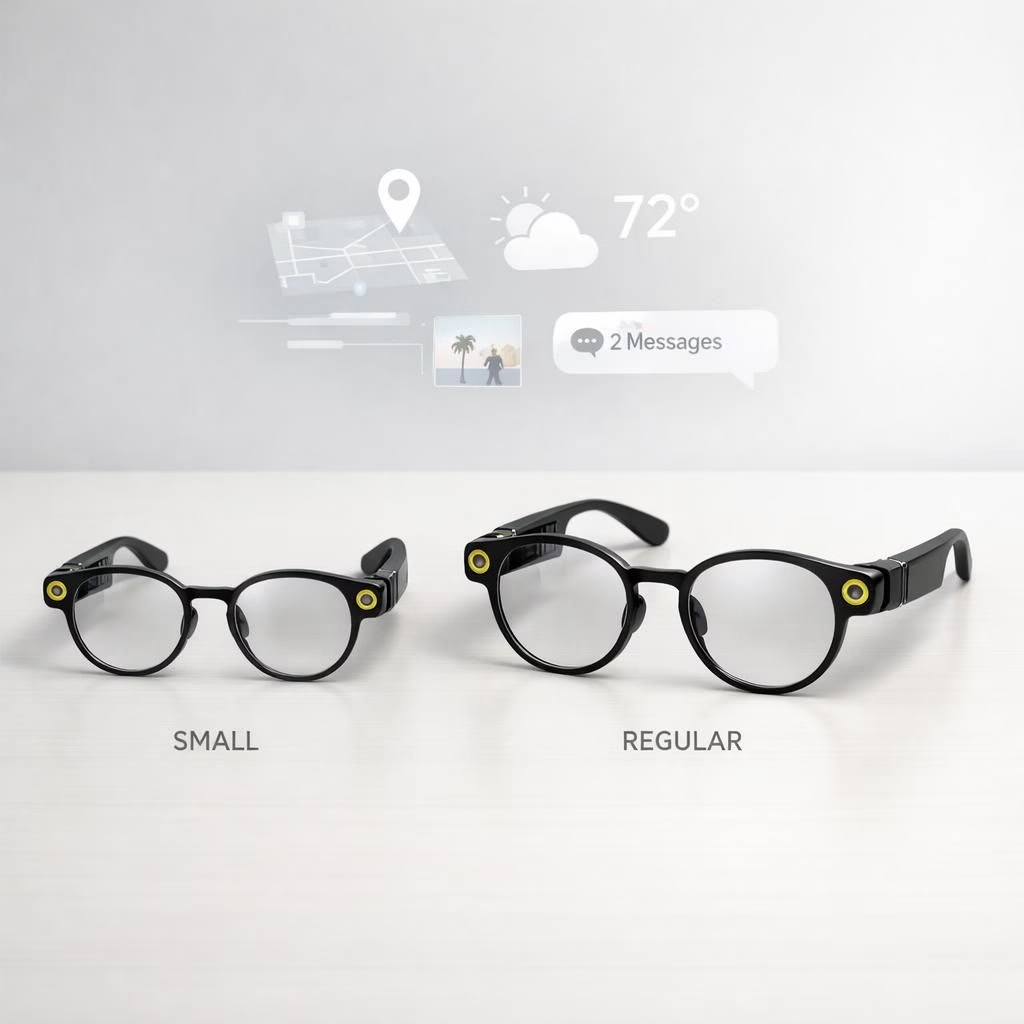
Specs and Tag B ambitions have landed in a bold, consumer-ready package from Snap. The company unveiled fully standalone Specs glasses and opened preorders for a fall launch in the US, UK, and France at $1,995 with a $200 deposit. This isn’t a lab toy; it’s designed to be worn outside, blending real-world tasks with digital overlays. If you’ve followed AR for years, you know the dream has hovered near your face long enough; now it’s finally on your nose.
Specs and true AR: Snap’s Standalone Glasses
Under the hood, Specs runs Snap OS on two onboard Snapdragon chips. The exact chip names remain under wraps, but the pairing enables a fully standalone experience without a separate computer. The device uses a proprietary LCoS display capable of 16 million colors per pixel, a figure Snap confirms but won’t publish in full resolution details yet. The diagonal field of view is 51 degrees, and the two frame sizes keep weight manageable: about 132 g for the smaller frame and 136 g for the larger one. It’s still heavier than regular glasses, but the payoff is a Tag B feel rather than a mini TV hovering in front of one eye.
Latency is where Snap pushes ahead. Motion-to-photon latency is a claimed 7 ms, the lowest publicly stated for a 6DoF XR product so far. That speed matters for smooth object placement and natural interaction as you navigate real space. The electrochromic lenses adjust quickly to your environment: indoor becomes clear, outdoor can shade, and the system promises a ten-second transition to near full opacity. It isn’t guaranteed to become fully transparent in all lighting, but it’s a meaningful improvement over older photochromic tech and many car windshields.
Inside Specs: true AR chips and latency
Size and weight aren’t the only tradeoffs. Snap designed Specs with two frame sizes to balance comfort and optics. The frame is a Swiss TR90 polymer that blends durability with a flexible, lightweight feel. Prescription inserts are supported, so you don’t have to choose between vision correction and overlays. The battery life is described as up to four hours of “mixed use,” though power-hungry AR experiences can shorten that figure. A charging case provides four full recharges, ensuring you don’t run dry at the coffee shop or on a plane.
The software story is essential. Snap OS is Android-based at its core, but you can’t sideload APKs. Instead, developers build sandboxed Lenses using Lens Studio on Windows or macOS, employing JavaScript or TypeScript to interact with high-level APIs. The goal is a safe, controlled set of experiences that work well with limited onboard compute, enabling a standalone 6DoF AR experience without a cloud relay or external puck. This approach helps Snap deliver a cohesive stack while other players experiment with different compute offloads.
Out of the box, Specs ships with first-party Lenses for web browsing, real-world navigation, measuring objects and spaces, second-screen laptop casting, whiteboarding, translation, and a contextual AI assistant. Lenses will be monetized via in-app payments or subscriptions, and a store will host third-party content from LEGO, Niantic, Synth Riders, Star Wars, and Avatar: The Last Airbender. It’s a bold move toward a developer ecosystem rather than a closed platform.
To support developers, Snap announced a Native Development Kit, enabling native C and C++ code and libraries in Lenses. The company also described a workflow that supports AI coding assistants like codex-style agents, paving the way for more advanced spatial mapping, physics, audio processing, networking, and navigation features. The combination of native tooling and AI-guided development could accelerate creative AR applications beyond the initial launch lineup.
The hardware and software package hints at a larger story: Specs could become a launchpad for consumer-friendly AR in a head-worn form factor. It remains to be seen how the blend of price, comfort, and performance lands with everyday users, but the direction is unmistakable: a true AR future that you can wear to work, travel, and casual days out.
Content partnerships suggest a growing appetite for practical, entertaining, and branded AR experiences. We’ve already seen third-party collaborations, and Snap’s store model invites more developers to build Lenses for daily life. The ecosystem approach is a smart hedge against a single-use device; if a handful of useful Lenses gain traction, the platform could justify the premium for many early adopters.
When we zoom out, this is not just a hardware reveal. It’s a statement about how AR should feel in real life: transparent enough to forget it’s there yet capable enough to overlay meaningful information. Tag B won’t be perfect at launch, and the weight will be a talking point for users with different comfort needs. But as a landmark moment, it signals a pivot toward consumer-ready 6DoF AR in a form that resembles everyday eyewear rather than a sci-fi prop.
In the broader market, the debate will revolve around accessibility, developer momentum, and real-world use cases. If Snap manages to balance price with compelling, consistently polished experiences, Tag B could become a familiar tool rather than a niche curiosity. As the product rolls out to more regions and early buyers report real-world impressions, we’ll learn whether this leap translates into durable everyday usefulness or a stylish but niche novelty.
Finally, a note of gratitude: the original coverage provided the groundwork for this deeper look at Specs. Thank you to the original article for outlining the key milestones and for helping readers understand what Snap is attempting with true AR glasses. Original source: UploadVR: Snap Specs design revealed, preorders open, price.
We’d love to hear what you think about consumer true AR hardware becoming a reality. Share your thoughts in the comments below to join the discussion about whether Specs will deliver the promised convenience or drift toward gadget limbo. Your perspective could illuminate the future of AR glasses in daily life.
Practical use cases for Specs
- Real-time navigation overlays for walking and driving scenarios.
- Object measurement and spatial planning for home or workshop projects.
- Second-screen casting to a laptop or meeting room display.
- Whiteboarding and collaborative notes with an AI-assisted lens.
Developer ecosystem and how to get involved
Snap is betting on a robust Lens ecosystem. Lenses can be downloaded for free by owners, while developers can monetize through in-app payments or subscriptions via Snap’s Commerce Kit. The Native Development Kit enables native C/C++ code in Lenses, broadening possibilities for complex spatial mapping, physics, and networking.
FAQ
- What exactly is Specs? It’s Snap’s fully standalone, 6DoF AR glasses with a dedicated OS and a Lens-based app store.
- How much does it cost? Preorders start at $1,995 with a $200 refundable deposit; shipments are slated for this fall in the US, UK, and France.
- How long does the battery last? Snap cites up to four hours of mixed use, though AR workloads can reduce that in practice.
- Will I be able to install third-party apps? Not as traditional APKs; apps run as sandboxed Lenses built with Lens Studio, with a controlled environment and optional AI-assisted development.
Conclusion
Snap’s Specs announce a pivotal shift toward wearable, consumer-friendly AR. The first generation won’t be perfect—weight is nontrivial, and the feature set is intentionally curated. Yet the groundwork is clear: a platform you can wear, with a growing library of practical Lenses and ongoing developer tooling. If price and experience align, Specs could redefine how we blend digital overlays with daily life.