

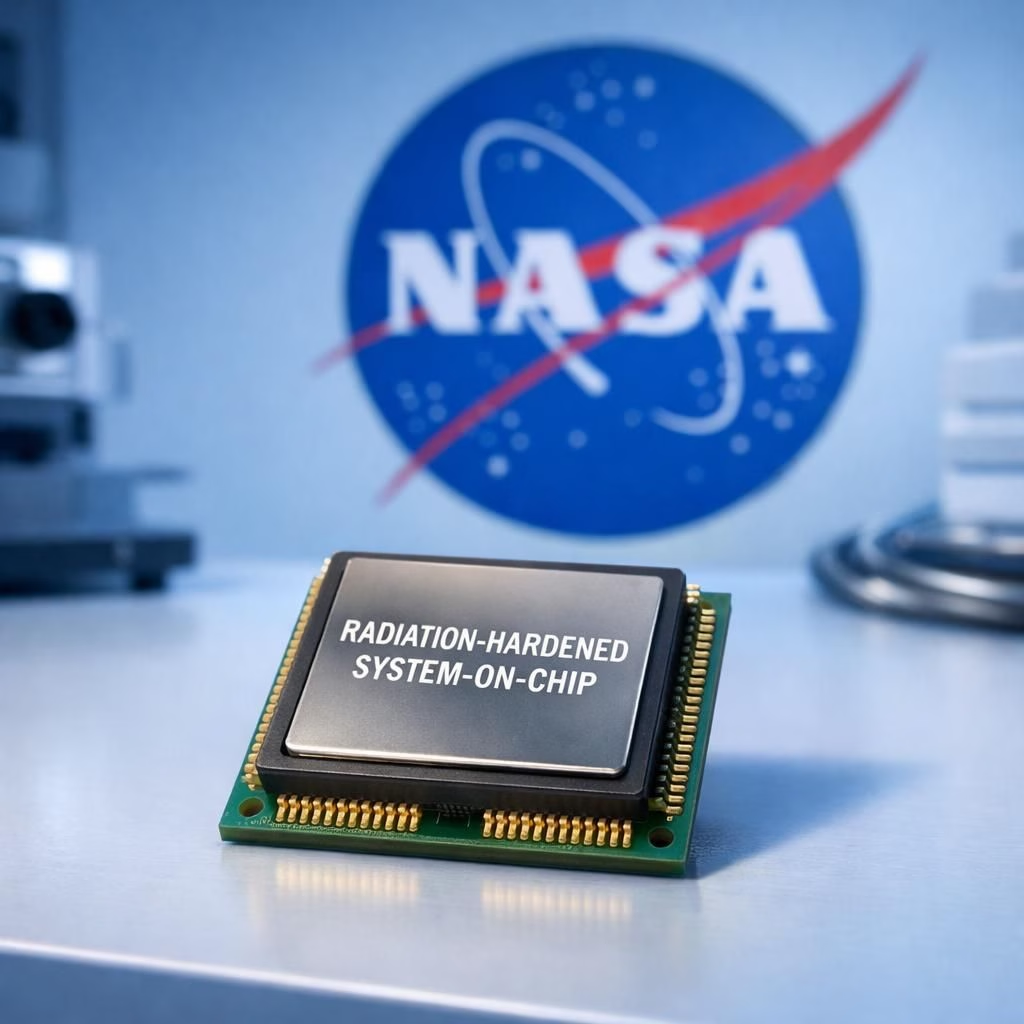
NASA’s latest hardware beat is a powerful, radiation-hardened system-on-a-chip designed to change how spacecraft operate in deep space. Born from a commercial partnership, this chip promises faster onboard processing, autonomous decision-making, and less downtime waiting for directions from Earth. In the world of far-flung missions, SpaceComputing is no mere buzzword; it’s a practical upgrade that helps AutonomousSpacecraft do more with less human oversight. The project targets control, science data, and crew safety, all wrapped in a palm-sized package that can endure radiation, temperature swings, and the occasional solar punch. This isn’t sci-fi; it’s engineering, with a wink and a nod to reliability. If you want to imagine it, picture a tiny, tough brain on a circuit board that can sort sensor streams, spot anomalies, and keep the ship marching toward its destination even if the link to home dims. Welcome to the era of smarter spaceflight hardware.
SpaceComputing: A New Frontier for Deep Space Processing
The High Performance Spaceflight Computing program is tasked with lifting the computing bar for exploration missions. In practice that means faster onboard data processing and smarter autonomy. Today’s spacecraft rely on proven, rugged processors that endure the space environment but can bottleneck critical tasks. SpaceComputing upgrades aim to accelerate scientific data analysis, enabling onboard AI to filter, compress, and relay only the most important findings. For SpaceComputing, this upgrade is a meaningful leap that reduces the need to wait for mission control to approve routine decisions. NASA frames this as a step toward more capable, safer deep-space operations and a foundation for future crewed missions to the Moon and Mars. The move has the sense of a tech upgrade with a mission pulse — practical, progressive, and boldly optimistic.
AutonomousSpacecraft: AI, Autonomy, and Safety in Orbit
As a practical test bed, engineers stress-test the processor with radiation, thermal, and shock scenarios to simulate the harsh realities of deep space. JPL researchers run functional campaigns to verify reliability. The plan: ensure the chip can survive the Sun’s high-energy particles and the cold of deep space, avoiding safe mode interruptions whenever possible. The aim is a chip that keeps the spacecraft mission-ready even when the link back to Earth blips. This is where SpaceComputing meets the real world of spaceflight, turning theoretical resilience into tested performance.
At the heart of the system lies a system-on-a-chip that packs CPUs, computational offloads, networking, memory, and I/O into a single unit. This compact design reduces mass, power use, and potential failure points. The SoC approach mirrors consumer designs, but NASA engineers designed this version to last years in space, far from any repair shop. In long missions, the SoC helps the spacecraft juggle multiple tasks — science data processing, navigation signals, health monitoring — with a nimbleness that old hardware could only dream of.
Testing began in February at JPL, and early results look promising. Measurements suggest the chip could deliver hundreds of times higher performance than current spaceflight processors, with a strong likelihood of up to 500 times in certain tasks. Engineers marked the milestone with a lighthearted note to celebrate progress. This blend of rigor and cheer signals a project that values results as much as it enjoys the journey.
The chip is the product of a partnership between JPL and Microchip Technology, a Chandler, Arizona-based company. Early prototypes have already been shared with defense and commercial aerospace teams. NASA describes the collaboration as an engine for standardization and cross-pollination into other industries, from aviation to automotive manufacturing. The teamwork here shows how space ideas often thrive when ideas cross borders.
Beyond raw power, the processor is designed to support AutonomousSpacecraft using artificial intelligence to react in real time to unexpected events when latency makes human input impractical. The SoC aims to speed up data analysis, enable rapid onboard storage and transfer of large datasets, and support future crewed or uncrewed missions alike. In short, SpaceComputing becomes a flexible backbone for mission resilience in the unknown.
Looking ahead, NASA envisions this technology enabling Earth orbiters, planetary rovers, crew habitats, and deep-space spacecraft to operate with higher autonomy, safer fault handling, and smarter data handling. The implications reach beyond the Moon and Mars: improved data triage, faster science loops, and better disaster-proofing for crews. In the best-case scenario, SpaceComputing and AutonomousSpacecraft become the quiet workhorses behind many of NASA’s next giant leaps.
Microchip and NASA expect the technology to mature, with adaptations for terrestrial industries in aviation and automotive sectors. The project remains under the Space Technology Mission Directorate’s Game Changing Development program at Langley, with JPL and Caltech guiding from concept to delivery. The cross-institution energy is part of a broader pattern: challenging the boundaries of what an onboard computer can do while keeping hardware friendly and survivable.
As with all bold tech, the real test is in operation. The promise of SpaceComputing and AutonomousSpacecraft is a future where spacecraft think a little more like us in a good way and rely less on constant contact with home base. What do you think about this next-gen space computer? Share your thoughts in the comments. And if you found this glimpse into NASA’s hardware journey interesting, you might enjoy following the latest updates in the field.
Original article: SciTechDaily article. Thank you to SciTechDaily for the original material that inspired this piece.
Looking ahead, this level of AutonomousSpacecraft capability will be tested under mission-like conditions.
Practical implications and steps
- Faster onboard data analysis enables real-time filtering and prioritization of science results.
- Autonomy reduces dependency on constant ground control, helping missions in deep space stay on track.
- Radiation-hardened design lowers risk of data corruption and unexpected resets.
- Smaller, lighter hardware translates to lower launch mass and energy use over long missions.
FAQ
- What is SpaceComputing? A radiation-hardened, multicore system-on-a-chip that handles multiple onboard tasks—data analysis, control, and communications—natively in space.
- What is AutonomousSpacecraft? A concept and capability set that lets spacecraft respond in real time to events without waiting for Earth-based commands.
- Why is radiation hardening important? High-energy particles can flip bits or crash processors; radiation-hardened designs maintain performance and reliability in space.
- When could this be flight-ready? Development continues under NASA’s Game Changing Development program, with testing across months to years depending on mission requirements.
Conclusion
SpaceComputing and AutonomousSpacecraft together promise smarter, safer spaceflight. The approach blends robust hardware with onboard AI to speed discoveries, protect crews, and extend mission lifespans far from Earth. As tests continue and collaborations mature, these advances could underpin NASA’s next giant leaps—across the Moon, Mars, and beyond.