

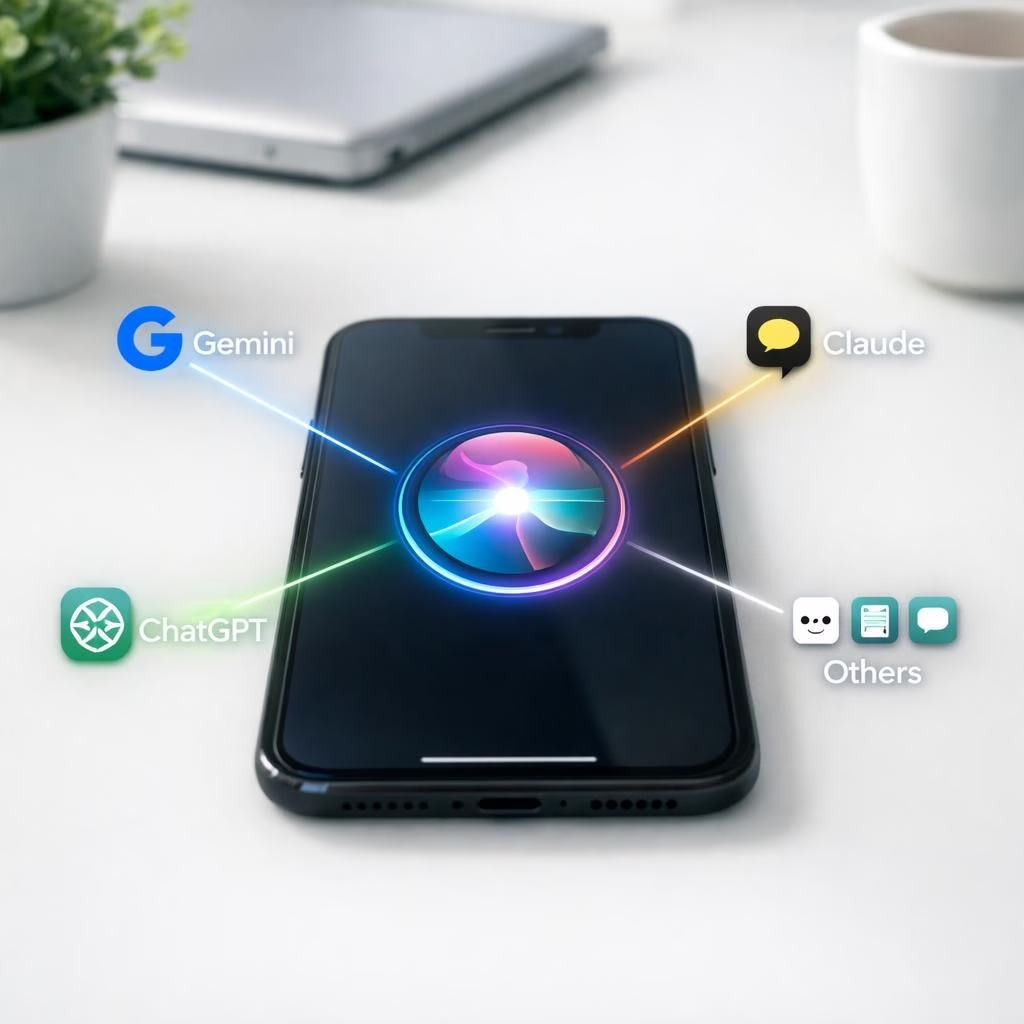
Apple is quietly reshaping Siri Extensions with a move that invites AI chatbots like Gemini, Claude, ChatGPT, and a handful of others into the conversation, rather than forcing users down a single partner path. The result is a friendlier, more flexible Siri that finally acts like a smart assistant instead of a rumor mill. In plain terms, Siri Extensions signals that no single partner will own the AI space for Apple users any longer. This is less of a revolution and more of a policy upgrade—one that prioritizes choice, control, and a dash of healthy competition.
Siri Extensions and AI chatbots: a practical guide
The plan is simple in concept and surprisingly forward-looking in practice. Starting in 2026, iPhone, iPad, and Mac users would download the chatbot app they prefer, then enable it in Settings under the Apple Intelligence and Siri section. After that, Siri can route queries to the chosen bot with a tap, a voice cue, or a quick automation. The key idea is multi-bot flexibility: you can keep Gemini handling global tasks while AI chatbots tackle a specialized writing job, or you can mix and match as your needs shift. The Extensions feature is slated for iOS 27, iPadOS 27, and macOS 27, with Apple expected to unveil all three at WWDC on June 8. The underlying promise is explicit: smarter helpers through a smarter ecosystem, not a single, monocultural AI chatbots partner.
From a consumer standpoint, the change is mostly welcome with a wink. For two years, Siri endured delays and internal churn while trying to keep up with AI chatbots. The new approach acknowledges that no one partner will be perfect for every task. It also acknowledges that people want variety, transparency, and the ability to switch gears without changing devices. In this model, Siri becomes a concierge rather than a gatekeeper, guiding you toward the best bot for the moment without locking you into a single vendor’s roadmap.
Choosing AI chatbots with Siri Extensions in 2026
Behind the scenes, the shift isn’t merely about adding more voices to Siri. It’s about giving Apple leverage to curate a layered AI chatbots experience. For example, Gemini might remain the backbone for core reasoning and background tasks, even if you opt for Claude or AI chatbots for more specialized dialogue or writing help. The Information and Bloomberg reports suggest that Apple already has a multi-year deal with Google to use Gemini as the backbone for its Foundation Models. The arrangement reportedly runs around $1 billion per year for access. An important twist is the possibility to distill Gemini into smaller, on-device models, letting Apple keep sensitive parts of the pipeline in-house while still offering a vibrant, multi-bot ecosystem to users.
The financial layer is also worth noting. Subscriptions for chatbot services that you access through Siri Extensions could feed Apple a commission via the App Store, potentially up to 30% on each sale. That revenue model aligns incentives with a broad, open marketplace while still rewarding Apple for the platform it provides. In other words, Apple is betting on a win-win: richer services for users, a cleaner app store economy for developers, and a strategic position in the evolving AI stack. Even with a broader mix of bots, Google’s Gemini is said to maintain a steady hand in the background for certain core tasks, ensuring stability and a consistent user experience even as choices multiply.
On the user experience front, this means more options, not a chaotic jumble. You could route a travel inquiry to Gemini for fast planning, switch to AI chatbots for nuanced tone and style in a draft, or pull up a ChatGPT-assisted explanation for a complex topic. The Extensions approach also reduces the risk of feature stagnation: with multiple partners, Apple can keep raising the bar for what a voice assistant can do, while smaller developers gain a direct path to reach iPhone and Mac users. In a world where AI progress is rapid, the multi-bot model feels more resilient and more fun than a single-bot monoculture.
Security and privacy remain on the checklist as well. Apple’s model of on-device distillation and selective server-side processing could help balance performance with user control. The company has long emphasized privacy design, and the Extensions framework can be built to minimize unnecessary data exposure while still enabling high-quality responses. The practical upshot is clear: you get more capable tools without surrendering more of your data to a single vendor’s global strategy. It’s not a perfect guarantee, but it’s a thoughtful, business-savvy approach that aims to align incentives across developers, users, and Apple’s own platform goals.
For developers, the Extensions feature opens a bustling marketplace: a single Siri-enabled entry point can direct queries to a diverse set of bots, each with its own specialty and voice. App developers will want to optimize their apps for quick activation, clean handoffs, and robust privacy controls so that users feel confident in routing queries to an external AI. In practice, that means clearer assistant prompts, smoother transitions, and agreements on how data is shared between Siri and third-party bots. It also means more opportunities for innovation in user interface design, with less friction when a user shifts from one bot to another mid-conversation. All of this, of course, happens within Apple’s guarded, well-documented ecosystem, which is largely good news for people who value consistency and reliability in their tech products.
As this strategy unfolds, one running thread remains constant: Apple’s commitment to giving users choice while maintaining a trustworthy platform. The AI race isn’t headed toward a single winner anymore; it’s trending toward a collaborative, interoperable layer where Siri becomes the conductor. The Alexa-style “skill” model gets an upgrade into a broader, more integrated AI orchestra, where you can invite the players you prefer and still benefit from the orchestration that Apple’s security and design standards promise. The net effect is a more capable, more flexible Siri that respects user preferences and keeps pace with a fast-moving AI landscape.
Original article: Bloomberg original article — thank you for the material and insights.
Siri Extensions: benefits for users
With Extensions, you gain a practical choice: you can pick a primary AI assistant for most tasks while keeping a backup that excels at specific jobs. It also means updates arrive faster because multiple partners compete to improve core capabilities and specialized features.
For everyday use, this translates into faster travel planning, smarter writing help, and clearer explanations across topics, all while keeping your data under a single, trusted umbrella.
How to get started with Siri Extensions: a quick guide
- Update your devices to the latest compatible OS versions when Apple rolls out iOS 27, iPadOS 27, and macOS 27.
- Download the chatbot apps you prefer from the App Store and grant the necessary permissions for Siri integration.
- In Settings > Apple Intelligence and Siri, enable Extensions and select your preferred default bot for different tasks.
- Test handoffs by asking Siri to switch between bots during a single conversation to see how well transitions work.
FAQ
- Do I have to choose a single AI chatbots partner?
- No. Extensions lets you route queries to multiple AI chatbots based on task and context.
- Will my data be shared with third-party bots?
- Apple emphasizes privacy; data handling depends on each bot’s policies and the agreed handoff rules within the Extensions framework.
- Is this available on all devices?
- Apple plans to ship the feature across iOS, iPadOS, and macOS 27, with WWDC 2026 as the kickoff moment.
In summary, Siri Extensions marks a practical shift toward a multi-bot ecosystem, where users can choose the AI assistants that best fit their needs without surrendering control over the platform.
References
- Times of India — original source
- Bloomberg: Apple opens Siri to multiple AI chatbots
- Apple WWDC overview