

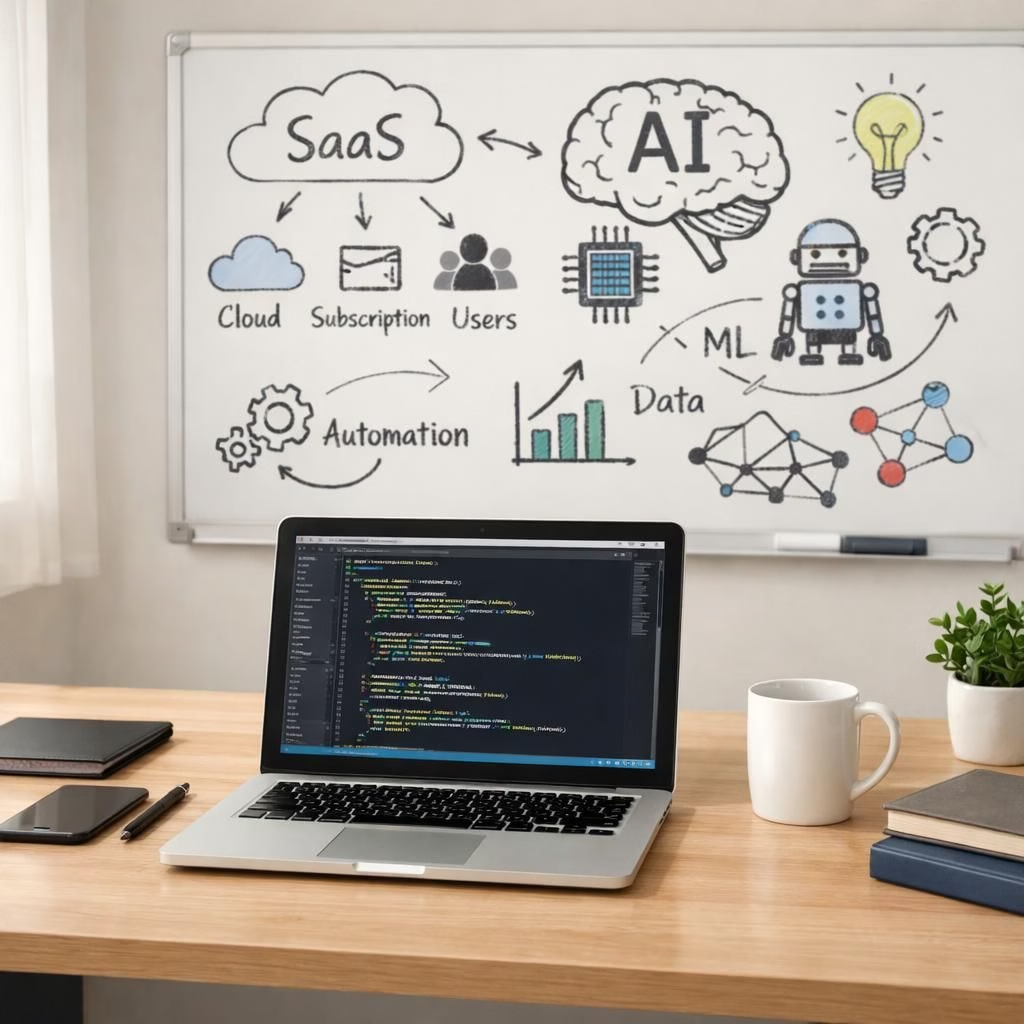
In 2026, the old rule that SaaS equals monolithic, off-the-shelf software is fading. Palantir’s Danny Lukus argues that generative AI lets forward-deployed engineers craft highly customized corporate software in days, not months, and at a fraction of the cost. The takeaway isn’t that SaaS is dead; it’s that the traditional package mindset is becoming a flexible, on-demand toolkit.
The reaction isn’t panic; it’s curiosity. Instead of wading through lengthy studies and armies of consultants, teams can sketch a solution, test it, and pivot on the fly. AI-powered tooling is central to this shift, enabling rapid prototyping and feedback-driven refinement that previously took months.
The headline claim sounds provocative, yet the spirit is practical: better software, faster, with less overhead, powered by AI. This more agile approach also makes room for experimentation, prototypes, and quick wins that show value early.
SaaS Reimagined: A 2026 Perspective on Custom Software
The death of the million-dollar study is overstated; the market shape has shifted. AI accelerates design, but governance, security, and domain knowledge still matter.
In practice, forward-deployed teams walk into a business, deploy AI-assisted tooling, and generate working models on the spot. They continuously test, refine, and scale as feedback arrives. This isn’t magic; it’s orchestration: AI helps write code, run tests, simulate workloads, and update architecture in near real time.
The old path of months of discovery and large consulting invoices has quietly become a slower lane on the highway to value. With AI, the SaaS concept becomes a living platform where components are assembled, swapped, and upgraded as needs evolve. The outcome is not chaos; it is coherence: a system that matches critical business processes to outcomes with less friction than the old one-size-fits-all approach. Teams that adopt this mindset report faster onboarding, clearer accountability, and a sharper focus on customer outcomes rather than vendor fatigue.
Governance, security, and domain knowledge still matter; AI can’t replace context. In real-world deployments, human oversight remains essential to steer decisions and ensure compliance.
Practical implementation matters. In this model, teams combine governance, security, and domain expertise with AI-driven tooling to iterate rapidly. The emphasis shifts from chasing licenses to mastering orchestration and outcomes. When developers, ops, and product managers collaborate with AI-assisted workflows, onboarding speeds up and accountability becomes clearer.
In short, the horizon is not doom for software teams but a retooling of how they work. The SaaS label remains useful, but it now sits on a dynamic, AI-powered base that can bend to a business will. If 2026 is any guide, the era of bespoke, rapidly deployed software is here, and it is powered by AI that can understand a workflow as well as a budget line item. The trend invites CIOs and developers to rephrase success in terms of velocity, value, and governance, rather than milestones on a vendor roadmap. The result is software that feels tailor-made but built from shared, composable pieces that can be swapped without breaking the entire system.
We invite readers to share their thoughts in the comments. Tell us how you see AI shaping your SaaS strategies and whether your team is already prototyping with on-demand architectures.
Special thanks to Forbes and Palantir for the original coverage that inspired this rewrite. Original article: Forbes coverage.
AI in Practice: Practical steps to prototype
- Survey business needs and map to a minimal viable workflow.
- Choose AI-assisted tooling to generate prototypes and test early.
- Set governance, security, and data controls from the start.
- Iterate with feedback loops and stakeholder reviews.
- Plan for scaling with automated testing and monitoring.
AI at Work: How Automated Agents Orchestrate Operations
Here the spotlight shifts to AI agents. Multiple specialized agents collaborate to manage end-to-end operations, from data pipelines to customer workflows. They emulate distinct roles in a chain of responsibility, monitor compliance, run tests, tune performance, and trigger workflows automatically. The result feels like having a small, diligent team on standby around the clock.
Prototyping becomes days, not months; testing and scaling are ongoing tasks with AI-driven governance. Critics worry about control; proponents push for governance by design: clear ownership, auditable decisions, and safe fallbacks. The AI-driven model does not erase human expertise; it reallocates it to higher-value work like strategy, ethics, and user experience. The synergy of AI plus human judgment yields software that learns and adapts without waiting for a vendor cycle to finish. In this setup, the role of the software engineer shifts from chasing licenses to orchestrating outcomes with AI as a partner.
- Speed: AI-assisted prototyping cuts cycles dramatically.
- Cost: Fewer external studies translate to lower project costs.
- Customization: On-demand software aligns with specific workflows.
- Governance: Human oversight remains essential for compliance and ethics.
- Reliability: Continuous testing and automated monitoring reduce drift.
In short, the horizon is not doom for software teams but a retooling of how they work. The SaaS label remains useful, but it now sits on a dynamic, AI-powered base that can bend to a business will. If 2026 is any guide, the era of bespoke, rapidly deployed software is here, and it is powered by AI that can understand a workflow as well as a budget line item. The trend invites CIOs and developers to rephrase success in terms of velocity, value, and governance, rather than milestones on a vendor roadmap. The result is software that feels tailor-made but built from shared, composable pieces that can be swapped without breaking the entire system.
FAQ: Common questions about AI-powered SaaS
- Is AI replacing software developers? No. It shifts the role toward orchestration and higher-value work while automating repetitive coding tasks.
- How secure is AI-driven software? Security and governance must be baked in from the start, with clear ownership and auditable decisions.
- Can smaller teams compete with giants? Yes. AI-enabled prototyping compresses cycles and enables rapid iteration.
- Where should I start? Begin with a pilots project on a single process, with strict governance and measurable outcomes.
Conclusion: Takeaway and next steps
The era of bespoke, rapidly deployed software is here, powered by AI that understands workflows and budgets. For CIOs and developers, success now means velocity, value, and governance rather than vendor milestones. Start with a small, well-scoped prototype and build from shared, composable components.
References: Original source linkback below.
References
Original source linkback: Times of India