

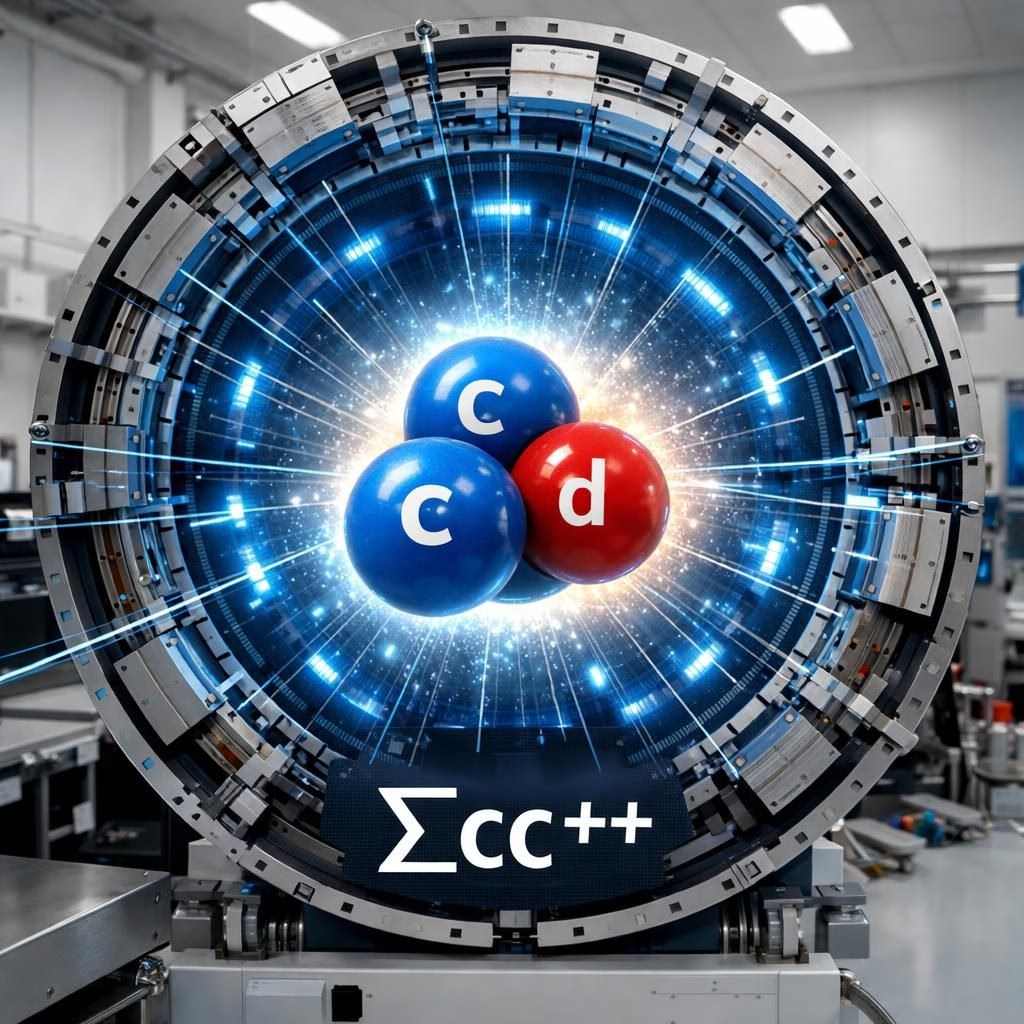
CERN’s LHCb collaboration announced Xi-cc-plus, a baryon that tests quantum-chromodynamics under the hood of the strong force. The particle carries two charm quarks and one down quark, making it heavier than a proton. It marks the 80th baryon observed at the Large Hadron Collider. This finding is not a trivial footnote; it provides a critical data point for how quantum-chromodynamics binds quarks and behaves in multi-heavy systems.
quarks in Xi-cc-plus: a closer look
Quarks are the fundamental building blocks that come in six flavors. Xi-cc-plus inherits its flavor mix from two heavy charm quarks and a lighter down quark. The result is a particle with a heftier mass and a distinct internal dynamic compared to the familiar proton. This setup is especially valuable for testing quantum-chromodynamics, the theory that governs how color charges interact via gluons. In multi-heavy-quark arrangements, the equations get intricate, and Xi-cc-plus offers a cleaner proving ground for those theoretical tools.
quarks and quantum-chromodynamics in practice: the two charm quarks matter
The two charm quarks shift how mass is distributed inside the baryon and impact the particle’s decay routes. Their presence tends to shorten the lifetime, complicating the experimental reconstruction. Detecting the decays requires precise timing and meticulous pattern recognition in the detectors. The 2023 upgrades to the LHCb apparatus improved tracking precision, vertex resolution, and particle identification, making it safer to claim a discovery for such a fleeting object.
quarks and quantum-chromodynamics: Looking ahead with Xi-cc-plus
Beyond the immediate finding, Xi-cc-plus helps physicists stress-test quantum-chromodynamics. The measurements feed lattice QCD calculations and other numerical approaches that theorists rely on to map how quarks interact at short distances. As the particle decays, the observed products act like breadcrumbs, guiding researchers to refine their models of confinement and hadronization. The result is a more robust framework for interpreting not only heavy baryons but a wider family of exotic hadrons, including tetraquarks and pentaquarks.
quarks and quantum-chromodynamics in action: upgrades and experiments
Detector upgrades intersect with scientific goals. Improved resolution reduces backgrounds and reveals rarer processes. This is essential because Xi-cc-plus decays shortly after its creation, leaving only a narrow window to collect clean signals. The upgrades at LHCb power more reliable tests of quantum-chromodynamics and a deeper confidence in our understanding of confinement. The work also builds a bridge to future machines that could push energies even higher and open new flavors of hadrons for study.
Looking ahead: the Future Circular Collider and the long arc of discovery
Researchers envision a future circular collider that surpasses the LHC in energy and luminosity. With that increased reach, scientists expect to observe even more heavy baryons and to probe their internal dynamics with unprecedented clarity. Xi-cc-plus is one of the early success stories that motivates investment in longer-term projects. If quantum-chromodynamics continues to match experimental data, physicists gain confidence in their predictions; if discrepancies appear, they gain a roadmap to new physics beyond the current model.
Beyond the standard picture: learning from Xi-cc-plus and friends
Every new baryon discovery reshapes the standard picture by revealing patterns or gaps in our knowledge. The interplay between theory and experiment strengthens as more data come in from upgraded detectors and future colliders. In practice, that means tighter tests of the strong force and more precise determinations of how mass arises from binding energy. The scientific payoff goes beyond one particle; it refines the entire toolkit used to explore the quantum realm.
We invite readers to share their thoughts about what the Xi-cc-plus discovery means for our understanding of the strong force and the colorful world of quarks. Do these results change how you view the reliability of quantum-chromodynamics, or do they simply add another piece to the puzzle?
Original article attribution: Thank you to Agence France-Presse for the original report. For the detailed CERN/LHCb press release, see the link: https://home.cern/news/2026/xi-cc-plus-discovery
References
- Original attribution: Agence France-Presse
- CERN/LHCb press release on Xi-cc-plus discovery