

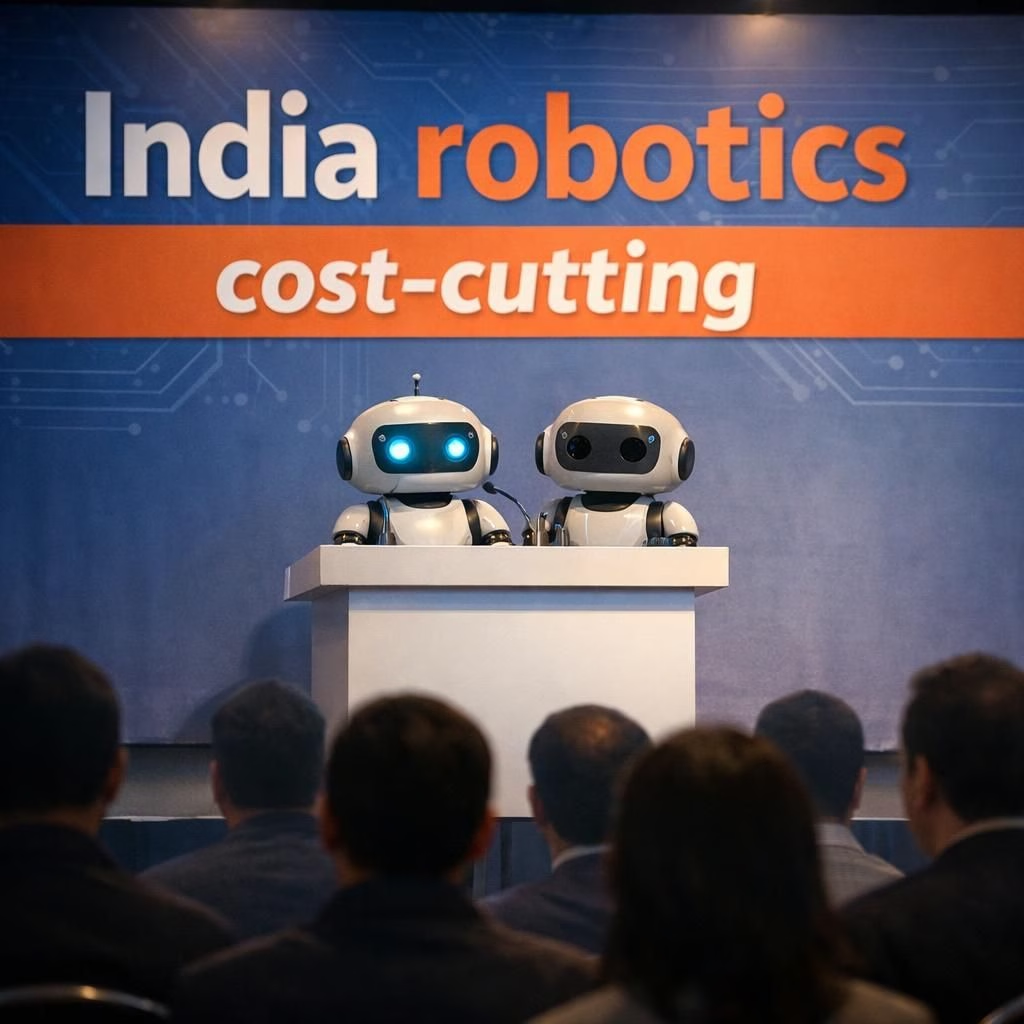
In 2026, India robotics stands at a curious crossroads: bold experimentation meets practical cost-cutting discipline. At the India Today Conclave 2026, two robots built in China rolled onto the stage, signaling more than spectacle. Rahul Shah, managing director of Bidyut Innovation, framed the moment as a nudge to inspire a new generation of builders.
His message was clear: these robots are not a gift to educational institutions; they are a catalyst to plant the seeds of curiosity so that Indian students can grow their own versions of such machines. The focus was simple, practical, and distinctly optimistic: cost-cutting—driven innovation can catalyze a homegrown ecosystem that prizes invention over imitation.
India robotics and cost-cutting in classrooms
Education is the most fertile ground for any robotics revolution, and the Conclave highlighted how India robotics can translate high-level talk into classroom action. Shah argued that India’s historical strength in frugal engineering—think Chandrayaan-era cost efficiency—serves as a blueprint for modern robots too. If India once sent a probe to the Moon at a fraction of the cost of foreign contenders, why not replicate that logic in educational robotics? The argument isn’t just about saving rupees; it’s about saving time and expanding access. When students see a locally sourced robot or a locally inspired design, their curiosity rises and their willingness to experiment grows. The emphasis on cost-cutting here is strategic: money saved on procurement can be redirected toward teacher training, better lab infrastructure, and hands-on projects that reinforce theory with practice. The combination of India robotics and cost-cutting creates a virtuous loop—more experimentation, more learning, more student-led innovation. The idea is to move from passive observation to active creation, with cost-cutting planning as the engine rather than a brake pad. In this scenario, students are not just consumers of technology; they become contributors who understand the trade-offs between performance, power, and price. The tone remains practical, yet the vibe is encouraging: India robotics can belong to the classroom, not just the boardroom.
The emphasis on cost-cutting in the narrative was not about cheaping out, but about scalable innovation that saves resources for important investments like training and lab infrastructure. In short, the talk painted a picture where ambition meets affordability and India robotics shines in that intersection.
Cost-cutting fuels India robotics progress on stage
The two Chinese-built robots on stage became symbols of possibility rather than proof of limitation. The choreography between hardware and software didn’t rely on high-end funding; it thrived on clever coding and tight timing. Shah noted that the team took about ten days to code the stage choreography, a reminder that the bottlenecks in innovation are often not the machines themselves but the logistics of learning and iteration. The robots delivered a lighthearted moment when one was asked if it likes humans. The reply, “I’m programmed to say yes, but I have seen your WhatsApp forwards, and it is becoming difficult to like you,” drew laughs and a brief, human moment of reflection about machine empathy and social skepticism. It wasn’t just a joke; it was a reminder that technology’s social dimension matters just as much as its technical prowess. The episode underscored a broader point: India robotics will advance faster when it blends technical skill with ethical and social awareness. The audience saw a microcosm of a potential future—world-class capability built on a foundation of common sense, cost-cutting, and creative education. The repeated emphasis on cost-cutting remains a practical blueprint: build, test, iterate, and share. This is how a country grows its own robotics industry, not merely by importing talent but by nurturing homegrown problem-solvers who can compete on cost and capability alike. The conversation naturally imports questions about automation in everyday life, and it hints at a near-term future where Indian robots might handle a wider range of tasks while staying affordable for schools, small businesses, and local communities. Musk and his visions are often cited in this space, but the conclave’s tone stays grounded: automation should expand opportunity, not eclipse it. The message is clear—India robotics can be a national project that births affordable, practical machines without sacrificing quality or safety, as long as cost-cutting is paired with smart engineering, robust testing, and a commitment to education.
Looking beyond the stage, experts weighed the longer arc: robots aren’t simply toys or lab curiosities; they are becoming essential to automation and manufacturing. The idea that humanoid and non-humanoid robots will shoulder more tasks aligns with a broader trend: automation as a tool for human freedom rather than a threat to it. NASA’s robotics program demonstrates how modular hardware and open software can lower costs while improving safety. Cost-cutting plays a dual role here. It keeps products affordable and accelerates adoption, while it forces designers to innovate smarter, often in ways that emphasize reliability, maintainability, and local supply chains. India robotics, therefore, doesn’t chase the cheapest option; it chases the option that offers the best balance of performance, safety, and cost over the lifecycle of a device. The conversation also touched on the global dynamics of robotics competition, including the friction with Western and Chinese players, and the need for India to protect intellectual property while sharing knowledge for the greater good. The result is a narrative that blends humor with seriousness, a hallmark of a practical, long-term strategy rather than a one-off show. The idea remains consistent: India robotics will grow faster if cost-cutting is used to fund training, to expand access to labs, and to encourage students to tinker, iterate, and excel. In short, the combination of India robotics and cost-cutting isn’t a constraint; it’s a catalyst.
As the Conclave wrapped, the dancing robots and the quiet confidence of the speakers offered a balanced forecast. The public conversation didn’t promise instant domination by Indian robots, but it did offer a tangible path toward homegrown capabilities that can compete on quality and price. It’s a future where students aren’t simply taught to consume technology; they’re taught to build it, adapt it, and improve it in a cost-conscious framework that scales. The message is a little cheeky, a little hopeful, and entirely pragmatic: if India robotics can harness its tradition of frugal innovation and pair it with modern robotics education, the next wave of Indian robots could be not just affordable but transformative. The crowd left with a refreshed sense of possibility, and a reminder that progress often begins with a few bold questions, a friendly robot onstage, and a plan that puts India robotics and cost-cutting at the heart of the journey.
Original article: Thanks to India Today for coverage of the India Today Conclave 2026.
Practical steps for schools and educators
- Start with a low-cost robotics kit and open-source software to teach core concepts.
- Involve local mentors from universities and industry to provide hands-on guidance.
- Use project-based learning: students design, build, test, and iterate, then share results with peers.
- Allocate funds saved from procurement to teacher training and lab upgrades.
- Create a simple pilot program in under-resourced schools to scale gradually.
FAQ
Can India’s robots rival global models within 3–5 years?
Experts say rapid progress is plausible if schools, labs, and startups collaborate to emphasize cost-efficiency and reliability alongside performance.
How can schools adopt cost-effective robotics programs?
Start small with open-source tools, partner with local colleges, and invest in teacher training to sustain long-term impact.
What about safety and standards?
Emphasize tested components, clear testing protocols, and alignment with local safety standards to ensure responsible adoption.
Conclusion: A pragmatic road map for India robotics
The India Today Conclave moment underscored a practical vision: frugal innovation paired with robust education can fuel homegrown robotics that meet real needs. The path emphasizes accessibility, careful engineering, and a steady push toward in-country capabilities. If India keeps investing in training, lab access, and open collaboration, the next wave of Indian robots could be both affordable and transformative for schools, small businesses, and communities.
References
- Original India Today coverage
- NASA Robotics program
- World Economic Forum on automation and robotics
- IEEE Spectrum: Robotics coverage