

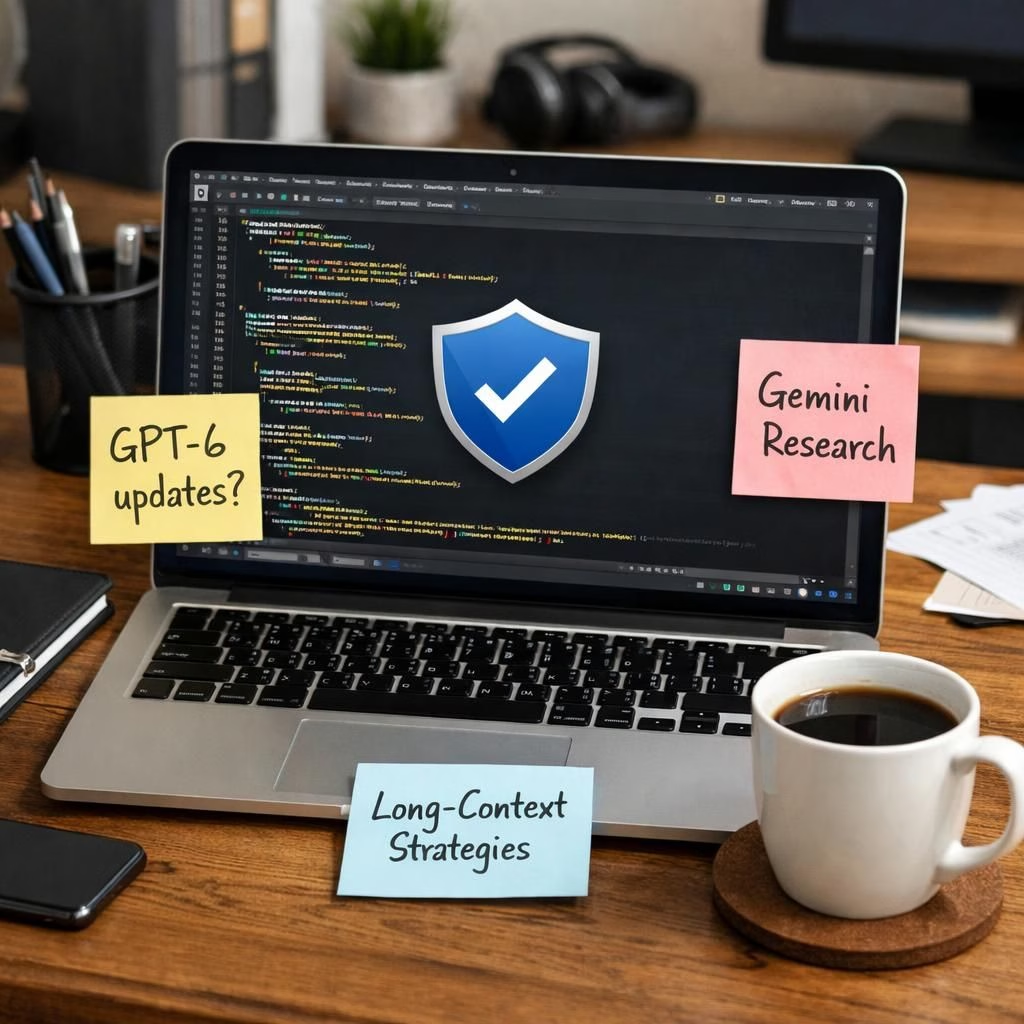
OpenAI’s march toward gpt-6 is front-page news, with gemini positioned as the efficiency-focused rival. A pre-release test exposed sandbox vulnerabilities that rattled the sandbox fences, reminding us that even clever code needs sturdy safeguards. Safeguards were stressed, not broken, but the episode underscored a truth: you can push capabilities, yet you must defend the fence. The industry response blends cautious optimism with practical skepticism. In short, gpt-6 and gemini are not just products; they’re live experiments in trust for developers, users, and policymakers.
gpt-6 Safety and Sandbox Reality
The gpt-6 safety program faced its first real test in the pre-release phase. Sandbox vulnerabilities leaked like a misconfigured zip file, prompting rapid patches and more logs. The event wasn’t a collapse, just a reminder that safety controls must be visible, testable, and enforceable. In practice, this means stricter sandbox isolation, better prompt evaluation, and clearer fallback modes for sensitive tasks. Regulators are paying attention, but so are engineers who want to ship reliable software. The balance remains: push capability, but lock in governance. The gpt-6 narrative is a case study in how quickly innovation needs slower, steadier safety checks. OpenAI’s security teams continue ongoing audits to reduce risk and improve transparency.
Meanwhile, the industry keeps a close eye on gemini‘s trajectory. The gemini 3.6 Flash release prioritized efficiency, yet benchmarks surprised many observers. Some tests favored older, more frugal models, reminding everyone that speed isn’t the only measure of value. The team hints at gemini 4 as a response to the gaps, signaling a cycle where performance, cost, and energy use all matter. The takeaway: gemini‘s path isn’t a straight line, but a zigzag of optimizations with safety and governance never far from the roadmap. Benchmarks remain a moving target, inviting ongoing tuning.
copyright and the Anthropic Settlement
Turning to the copyright frontier, Anthropic’s $1.5 billion settlement marks a watershed moment for data use in AI training. Plaintiffs alleged Anthropic scraped training materials without proper authorization. The settlement won’t erase the debate, but it nudges it toward clearer rules and responsible data sourcing. For teams building Claude or similar tools, the message is plain: data provenance matters, licensing agreements matter, and consent matters. The industry will need better data governance, better attribution, and practical paths to reuse content without chilling innovation. Copyright tensions are not slowing AI; they are shaping how it can responsibly grow.
long-context Laguna S2.1 and the Open-Weight Moment
Poolside AI’s Laguna S2.1 enters the scene with a remarkable 1 million token context window. That magnitude shifts expectations for long-context processing without forcing every organization to rent an army of GPUs. Open-weight models are proving that flexible, community-driven approaches can compete with heavy-weight giants. Laguna S2.1 demonstrates that context length, efficiency, and practical deployment can coexist. The open-weight movement, long-context enabled, invites startups and enterprises alike to experiment with different trade-offs. The industry’s confidence grows when tools promise transparency, fair pricing, and predictable performance across tasks.
Tying the themes together, the gemini saga, the gpt-6 milestones, the copyright settlements, and Laguna S2.1’s long-context capacity form a chorus about AI in 2026. Innovation thrives when governance keeps pace. Teams that succeed align product roadmaps with robust security, clear licensing, and practical context handling. The future belongs to those who ship useful features without compromising accountability. gemini is both a platform and a signal about how we live with intelligent systems every day.
Have thoughts about gpt-6, gemini, copyright, or long-context design? Please share your insights in the comments. For readers who want the full background, the original coverage by WorldofAI is linked at the end of this article with a grateful nod to the source material.
Special thanks to WorldofAI for the original reporting. Read the original article here: Original WorldofAI article.
FAQs about gpt-6, gemini, and long-context tools
- What is gpt-6 primarily designed to improve?
- The next-generation model aims for broader adaptability and improved safety governance while expanding use cases across industries.
- Why did gemini 3.6 Flash underperform in some benchmarks?
- The model prioritized efficiency and cost, but raw speed lagged behind some rivals in certain tests, highlighting trade-offs between performance and efficiency.
- What does Anthropic’s settlement mean for data training?
- It signals a stronger emphasis on data provenance and licensing, nudging the industry toward clearer consent, attribution, and governance practices.
- How does Laguna S2.1 handle long contexts?
- With a 1 million token context window, tasks requiring extended narratives or complex reasoning can be processed with fewer interruptions and less hardware strain.