

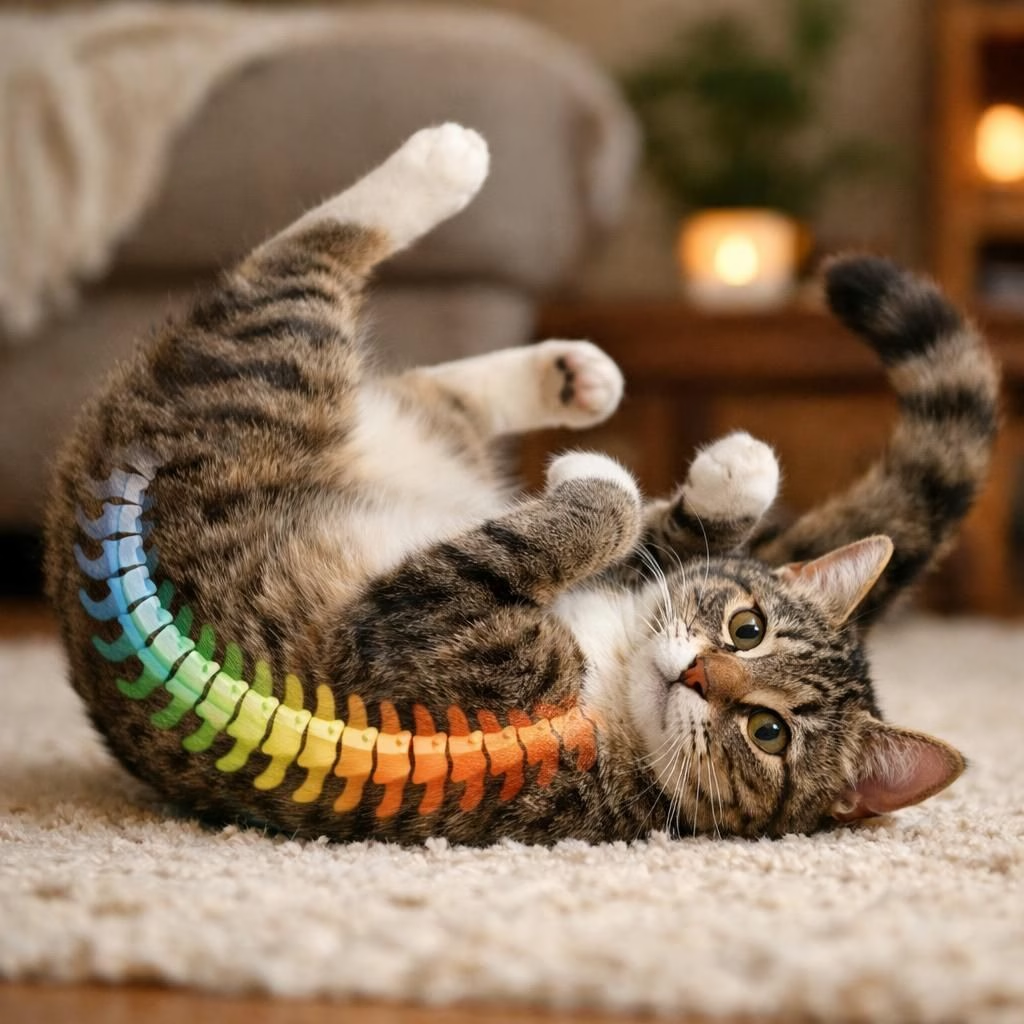
In the curious world where cats meet physics, flexible feline spines let bodies twist and reorient midair with astonishing grace. The falling cat puzzle is famous: how does a cat land on its feet almost every time? This article translates that mystery into practical insights for fans, pet owners, and curious engineers in 2026. Expect punchy explanations, practical takeaways, and a dash of humor about how nature signed off on efficient design.
flexible feline spines and balance in motion
The spine in a cat is more an accordion than a rigid column. Its flexible feline spines design acts as a natural steering system, allowing a rapid change of orientation even when the feet are still in the air. As the back vertebrae adjust in tiny steps, the head and tail serve as counterweights to guide the torso toward a safe landing. In 2026, researchers map the precise sequence of vertebral movements that minimize the risk of a messy touchdown. The bottom line: flexible feline spines enable swift, energy-efficient reorientation.
Notice how in motion the word spines keeps popping up. The phrase flexible feline spines appears in summaries and diagrams, because it captures a torso that pivots without flailing. This isn’t abstract; it shapes how we think about balance under uncertainty. For cat lovers and lab researchers alike, flexible feline spines is a handy shorthand for a broader design idea: give joints and muscles room to work while keeping the system simple and predictable. When you watch a cat land, you see the spine lifting with precision, complemented by timely tail movement observed in slow motion and in real life.
The falling cat problem solved by physics
To appreciate the falling cat, we need a quick primer on angular momentum and gravity. When a cat starts to fall, it twists its upper body in one direction while keeping its hips and hind legs tucked. The result is a rotation of the torso without flipping the entire body into a corkscrew. The falling cat becomes a textbook case of conservation of angular momentum at work, with the spine acting as the primary lever. With every tiny adjustment, the cat changes the axis of rotation and lines up for a forepaw contact with the ground. The tail rotates as a counterweight, helping to correct yaw without wasting energy. It is a beautiful demonstration that simple rules can yield complex behavior in a living animal. The falling cat problem, in practice, maps to a robust strategy: sense fast, react faster, and accept small errors as part of the landing plan.
For designers building autonomous agents, the falling cat principle translates into a design choice: favor rapid feedback and multiple articulation points over a single hinge. The spine becomes an adaptable chain of segments that can fold, twist, and rebound. This approach reduces the need for heavy stabilization gear, a win for lightweight robots. In human terms, the falling cat idea teaches resilience: when life tilts, the best response is quick reorientation, not a heroic stand in a fixed posture. The concept is simple, and the payoff is pragmatic: safer landings with fewer broken parts and more reliable performance in unpredictable environments. This is the kind of knowledge that helps robotics, biomechanics, and even sports equipment designers avoid over-engineering while staying dependable.
Beyond the lab, the idea spills into everyday life. You can observe the falling cat at play if you own a curious kitten or a curious child who loves to toss a toy in the air. The cat’s instinctual training, refined by evolution, becomes a template for teaching tools and playful simulations for students. The falling cat also informs home safety: soft landing zones, shallow steps, and non-slip surfaces all give felines room to practice their righting reflexes safely. And if you are a pet parent, a small space with cushions, mats, and varied textures can help your cat refine its balance without injury.
Robust design is rarely about a single trick. It is a choreography of form, feedback, and timing. The spine acts as the central rhythm: the torso twists, the tail cues the rotation, and the legs deliver the final contact. This triad keeps motion smooth and reduces the chance of a tumble becoming a tumble with consequences. Engineers borrow that elegance to create systems that are adaptable, fault-tolerant, and easier to maintain in the long run.
As we look toward 2026, the interdisciplinary dialogue among biology, physics, and engineering grows louder. The flexible feline spines concept is not a curiosity; it is a design philosophy. From soft robotics to prosthetics, the idea that multiple joints and a nimble spine can absorb shocks and realign a body under gravity remains powerful. The falling cat demonstrates that you do not need to fight physics to master it. You simply learn to embrace it with a well-choreographed sequence of twists, turns, and timely touches of the ground. If you want a memorable metaphor for resilience, borrow the cat’s maneuver: act quickly, adapt, and land softly.
In practice, teachers, students, and hobbyists can frame experiments that illustrate physics in action. Build a small segmented-spine model with a lightweight tail, attach sensors along the back, and measure how quickly different designs respond to a tilt. The goal is not to mimic a cat exactly but to replicate the core idea: multiple segments enable more precise, less costly reorientation. Flexible design becomes a blueprint for robust motion systems, and the falling cat morphs into a practical tutorial for navigating a tilting world.
To close on a practical note, try a simple thought experiment: stand on one leg and tilt gently to one side. Feel how your spine segments compress and re-expand, guiding your center of mass toward a safer position. Compare this with a falling cat‘s effortless twist. The takeaway: flexible feline spines are a living demonstration of how to design resilient systems that cope with uncertainty and gravity. The falling cat remains a powerful reminder that intelligence often hides in the body’s natural agility.
Original article: Ars Technica. Thank you to Ars Technica for the original article.
If you enjoyed this exploration, please share your thoughts in the comments. Your perspective helps keep the dialogue lively and helps others learn how to apply these ideas in practical ways.
Credits and attribution: Original article via Ars Technica; a grateful nod to the source for the inspiration and data behind these reflections.
References
- Cat righting reflex overview: Wikipedia.
- General cat biomechanics: Britannica.
- Original Ars Technica article: Ars Technica.
FAQ
- What is the falling cat problem? It’s a classic question in physics and biomechanics about how a cat reorients midair to land on its feet, often explained via angular momentum and multi-segment flexibility.
- Can flexible feline spines be applied to robotics? Yes. Engineers borrow the idea of multiple joints and rapid reorientation to improve stability and adaptability in lightweight, fault-tolerant robots.
- Why is this relevant to everyday life? The principles guide safer home design, teaching tools, and sports equipment that favor quick adjustments over heroic but risky posture changes.
- Where can I learn more? Check cat biomechanics resources and robotics literature, and see the external links above for credible overviews.