

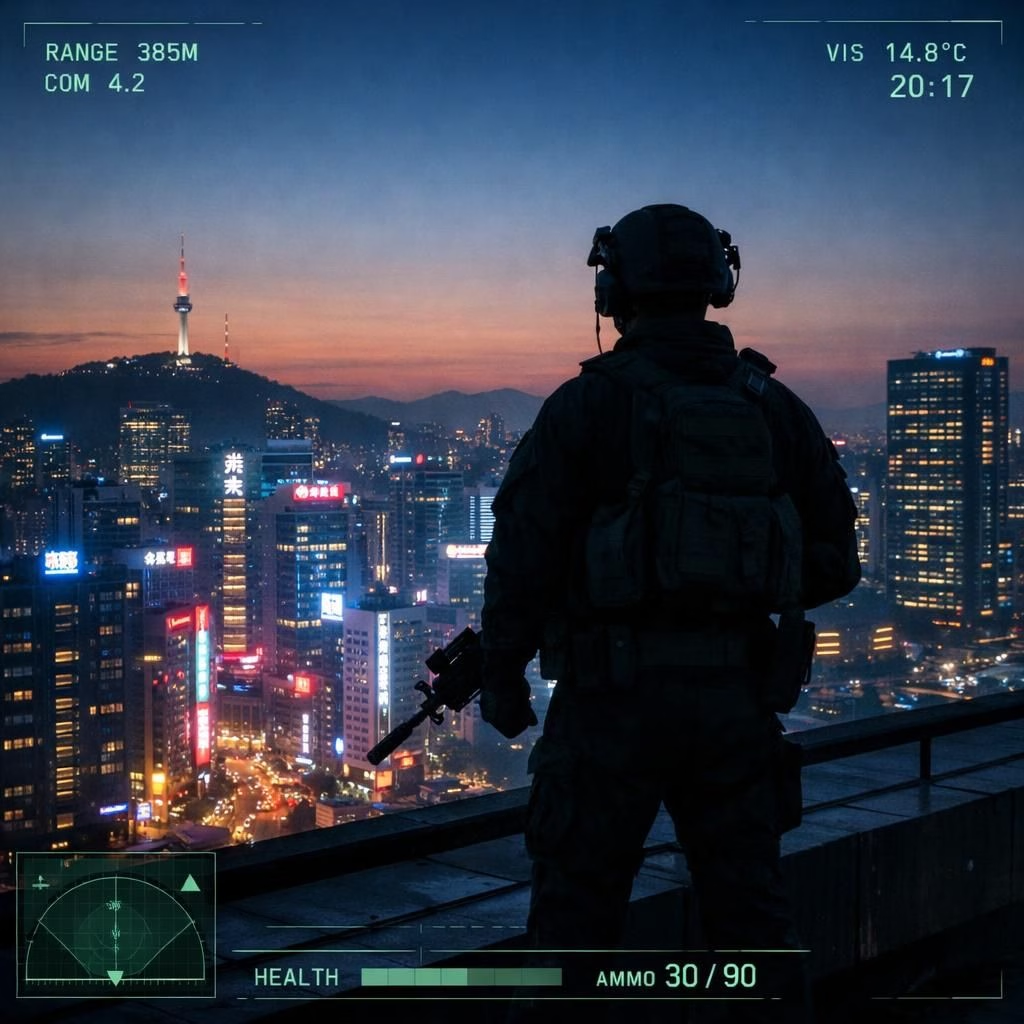
Welcome to a breezy, but not-brainless, look at Call of Duty and Modern Warfare as 2026 unfolds. This piece savors the spicy details of Call of Duty’s next campaign, the robust multiplayer scaffolding, and the DMZ mode, while offering a sunny take on Modern Warfare‘s continuing evolution. The aim isn’t to preach doom to the pixelated front lines but to celebrate how a big-franchise tent can still feel nimble, relevant, and entertaining. If you crave a review that respects your time and invites a smile, you’re in the right briefing room. And yes, we promise to keep the focus on the core truth: this is a big, ambitious reload of a familiar formula, with a few clever twists that land.
First, a quick map check: Call of Duty has long thrived on the cadence between campaign drama, multiplayer depth, and the unpredictable thrill of discovery. In 2026, Modern Warfare continues to push that cadence with more granular gunplay feel, smarter enemy AI, and a campaign that leans into the realities of modern geopolitical storytelling without losing its appetite for spectacle. If you’ve followed the series, you’ll recognize the skeletal structure: a cinematic campaign that pushes the player to make choices, a multiplayer slate that rewards skill and timing, and a DMZ-style mode that invites persistence and risk-taking. The result is not a mere sequel; it’s a reimagining that respects its roots while poking at new corners of the map.
Call of Duty Modern Warfare 2026: Campaign design and player agency
Let’s talk campaign design the way a friendly co-pilot talks through a bumpy ascent. The latest Call of Duty entry leans into a dense narrative net where every mission threads into the next with a subtlety that feels earned. The creative team treats players as co-authors of their own outcome rather than passive passengers. In practical terms, that means mission pacing that blends quiet, tense reconnaissance with high-octane set pieces. When you navigate a city under partial blackout, you’ll make choices that ripple through the next sequence, altering briefings, weapon loadouts, and even the gravity of enemy encounters. This is not a mere button-mashing drill; it’s a choreography of risk and reward that rewards situational thinking and precise execution.
From a lore perspective, Modern Warfare maintains its habit of leaning into contemporary tensions rather than retreating into space-novelty. The story threads the player through a plausible near-future scenario, with a focus on the consequences of escalation and the ethics of intervention. The tone stays earnest enough to feel weighty, yet it never forgets to wink at itself at the moment you down a drone-powered tank with a well-timed headshot. This balance—serious stakes paired with occasional levity—helps keep the Call of Duty experience accessible to newcomers while still rewarding longtime fans who crave continuity. The campaign’s architecture is designed for repeat playthroughs: alternate routes, variable encounters, and a few morale-check moments that remind you this is a living, breathing conflict, not a linear museum tour of explosions.
Call of Duty Modern Warfare 2026: Crossplay, DMZ, and Switch 2 reach
The Crossplay era is not a trend; it’s a standard. This iteration of Call of Duty embraces cross-platform progression with a straightforward account system and a matchmaking ecosystem that minimizes dragging your squad into awkward lobbies. The aim is to reduce friction so teams can actually play together rather than spend precious time wrestling with servers and region locks. In practice, that translates to quicker party formation, more balanced matches, and a less irritating queue experience. The result is a more enjoyable doorway into the full Call of Duty experience, whether you’re on a console, PC, or the newly available Switch 2 variant. Yes, the Nintendo crowd gets a seat at the table, and the table doesn’t wobble when the pizza arrives—only the enemy does.
Modern Warfare returns in the DMZ mode with its signature blend of extraction gameplay and emergent storytelling. It isn’t about turning every match into a scavenger hunt; it’s about offering a tense sandbox where your strategy matters as much as your reflexes. You’ll plan, extract, or cleverly disengage when the odds tilt, and you’ll learn the limits of your gear under pressure. The DMZ mode isn’t a trivial add-on; it’s a sandbox that rewards curiosity and careful risk-taking. The long tail here is clear: the more you practice, the more you’ll realize your choices in the DMZ map are as critical as any firefight you win on a standard multiplayer map.
And yes, Switch 2 gets a thoughtful optimization pass. The challenge with a handheld adaptation is preserving the heartbeat of the game without forcing players into impossible compromises. This edition achieves a practical balance: crisp visuals, responsive controls, and a net-positive control scheme that respects handheld constraints while delivering the same core sensations you expect from a modern shooter. The outcome is a labeled achievement in inclusive design—good performance, good fidelity, and the same satisfying gunplay loop you crave after a day’s work, commuting, or couch gaming with friends. Call of Duty’s reach remains broad, and Modern Warfare‘s 2026 version steps onto every stage with competence and a dash of swagger.
For fans who crave the in-depth meta, there’s more than enough numerical and mechanical texture to satisfy the theorists. Weapon tuning, recoil patterns, map rotation cadence, and matchmaking heuristics are all tuned to reward skill without punishing newcomers. That means you’ll feel a sense of progression even if you’re still learning the lay of the land. The campaign’s pacing, meanwhile, carefully calibrates tension so you never feel overwhelmed, yet you always feel the weight of your decisions—an essential quality for any game in the Call of Duty family and a hallmark of Modern Warfare when it’s firing on all cylinders.
Call of Duty Modern Warfare 2026: A community-centered, player-first vibe
One of the small, often overlooked wins is how the community interacts with this era of Call of Duty and Modern Warfare. The culture around the game—thinking, joking, dissecting—feels healthier when the gameplay loop is this well-maintained. The developers have done a solid job of listening to feedback and threading it into updates that arrive with reasonable cadence. This creates a sense of shared ownership: players feel like they’re helping shape the ongoing story rather than just reacting to it. The result is a community that feels participatory, not parasitic, and that matters when a title is as social as this one. The campaign veterans will spot nods to past chapters, while new players will find an inviting entry point that doesn’t demand a classicist’s memory.
Graphics, sound design, and environmental storytelling all get a subtle but meaningful upgrade. The soundtrack leans into cues that heighten tension without overwhelming the dialogue, and the visual fidelity maintains a steady, cinematic groove without sacrificing performance. In the end, the experience lands on two legs: the thrill of the frontline and the quiet, patient calculus of strategy. That duality is precisely why Call of Duty remains a cultural touchstone and why Modern Warfare endures as a living, evolving chapter in a sprawling saga.
One practical takeaway for aspiring defenders of the cause: if you’re planning a first run this year, approach the campaign with curiosity, then circle back for the optional side missions and hidden routes. You’ll uncover character moments and worldbuilding flourishes that deepen your appreciation for the narrative while sharpening your reflexes for the competitive layers that follow. The designers have built a platform that invites exploration, experimentation, and a little healthy mischief—an inviting combination for players who want to savor the journey as much as the destination.
Before we wrap, a quick note on accessibility and inclusivity. The modern Call of Duty landscape remains mindful of players with diverse needs, offering scalable difficulty, colorblind options, and intuitive HUD customizations. This is not a mere afterthought; it’s a reflection of a franchise that recognizes its audience is a mosaic of styles and skills. In practice, that means more players can enjoy the adrenaline without worrying about whether the game will adapt to their setup. In 2026, accessibility is not a feature; it’s a baseline that helps the Call of Duty experience reach more households and reward more players for their time and dedication to Modern Warfare‘s evolving campaign universe.
In sum, Call of Duty and Modern Warfare in 2026 feel like a well-caffeinated mixtape of design choices, each track carefully chosen to keep fans on their toes and new players eager to join the chorus. The campaign remains a narrative engine that respects your agency, while the multiplayer and DMZ modes broaden the playground without turning the game into a maze. The Switch 2 support makes the whole affair portable in a way that still respects the core combat tempo. It’s a rare feat: a blockbuster that feels both ambitious and thoughtful, loud yet precise, and, most importantly, enjoyable from the first mission to the final extraction. If you’ve got even a passing curiosity about where this series is headed, you’ll find enough here to get excited about the next round of updates, maps, and personal bests.
What do you think about the 2026 plan for Call of Duty and Modern Warfare? Do you love the crossplay polish, or are you waiting for more DMZ innovations? Share your thoughts after you’ve given the campaign and modes a spin. And if you found any particular moments that sparked a grin or a thoughtful pause, tell us about them—we’re listening and learning together.
Original coverage and inspiration for this article came from a thoughtful round of reporting on the upcoming Call of Duty: Modern Warfare 4, as highlighted by XBOX Wire and related trade outlets. A special thank you to the original sources for the groundwork that informed this friendly, forward-looking discussion:
Original coverage on XBOX Wire — Thank you for the foundational material and the timely information that helped shape this piece.
External sources
For additional context, see: Variety, USA Today, and Nintendo.