

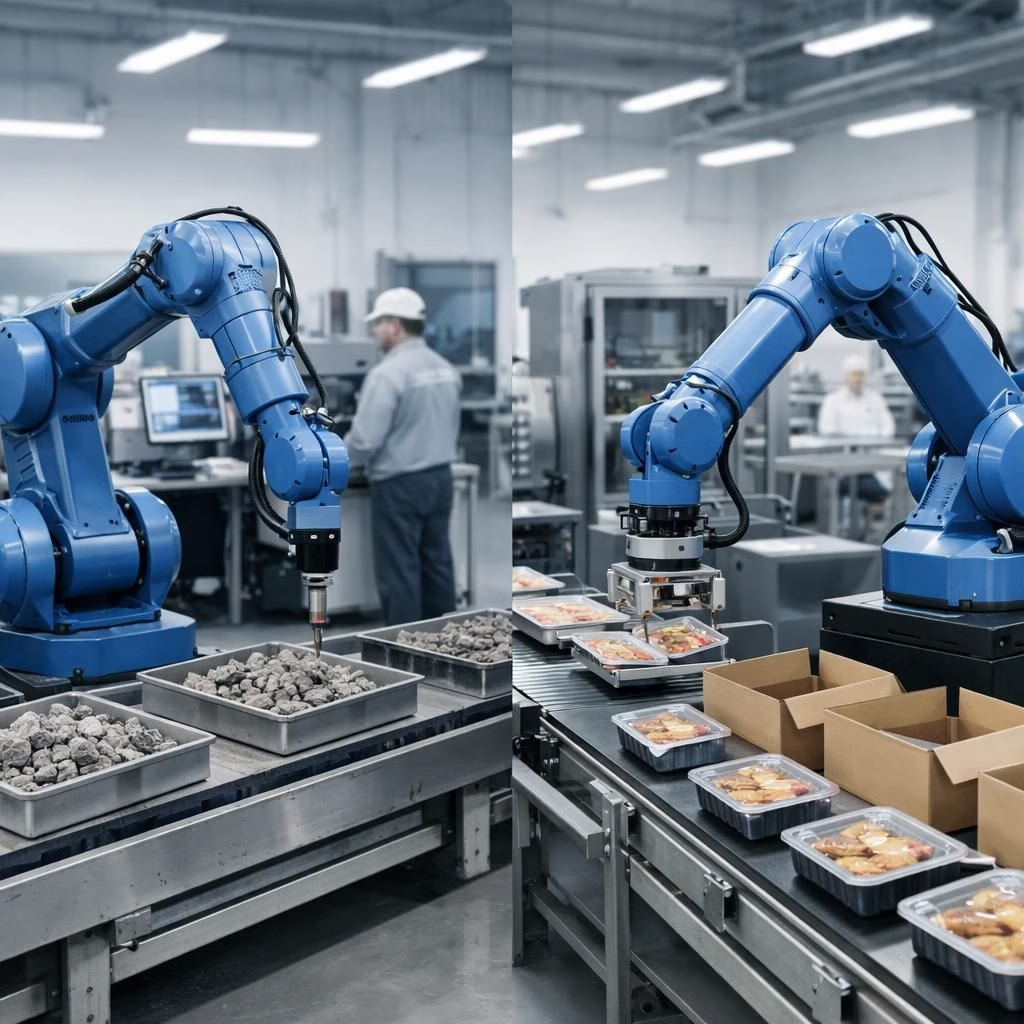
Atoms stands as the bold, fresh label for a venture from Travis Kalanick with a practical mission. The playbook? Put specialized industrial robotics to work in the real world—mining, logistics, and food infrastructure—so machines handle fiddly, repetitive, high-stakes tasks while humans focus on higher-level thinking. In 2026, Atoms and robotics aren’t just buzzwords; they’re a bet that task-specific systems can deliver measurable productivity gains where general-purpose automation struggles. This marks a refreshing turn after several tense years in the automation arena, where hype often outpaced real-world results. And yes, the two words—Atoms and robotics—sit together, signaling a cohesive strategy rather than a scattershot approach.
What’s happening is a refined rebranding of City Storage Systems, the parent company beloved by kitchen-into-delivery enthusiasts for CloudKitchens. The new Atoms umbrella splits into three explicit verticals: Atoms Food, for food industry infrastructure; Atoms Mining, aimed at lifting mine productivity; and Atoms Transport, described by Kalanick as a wheelbase for robots. The idea is tactile: give each domain its own, purpose-built robotics system rather than shipping a one-size-fits-all bot that wanders around like a confused tourist. In short, the mission is to make specialized robotics with clearly defined jobs that deliver tangible value to owners and, ideally, to society at large.
The launch also underscores a broader industry moment: physical AI and specialized robotics are drawing more investor attention as a path to profitability. Rather than wrestling with the slippery questions of how to teach a robot to navigate any environment or reason like a human, Atoms leans into the simpler, more tractable challenge: perform precise tasks reliably in controlled or semi-controlled settings. The result could be fewer failed experiments and more demonstrated ROI, especially in sectors like mining and waste management where repetitive, dangerous, or precision-based work is routine. At the end of the day, the core value proposition remains straightforward: productive robotics with real-world, repeatable outputs.
Atoms in Action: robotics for Industrial Tasks
On the business side, Atoms isn’t starting from scratch. The company alludes to an eight-year stealth period with a surprisingly large workforce, a sign that the team has been quietly building, testing, and iterating. The staying power implied by a stealth period of this length suggests a portfolio that’s less about flashy demos and more about durable, scalable deployments. It’s a pragmatic counterpoint to the current wave of highly publicized robotics experiments. By focusing on task-specific machines, Atoms smartly aligns with industries hungry for reliability, predictable maintenance cycles, and clear service-level expectations. The approach may also help address capital expenditure concerns, since owners can purchase bite-sized robotic modules that tackle concrete tasks without demanding a full-scale robotic revolution.
From a technology standpoint, the emphasis on physical robotics is intriguing. The field aims to fuse sensing, actuation, and decision-making into mechanical systems that can operate in the real world with minimal downtime. The strategy of modular, purpose-built robotics could lower integration risk and accelerate time-to-value for customers. In practical terms, Atoms is pursuing a path where robots handle the dull, dirty, and dangerous parts of a process, while human operators supervise, tune, and intervene only when necessary. This is not merely headline-grabbing; it’s a plausible blueprint for sustainable robotics in 2026.
Robotics Roadmap: Mining, Transport, and Food with Atoms
Let’s break down the potential impact in the three clearly defined verticals. In mining, the focus is on uplift: faster ore extraction, improved safety, and tighter control of energy use. The robots would take on repetitive drilling, material handling, and inspection tasks with a precision that reduces downtime and wear on human teams. In transport and logistics, robotics promises a smoother, more predictable workflow: automated loading and unloading, precision routing, and better shelf-to-warehouse coordination for food products. For the food sector, AtAtoms Food envisions infrastructure that streamlines delivery-ready production, packaging, and cold-chain maintenance—areas where consistency and traceability translate directly into better service levels and compliance. Across all three verticals, the overarching promise is to turn specialized robotics into dependable productivity engines that create “abundance” by reducing waste, lowering error rates, and boosting throughput—without the theatrics of more generalized, humanoid robotics experiments.
Of course, there are practical realities to navigate. The broader adoption of physical robotics hinges on the ability to teach machines to perform in semi-structured environments, manage maintenance schedules, and integrate with existing enterprise systems. But because these are task-specific robotics, the barriers look more addressable than for a universal AI system. The near-term economics may favor pilots that demonstrate clear, incremental improvements—shorter cycle times, higher yield, and safer operations—before any large-scale commitments. In other words, the road to profitability for Atoms and similar ventures may be paved with modular, well-defined robotics rather than with sweeping, single-solution fantasies. This makes the concept both commercially sensible and technically credible in the current year, 2026.
Beyond the technology and business math, there’s a cultural angle worth noting. Kalanick’s post-Uber journey into hardware-backed robotics reads like a story of resilience. He describes a personal rebirth after a rough exit, framing Atoms as a continuation of a lifelong calling: building “atoms-based computers”—specialized systems that automate concrete tasks in the real world. It’s a narrative that blends grit with practicality, a reminder that big bets can be built on disciplined engineering and a clear societal upside. If the early lines and mission statement are any guide, Atoms as a brand embodies both ambition and a grounded sense of what actually moves the needle in manufacturing and logistics.
For industry observers, this implies that the next wave of automation may be less about dramatic, all-encompassing robotics and more about precise, field-tested machines that deliver measurable improvements. It’s a model that favors speed-to-value, steady deployments, and transparent outcomes. And while the market watches closely for proof of ROI, the initial blueprint feels deliberately plausible: invest in specialized robotics that transform specific tasks, and let those gains compound across operations over time. If successful, Atoms could become a useful blueprint for other firms seeking a similar, disciplined approach to industrial robotics in 2026.
As we move forward, the question isn’t merely whether Atoms will succeed, but how quickly real-world pilots will prove the economics and reliability of task-specific robotics. The sector’s appetite for practical automation remains strong, and Atoms is positioned to ride that wave with a clear focus on profitability, repeatability, and real-world impact. If you’re curious about how these robots will actually function on a factory floor, you’ll want to watch for updated case studies, deployment timelines, and performance dashboards that show exactly where the gains are coming from. And yes, we’ll likely see a steady stream of updates as Atoms grows its footprint across mining, transport, and the food supply chain.
Would you like to weigh in on this vision? Share your thoughts in the comments below and tell us how you think robotics will reshape industry workflows in the coming years.
Original article/source attribution: This article builds on reporting about Travis Kalanick’s Atoms initiative and the CloudKitchens ecosystem. A special thank you to CNBC and The TBPN podcast for background context that informed this synthesis. Original article reference: CNBC – Atoms, City Storage, CloudKitchens.
Practical steps for adopting Atoms-style, task-specific robotics
- Define a pilot scope for a single vertical (e.g., mining) with clear success metrics (cycle time, yield, safety).
- Choose modular, task-focused units rather than a single, monolithic system.
- Set measurable milestones for reliability, maintenance, and uptime.
- Establish data-sharing standards to integrate with existing enterprise systems.
- Plan for scalable rollouts across similar operations if pilots meet targets.
Frequently asked questions
- What exactly is Atoms aiming to do? It seeks to deploy task-specific robotics to perform defined, repeatable jobs in mining, transport, and food sectors, reducing downtime and improving predictability.
- How is this different from general AI or humanoid robots? The focus is on reliability and ROI through modular components that tackle concrete tasks, not on creating systems that navigate any environment or imitate human reasoning.
- What signals should we watch for ROI? Shorter cycle times, higher yields, improved safety records, and transparent maintenance dashboards tied to real-world metrics.
- Are there risks with this approach? As with any automation, integration with existing processes and data flows is critical; pilots should emphasize phased deployments and measurable outcomes.
Conclusion: a grounded path to industrial automation
The Atoms strategy presents a practical, risk-conscious way to scale automation across key industries. By emphasizing modular, task-focused robotics with clearly defined outputs, the plan aims to deliver repeatable value rather than speculative breakthroughs. If pilots prove reliable and economical, Atoms could offer a replicable playbook for other firms seeking disciplined progress in industrial AI in 2026.
References
- CNBC – Atoms, City Storage, CloudKitchens
- Original Indian Express article
- IEEE Spectrum: Robotics in the real world