

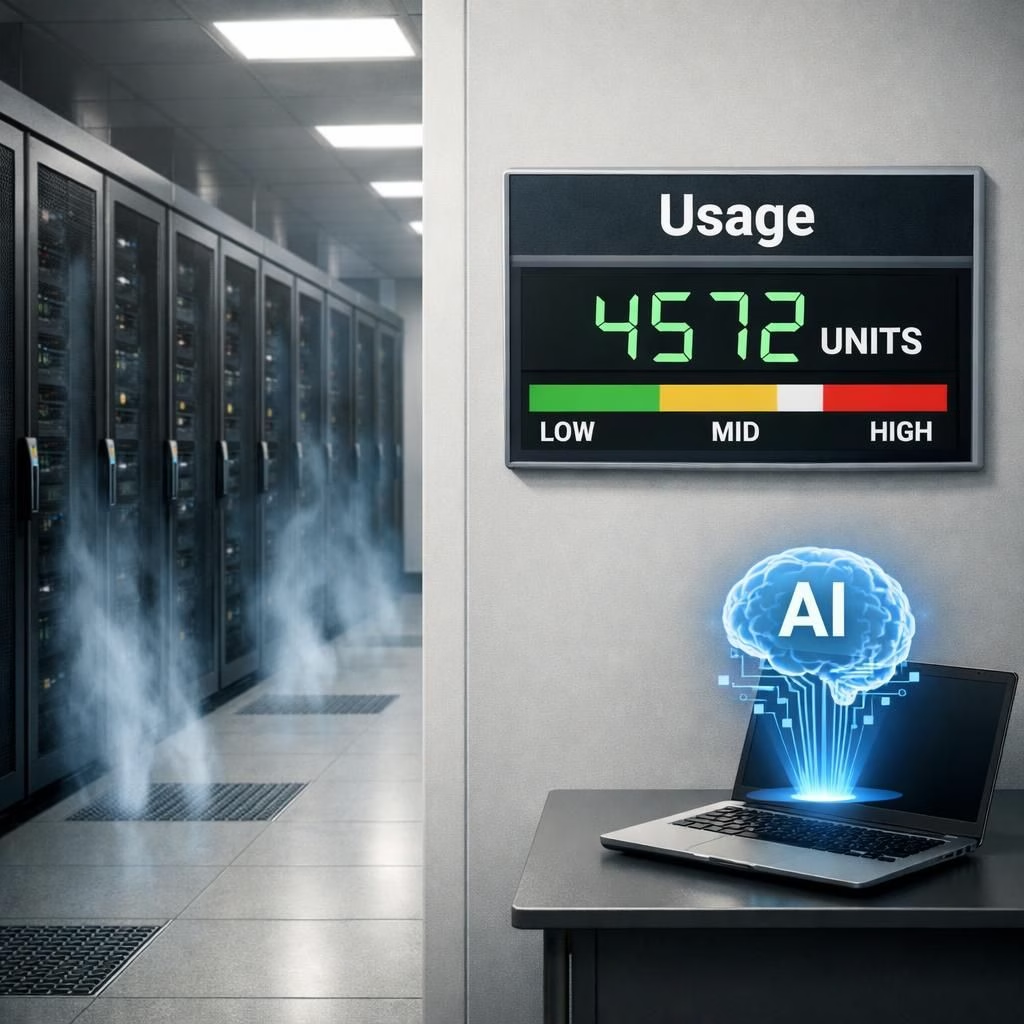
Imagine a future where AI infrastructure supports a daily AI utility service that scales to demand. Like water or electricity you pay for by the metre, this AI utility could become a basic service that people barely notice until they need help with a task.
In Washington, DC, Sam Altman described a space where the service is metre-based and the backbone is AI infrastructure that expands access and lowers latency. He noted that a coder in a small town and a student in a library could both tap into the system, paying only for compute used. The basic idea remains simple: you pay by the metre of compute rather than a fixed price, building a broad, shared AI network that feels like a utility rather than a boutique product.
AI utility in everyday life
In the real world, AI utility is already seeping into work, study, and entrepreneurship. Software teams report that coding tasks that once took hours can be nudged along by smart assistants, while researchers skim literature and extract key insights in minutes. Students get step-by-step explanations, and lifelong learners discover new skills without burning out. The trick is not in the magic of a single tool, but in turning a steady supply of helpful nudges into a daily habit. Here, usability matters most; the utility sits behind a familiar interface, ready whenever you ask for help.
As people experiment, the routine shifts from “do it yourself” to “have it helped.” A designer drafts a concept, a programmer prototypes a feature, and a project manager outlines goals while the AI handles data gathering, formatting, and quick checks. The human remains in the loop, but with a lighter load and faster feedback. In Altman’s vision, AI utility becomes a personal assistant that’s always available, never asks for vacation, and never judges your late-night attempts at coffee-fueled innovation.
AI infrastructure: the backbone behind the service
To make this metre-powered vibe a reality, you need serious AI infrastructure. Picture data centers as sprawling campuses with rows of servers, cooling tunnels, and dashboards that show utilisation in real time. The scale is staggering: thousands of engineers, a complex supply chain, and energy systems calibrated to keep costs predictable. Altman emphasizes that the backbone of the future is not a flashy product but a network of capable facilities that can deliver AI at scale. OpenAI’s ongoing investments, paired with partners such as Amazon, Nvidia, and SoftBank, aim to extend reach, reduce lag, and ensure reliability across regions. The mission is to put an AI service within reach of everyone, not just the biggest players in town.
Crucially, the infrastructure story includes power management, cooling efficiency, and secure access to vast swaths of data. As these facilities grow, the industry learns to balance energy use with performance, making the metered model sustainable rather than punitive. In practice, this means better uptime, lower costs per task, and more predictable budgeting for schools, startups, and small teams. The result is a service that feels as reliable as your electricity bill, yet far more versatile in what it can help you accomplish.
In this near-term future, the separation between innovation and everyday life blurs. The smart assistant, the search helper, and the coding coach all contribute to a broader sense that AI is not a distant breakthrough but a daily companion. The meter is the metaphor; the user experience is the reality. If things go as Altman expects, future generations may not even notice AI infrastructure as a distinct technology; it will merely be the quiet engine behind creation, learning, and problem solving—priced by metre, powered by a vast, shared AI infrastructure, and accessible to many.
Have thoughts on this metre-powered vision? Share your reflections in the comments below and join the conversation about how AI infrastructure and AI utility might reshape our 2026 and beyond.
Original source: Ankita Garg, India Today. See the original story here: Original India Today article.
Practical steps to explore metre-based AI in your work
- Assess your needs: List tasks that could benefit from regular AI nudges, such as coding, data analysis, or content research. Map them to a potential metre-based price.
- Pilot with a small scope: Run a pilot with limited data and a defined budget to understand latency, quality, and governance.
- Governance and security: Establish access controls, data handling rules, and privacy safeguards before expanding.
- Choose partners carefully: Look for providers with strong uptime, transparent metering, and clear terms for school or startup users.
- Measure impact: Track time saved, error reductions, and user satisfaction when tapping into the AI infrastructure.
FAQ
- What is metre-based pricing for AI? It is a usage-based model where customers pay for the actual compute resources consumed, rather than a fixed subscription.
- How would AI utility affect businesses? It could reduce friction to adopt AI, offering predictable costs and scalable access for teams of any size.
- What about privacy and data security in a shared AI infrastructure? Strong governance, encryption, access controls, and clear data-handling rules are essential as capabilities expand.
Bottom line: Altman’s metre-based concept aims to turn AI into a broad, shared utility rather than a boutique product. If built carefully, it could make AI available to more people—priced by usage, powered by scalable AI infrastructure, and integrated into everyday life.
References
- Original India Today article by Ankita Garg
- OpenAI: Scaling language models
- NVIDIA: AI infrastructure at scale