

In 2026, the AI Singularity chatter is louder than a newsroom espresso. This article reexamines Karpathy’s Autonomous Research experiments and what self-directed testing might mean for real progress, not just hype. The discussion centers on practical steps that could speed up learning while preserving safety and governance.
AI Singularity and Autonomous Research: the autoresearch experiment
Karpathy’s autoresearch project demonstrates an AI agent that edits and runs a training loop for a language model. The agent proposes changes, executes experiments, and selects the best versions with minimal human input. It is not AGI, but it is a clever glimpse into how an AI could guide its own improvement using measured experiments and version control. It is pragmatic: we watch the system learn to learn, not a science fiction leap yet. The phrase Autonomous Research may be dramatic in headline form, but the core idea is simple: systems that can test, compare, and choose improvements can accelerate discovery in meaningful ways, while leaving a human curator in the loop only for safety checks.
In Karpathy’s own notes, the project ran hundreds of experiments autonomously and steadily improved the model. A representative finding showed improvements identified over the last two days transferring well as the model scales from depth-12 to depth-24, implying a smoother path to better performance. The project remains small-scale and experimental, not a fully autonomous lab brain, yet it demonstrates a self-improvement loop that engineers crave for debugging and optimization. The intersection of AI Singularity talk and practical Autonomous Research is exactly where we should be: excited about incremental gains, while mindful of limits and risk, keeping human oversight for critical decisions.
Autonomous Research in practice for AI Singularity timelines
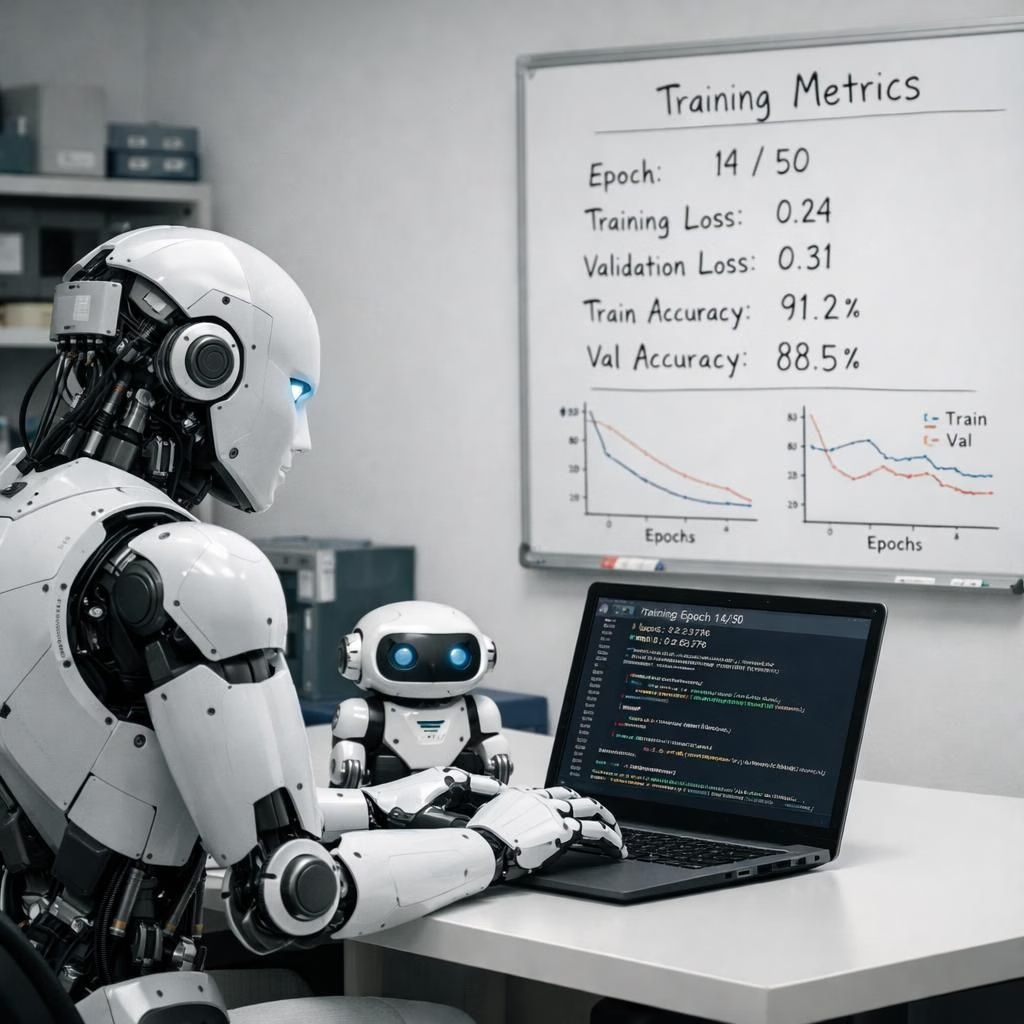
The Autonomous Research approach has a nerdy charm: the agent schedules tests, tracks metrics, and preserves helpful versions as it goes. This is not magic; it is a repeatable pipeline that rewards disciplined automation. The scene resembles a small, well-lit lab where software becomes the researcher, running experiments overnight and returning with a tidy log of results. The key takeaway: Autonomous Research is a bounded, auditable loop—an important distinction when we talk about self-directed systems that might one day improve themselves faster than we can narrate the news.
Commentators in the AI community quickly lit up with reactions. The conversation included Tobi Lutke replying that a signal of progress suggests the singularity is beginning, a sentiment echoed by Musk in the same thread. While admiration spiked, sober cautions followed: a single project with a few hundred experiments does not equal AGI. Yet the dialogue shifts: even if 2026 does not crown a full autonomous lab brain, the experiments show that autonomous experimentation is practical and replicable. The balance of hype and rigor makes Autonomous Research feel both hopeful and responsibly scoped.
What this means for the timeline and the work ahead
What top technology leaders say matters, but the picture remains nuanced. Elon Musk, speaking at major forums, has floated the idea that AI could reach human-level or greater intelligence by the end of 2026, and possibly surpass all human intelligence by around 2030. He also framed a future where humanoid robots and universal high incomes intersect, reshaping labor markets and social contracts. The message is bold, yet the caveats matter: robust safety, alignment, and governance are essential. In other words, AI Singularity remains a significant but undecided milestone.
Other voices weigh in with similar urgency. Sam Altman has argued that humanity may be nearing an event horizon of rapid takeoff, while Demis Hassabis has suggested a threshold moment for autonomous, agentic AI systems. The consensus is not fixed; some see a multi-year arc, others a shorter sprint. The practical thread is that Autonomous Research and its kin are now more visible as tools for faster iteration, not guarantees of self-improvement at scale. The core reality remains: the code in Karpathy’s project requires careful monitoring, testing, and governance—calling for transparent, auditable pipelines alongside ambitious aims.
Two practical considerations for readers and builders
- Autonomous Research accelerates iteration, but it must stay auditable. Logs, metrics, and reproducible experiments help verify progress and guard against drift.
- AI Singularity talk should inspire safe optimism. Clear boundaries, safety rails, and human-in-the-loop checks help keep ambitious experiments grounded and responsible.
As we watch 2026 unfold, the line between ambitious futurism and practical engineering becomes clearer. The autoresearch project shows what is possible when an AI system responsibly runs experiments, suggests improvements, and preserves the best results. It is not a guarantee of eventual self-improvement at scale, but it is a robust demonstration of a feedback loop that could become a staple in ML teams and research labs. The conversation around AI Singularity, Autonomous Research, and the future of intelligence is not a single moment but a process of continuous, careful exploration.
With more labs participating, we could see broader adoption of autonomous experimentation in mainstream ML pipelines. The excitement lies in the repeatability and transparency of the approach, not in sensational headlines. The vision is a future where AI can propose, test, and optimize its own learning loops under clear guardrails, enabling faster progress without sacrificing safety. In short, we are watching a curated path toward more capable systems rather than a leap into the unknown.
Thanks to the original article and its author for sparking this discussion, which helps frame how Karpathy’s autoresearch fits into the broader narrative of self-improving AI. Original article reference: India Today – Singularity starts now.
If you have thoughts, questions, or counterpoints, please share them in the comments. Your perspective helps shape the ongoing conversation about AI Singularity and Autonomous Research as we navigate 2026 together.
What to watch next (practical steps)
- Audit trails: maintain clear logs of experiments and decisions to ensure reproducibility.
- Guardrails: define safety checks and human-in-the-loop review for critical changes.
- Incremental goals: track small improvements that collectively move the needle toward robust self-improvement.
FAQ
- What is AI Singularity? A theoretical point when AI could surpass human intelligence and rapidly improve itself.
- What is Autonomous Research? A workflow in which an AI system autonomously conducts experiments to optimize models, with human oversight for safety.
- Is this proof that AGI is near? No. It demonstrates a repeatable, auditable self-improvement loop, not a fully autonomous lab brain.
Conclusion: a measured path forward
Karpathy’s autoresearch offers a tangible glimpse into how self-guided experimentation might assist progress in machine learning. It is a step, not a leap, toward more capable systems. The key takeaway is practical: build repeatable, auditable loops that enable faster iteration while keeping safety and governance front and center.