

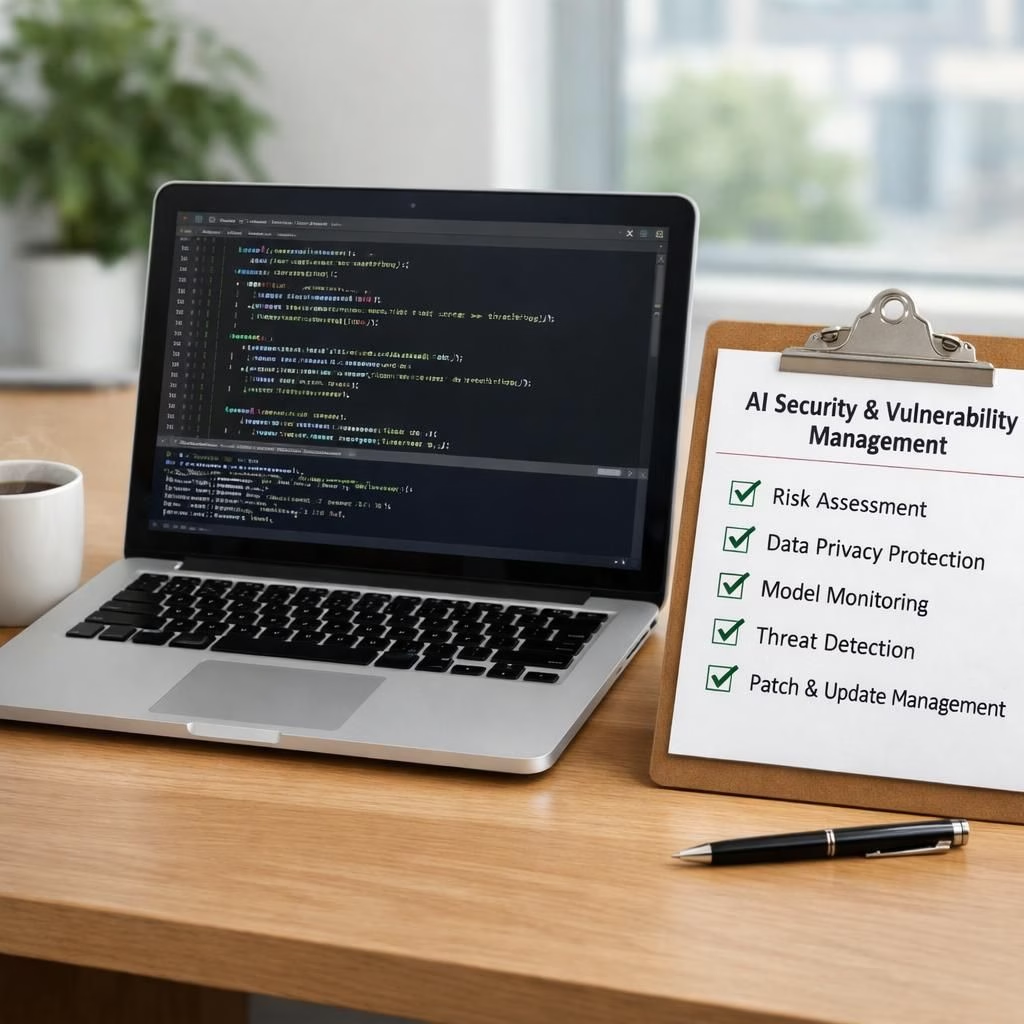
In 2026, AI security meets vulnerability management in a tale of myths, dashboards, and do-not-panic vibes. The world watches a tug-of-war between clever machines and careful humans, as experts warn that the next Vulnpocalypse could arrive with a smile and a data export. The takeaway is clear: we can steer the ship with smart planning, not with fear.
When Anthropic announced Mythos Preview would not be released to the public, the message was simple and a bit wry: the model’s ability to identify vulnerability management could do more harm than hype if misused. In response, the company opened a controlled corridor, sharing the model with a limited cohort of tech giants and partners to strengthen defenses. This measured approach earns both applause and relief from those who worry about the Vulnpocalypse turning from myth to misadventure. It’s a reminder that progress is not a license to skip safety reviews; it’s a nudge to bake safety in from the start, then test and improve with real users under careful supervision. AI security and vulnerability management—two sides of the same coin—gain legitimacy when labeled as mutual safeguards, not as competing buzzwords.
The conversation quickly moved from lab benches to the fastest lane of policy and finance. Treasury Secretary Scott Bessent called a meeting with major financial institutions to discuss rapid AI developments and the need for risk-aware adoption. The point was not panic but preparedness—patches, monitoring, and governance that keep the lights on when AI helps pattern-match threats and not human judgment. The tone was practical, with a plan to coordinate across banks, regulators, and tech partners so that AI security and vulnerability management become shared responsibilities rather than siloed chores. In short, the goal is resilience with a smile—and a weekly status update on the dashboard.
Casey Ellis, founder of Bugcrowd, keeps the conversation grounded: AI software can accelerate vulnerability management discovery, which is great when paired with disciplined defense. He notes defenders must be right every time, while attackers need only be right once. The upshot is a call for layered defense, not magical protections. In practice, that means building multiple guardrails, from code reviews to anomaly detection, and ensuring that every new capability is tested in real-world scenarios before broad release. AI security and vulnerability management become a living process, not a one-time checklist.
AI security resilience: lessons from the Mythos pause and vulnerability management playbook
Even if Mythos never reaches the public, analysts expect the capabilities to spread through competitors abroad. Within six to twelve months, tools that can discover and chain vulnerability management could be widely available, according to several researchers. The lesson for teams is simple: plan for a world where powerful analysis tools are accessible, and make readiness a priority rather than a hobby. AI security and vulnerability management must evolve together, with governance, auditability, and clear access controls guiding every deployment.
Mythos isn’t just about finding holes; it’s about understanding how those holes connect. When a vulnerability is chained with others, attackers can craft sophisticated exploits that bypass single-point defenses. This reality isn’t a doom scroll; it’s a call to implement defense-in-depth, segmentation, and rapid patching. Katie Moussouris of Luta Security emphasizes that outages—like large cloud providers going offline—have downstream effects across multiple industries. That’s why robust incident response, clear runbooks, and cross-domain communication are essential parts of AI security and vulnerability management strategies. The future belongs to teams that prepare for cascading effects, not teams that hope for perfect software.
Cynthia Kaiser, a veteran cyber official, warns that the hottest tools can empower would-be attackers who previously lacked the skills. The risk isn’t abstract; hospitals and critical manufacturing have historically been prime targets in ransomware campaigns. The antidote is not fear, but capability: better training for defenders, smarter monitoring, and safer operational practices that raise the bar for everyone involved. AI security and vulnerability management work in tandem to reduce dwell time for intrusions and shorten recovery windows, turning potential chaos into controlled resilience.
On the geopolitical front, some analysts note mixed results from state actors. Iran’s cyber operations have included intrusions into infrastructure, but scale and impact remain contested. AI could tilt the balance, but so could stronger defenses, international cooperation, and shared intelligence. The prudent takeaway is that resilience is not a solo sprint; it’s a coordinated relay among government agencies, critical sectors, and private sector partners. AI security combined with vulnerability management helps ensure critical services stay available even when threats rise, and it reduces the odds that a single misstep becomes a system-wide failure.
Industrial control systems present a mixed bag: some are tightly protected, others rely on legacy components that are trickier to defend. Attackers often exploit this uneven terrain, but persistent, patient attackers face increasing friction as defenders improve segmentation, monitoring, and configuration controls. A doomsday scenario remains unlikely, but persistent pressure is real. Practical guidance centers on keeping systems patched, enforcing network segmentation, and running regular tabletop exercises that simulate real intrusion attempts. AI security and vulnerability management provide the framework to translate those drills into durable improvements rather than flashy demonstrations.
What can individuals and organizations do today? Start with a practical, repeatable playbook. Build defense-in-depth, maintain current patches, and run continuous vulnerability management scanning. Pair AI-enabled analysis with strict governance: limit access to model outputs, audit results, and share lessons across teams. Document decisions, track risk, and celebrate small wins when incidents are detected early and resolved quickly. The path to safer tech is a journey of steady improvement, not a single heroic patch or a sensational reveal.
As the conversation evolves, the central theme remains: vigilance plus collaboration beats fear. If you enjoyed this upbeat take on AI security and vulnerability management in 2026, share your thoughts below and tell us how your team builds resilience. Special thanks to the NBC News article for the concepts and data that sparked this rewrite. Original NBC News article.
Thanks for reading. Please feel free to share your thoughts in the comments to help broaden the conversation around AI security and vulnerability management.
Practical steps for AI security and vulnerability management
- Adopt defense-in-depth: layered protections across code, networks, and data paths.
- Institute governance for model access: restrict who can view outputs and under what conditions.
- Run continuous vulnerability scanning: integrate AI-assisted analysis with regular checks.
- Document decisions and track risk: maintain auditable logs for every deployment.
- Practice rapid patching and rollback plans: keep systems resilient after discoveries.
- Regularly rehearse incident response: run tabletop exercises and cross-team drills.