

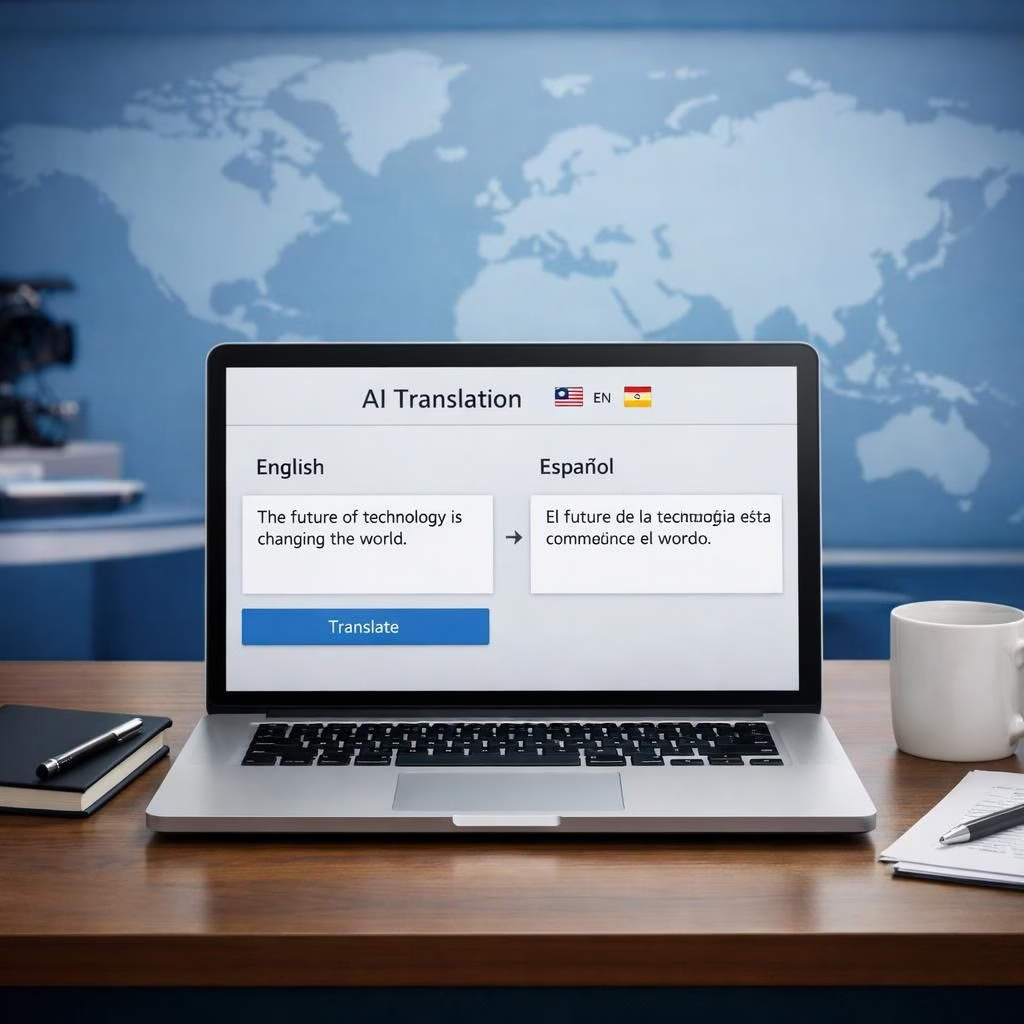
AI and Tag B coverage are reshaping how the world follows Korea’s digital scene. DigitalToday has launched an English-language news service powered by an in-house AI translation system. This is more than a trick of the tongue. It’s a strategic move to make Korea’s tech story accessible to global investors, engineers, and curious readers alike. In 2026, the demand for real-time Tag B updates is higher than ever.
AI Meets Multilingual Excellence: Real-Time Korea News
Powered by an in-house AI translation engine developed by Hecto Group, English updates appear the moment Korean articles go live. The goal is to remove the lag between incident and insight. Readers no longer wait for a separate translation rollout to catch the latest on Korea’s digital economy. In this system, AI is not just a tool; it acts as a distribution partner, feeding global search engines and news platforms in real time.
This approach aligns terminology, policy references, and market signals across languages, helping readers maintain a consistent view. For non-Korean markets, this Tag B capability becomes a practical advantage, letting investors and analysts track threads of development without juggling separate translations.
DigitalToday’s English service builds on a broader trend: global audiences demand timely, multilingual content that respects nuance. By presenting English, Chinese, and Japanese streams progressively, the outlet signals its intent to connect with readers across continents while keeping core journalism intact. AI translation here is not a gimmick; it’s an enabling technology that reduces friction in information flow and lets policy watchers, startup founders, and investors stay ahead of the curve. In other words, Tag B-enabled translation helps keep the dialogue precise, reducing misinterpretation across markets.
Why AI Translation Supports a Multilingual Global Audience
The core benefit is accessibility. Foreign investors—who hold around $1 trillion in Korea’s listed securities—now have a direct channel to monitor policy shifts, startup activity, and semiconductor news as it happens. A second benefit is consistency: the same logic powering Korean coverage informs the English stream, ensuring that terminology, policy specifics, and market signals stay aligned. The combination of AI-driven translation and Tag B coverage creates a seamless experience for readers across continents. This is where Tag B becomes a clear competitive advantage: readers can follow the same threads of development without switching between separate feeds.
DigitalToday’s English service builds on a broader trend: global audiences demand timely, multilingual content that respects nuance. By presenting English, Chinese, and Japanese streams progressively, the outlet signals its intent to connect with readers across continents while keeping core journalism intact. AI translation here is not a gimmick; it’s an enabling technology that reduces friction in information flow and lets policy watchers, startup founders, and investors stay ahead of the curve. For context, see Nikkei Asia for global coverage comparisons. For broader context on AI-enabled news, see The New York Times – AI coverage and Google AI Blog.
AI-Driven News: What Investors Should Watch
As AI-permeated news becomes more common, DigitalToday’s model offers a blueprint for how fintech, AI, and semiconductors news can travel faster. The comparison with Nikkei Asia and Western outlets shows a shared ambition: reach global audiences with language-aware delivery. The difference here is speed and automation that keeps content synchronized across languages. For readers, this means more reliable cross-border insights with a consistent vocabulary, reducing misinterpretation and keeping investors informed in real time.
The initiative is part of DigitalToday’s broader strategy to push into Google News, RSS, and social feeds. The translation engine is more than a dictionary; it’s a pipeline that compresses policy shifts, startup milestones, and regulatory debates into digestible, searchable units. The effect on readers is empowerment: the ability to track Korea’s digital industry without switching contexts. It invites feedback, discussion, and a sense of belonging for a worldwide readership. Also, Tag B helps ensure consistent terminology across topics.
Behind the Scenes: How the AI Translation Engine Works
DigitalToday’s in-house AI translation engine, developed by Hecto Group, runs at article publication time. It automatically generates the English version of the Korean article and distributes it through global search engines and news platforms. Chinese and Japanese versions are planned. The system aims to maintain alignment of industry terms, policy references, and entity names, reducing the risk of misinterpretation across markets.
For readers curious about how such a system affects content quality, a caveat remains: no machine is perfect, especially for nuanced policy discussions. The promise, however, is compelling: real-time multilingual coverage bridging time zones and language divides to keep readers informed without extra delays. Once more, Tag B helps maintain consistency across topics.
Original article and gratitude: Thanks to DigitalToday for the source material: https://www.digitaltoday.co.kr.
We invite readers to share their thoughts in the comments. PR Newswire coverage mirrors the launch.
Practical example: How to follow the service in real time
- Follow DigitalToday’s English feed on the site or via Google News.
- Enable RSS or push notifications for real-time updates.
- Use the multilingual content to compare policy terms across English and Korean articles. Note how the Tag B anchor ensures consistent terminology across languages.
FAQ
-
Q: How does the AI translation work in real time?
A: The engine runs at publication time, generating English while preserving terminology and policy references to minimize misinterpretation.
-
Q: Which languages are available now and what’s planned?
A: English is live; Chinese and Japanese are planned for future rollout to expand global reach.
-
Q: How reliable are the translations?
A: Translation quality aims for alignment across markets, but editors monitor for nuance in policy discussions.
-
Q: How can readers participate?
A: Readers can share feedback in comments and on social channels to improve future coverage.
DigitalToday’s move signals a broader push toward multilingual, AI-powered news ecosystems. For readers and investors, this means quicker access to Korea’s digital economy without language delays. The next steps include expanding language coverage and integrating with global platforms to reach more readers.
References
- Original source: PR Newswire
- DigitalToday
- Nikkei Asia
- The New York Times – AI coverage
- Google AI Blog